Solana (BSOL) vs. Litecoin (LTCC) ETFs: Which One Could Supercharge Your Crypto Portfolio?
Share
Key Takeaways
Grayscale now offers staking inside brokerage-friendly products so you can earn protocol rewards without running a validator.
Your net yield will be lower than on-chain APRs because of fund fees, provider/validator cuts, and the liquidity sleeve that keeps some assets unstaked.
Rewards can be retained or distributed, and there’s no guaranteed payout cadence.
GSOL is not an exchange-listed ETF, so expect wider spreads and potential premiums/discounts compared with ETHE/ETH.
On October 6, 2025, U.S. citizens began earning yields on spot crypto exchange-traded products (ETPs).
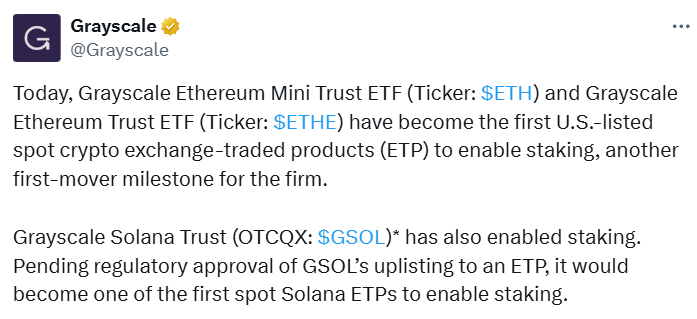
That’s right, staking is now live for the Grayscale Ethereum Trust ETF (ETHE), the Grayscale Ethereum Mini Trust ETF (ETH), and the Grayscale Solana Trust (GSOL). This means you can hold a standard ticker in a traditional brokerage account and still earn yield from staking rewards. No validator setup, no hardware, and no self-custody required.
A quick disclaimer, however, is that GSOL is not an exchange-traded product, but rather an OTC-quoted trust. This means GSOL may trade with higher spreads and different liquidity than its exchange-listed counterparts.
Unlike ETFs, which trade on exchanges like NYSE Arca with typically tighter spreads and higher liquidity, OTC trusts can trade at significant premiums or discounts to their net asset value (NAV) and often experience lower liquidity. For investors, this means buying or selling GSOL may be less efficient and potentially more costly than trading exchange-listed ETFs such as ETHE or ETH.
Try Our Recommended Crypto Exchanges
Sponsored
Disclosure
We sometimes use affiliate links in our content, when clicking on those we might receive a commission at no extra cost to you. By using this website you agree to our terms and conditions and privacy policy.
Staking Without Self-Custody: Grayscale’s ETF Model Explained
U.S. investors were previously limited to holding an ETF for convenience (no staking) or taking on self-custody to stake (requires technical knowledge).
Grayscale’s innovation introduces a middle path: hold a ticker, let the company stake on your behalf, and enjoy staking rewards (at a fee, of course). That combination, brokerage simplicity and on-chain rewards, is what’s new here.
Grayscale’s spot crypto ETP offerings. | Source: @Grayscale on X.
While U.S. investors have been able to access staking yield through centralized exchanges like Coinbase and Kraken, or even decentralized staking protocols such as Lido, these pathways require self-custody or interaction with decentralized finance (DeFi) platforms.
Think of it this way:
With Coinbase staking, you hold actual ETH in a Coinbase account.
With Lido, you interact with smart contracts and earn stETH tokens.
Through Grayscale’s ETFs, you simply buy a ticker symbol like ETH in your Fidelity or Schwab account the same way you’d buy Apple stock. Grayscale’s approach presents staking yields in a regulated ETF wrapper familiar to traditional investors.
Where to Access Grayscale’s Crypto Trusts and ETFs
You can invest in each product on the following platforms:
Grayscale Ethereum Trust, ETHE (NYSE Arca)
Grayscale Ethereum Mini Trust ETF, ETH (NYSE Arca)
Grayscale Solana Trust, GSOL (OTCQX)
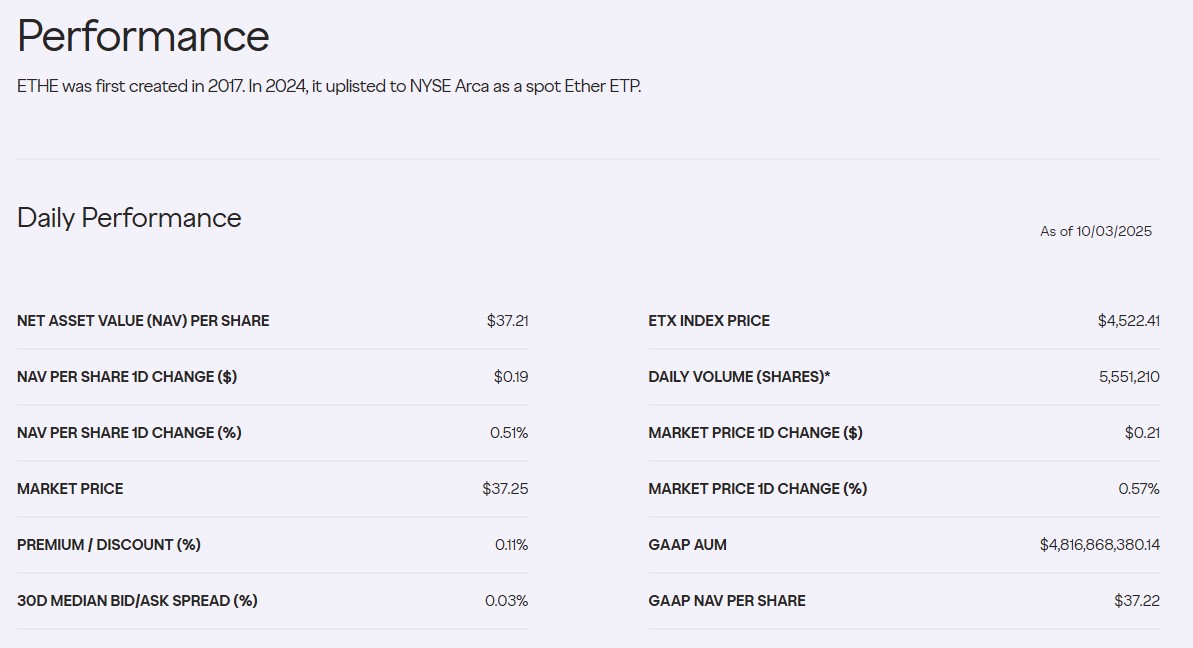
ETHE’s performance as of October 3, 2025. | Source: Grayscale
How Grayscale’s Funds Earn and Distribute Staking Rewards (Without Running a Node)
Here’s how the various funds stake and, in turn, provide you with rewards, according to Grayscale’s ETP staking policy:
The fund stakes via various staking providers and earns rewards, just as you would through self-custodial staking processes.
Grayscale verifies rewards and reserves the option to:
Hold rewards within the fund (your tokens-per-share increases).
Sell these rewards and pay holders in cash.
Distribute rewards in the form of crypto (in-kind).
Fees come off the top. Any fees or commissions tied to collecting or converting rewards are handled before reward distribution.
Current staking yields for Ethereum range between 3-4% annually, while Solana yields tend to run between 6-8%, depending on network conditions and validator performance. For context, that’s comparable to a high-yield savings account for ETH, and noticeably higher for SOL.
For example, if you invest $5,000 in the ETH Mini Trust through your brokerage account, and the base staking yield is 4% with a 0.15% annual management fee, your net yield would be about 3.85%. That works out to roughly $192.50 in annual returns, before any additional fees (explained later in this article).
If Grayscale holds your rewards, your “ETH per share” should creep up over time, meaning that while you won’t “earn” more shares per se, each share may represent slightly more ETH. If Grayscale distributes your rewards, you’ll likely see smaller, irregular profits.
How to Invest in Grayscale’s Staking ETFs Step-by-Step
Getting started with Grayscale’s staking ETFs is simple. You don’t need a crypto wallet or technical setup. Just follow these steps to choose a fund, track your rewards, and handle taxes.
Step 1: Pick a Fund
Choose a platform that offers Grayscale’s products. If you want the lowest fees, consider ETH Mini (0.15% annual fee). If you’re comfortable with higher fees, ETHE or GSOL are alternatives. No seed phrases or validator setup required.
Step 2: Track Your Distribution Method
If rewards are retained, your “ETH per share” (ETHE/ETH) or “SOL per share” (GSOL) will gradually increase. If rewards are distributed, you’ll see either cash payouts or in-kind crypto credits in your brokerage account.
Step 3: Manage Taxes
Grayscale notes that tax treatment depends on how rewards are received. Retained rewards may adjust your cost basis, while distributed rewards are generally treated as taxable income.
How to Calculate Your Net Profits from Crypto ETF Investments
Every Grayscale fund comes with management and operational costs that affect your net staking yield. For example, GSOL and ETHE charge a 2.50% annual fee, while ETH Mini is far lower at 0.15%. Beyond headline fees, several other factors shape what you actually take home.
Expense ratio: Annual management fees, plus potential custodian fees, reduce your return.
Provider overheard (haircut): Custodians and validator partners will take a slice of your rewards in exchange for managing your assets and staking infrastructure. Think of it like a property management fee: you own the house, but someone else handles the tenants and maintenance for a cut of the rent.
Liquidity sleeve: According to a conversation between Grayscale and the U.S. Securities and Exchange Commission (SEC), staking entities must maintain a “liquidity sleeve,” meaning they will not stake 100% of their assets. This is for handling new creation requests or paying for reward redemptions.
To put it another way, this can lower your realized yield compared to a self-custodial wallet where you stake 100% of your holdings. For example, if Grayscale keeps 5% of its assets liquid, and the base staking rate is 4%, you’re technically earning 4% yield on only 95% of Grayscale’s holdings.
In short, while headline APRs might suggest 4% on Ethereum or 6–8% on Solana, your actual yield will be lower once fees and operational requirements are factored in.
Risks of Investing in Crypto ETFs
Like all crypto investments, staking ETFs carry risks. Beyond price volatility, investors should weigh fees, liquidity limits, and regulatory uncertainty before committing capital.
Crypto volatility: Crypto volatility is a persistent issue, and a 2-4% yield is not a viable solution. Keep that in mind when investing.
Spread: Over-the-counter products can differ from the asset they’re tracking, and trade with wider spreads than exchange-listed ETFs.
No guaranteed payout cadence: Grayscale’s document does not detail a consistent payout cadence. If you want a regular cash flow, adjust your expectations.
Slashing risk: Validators can be penalized or experience downtime. These investments outsource behavior, leaving your rewards in the hands of an unknown entity.
Grayscale’s staking rollout turns crypto income into something native to brokerages. It allows you to earn on-chain rewards without running a validator. But what you actually keep depends on four levels: fees, provider overhead, the liquidity sleeve, and the retain-vs-distribute policy.
Keep these risks in mind if you choose to invest. Understanding such insights is how you turn Grayscale’s flashy milestone into a disciplined, net-return investment.
Not necessarily. The custodian can retain rewards to increase tokens-per-share or distribute them on an irregular schedule, so don’t plan on a fixed monthly payout.
If rewards are retained, how do I “see” the yield?
Track the fund’s tokens-per-share metric. If it trends up over time, retained rewards are accruing even if no cash shows up.
Why might my GSOL trade at a premium or discount to the asset’s native price?
As an OTC-quoted trust, GSOL doesn’t have the same creation/redemption process as an exchange-listed ETF, so its price can deviate.
How do taxes work if rewards are retained vs. distributed?
Retained rewards typically adjust your cost basis, while distributed rewards may count as taxable income in the year they’re received.
Disclaimer:
The information provided in this article is for informational purposes only. It is not intended to be, nor should it be construed as, financial advice. We do not make any warranties regarding the completeness, reliability, or accuracy of this information. All investments involve risk, and past performance does not guarantee future results. We recommend consulting a financial advisor before making any investment decisions.
Max Moeller is a Chicago‑based writer and video editor passionate about games, tech, and crypto. Whether it’s crafting clear, insightful articles or piecing together engaging video retrospectives, he’s driven by curiosity and takes pride in keeping things human. Since 2017, Max has been published in a variety of notable crypto magazines.


 Intermediate