Solana’s Alpenglow upgrade slashes finality to 150ms, beating Google search speeds.| Credit: Jaap Arriens/NurPhoto via Getty Images
Share
Key Takeaways
Alpenglow is designed to cut Solana’s finality time and make it faster than a Google search.
The upgrade replaces proof-of-history and TowerBFT with Votor and Rotor.
A new “20+20” fault tolerance model keeps the network secure even if 20% of validators act maliciously and another 20% go offline.
News of approval lifted SOL by 6% in a day, with some analysts forecasting $215–$250 by year-end.
When people complain about blockchain, one word comes up again and again: speed. For years, blockchain skeptics have highlighted transaction speeds that feel sluggish compared to the real-time responsiveness of everyday web services.
For instance, sending a payment across a blockchain network can take seconds, minutes, or longer, while typing into Google’s search bar yields results in under a blink. That long-standing contrast is what makes Solana’s Alpenglow upgrade so dramatic.
If it performs as intended, it will push transaction finality times down to 100–150 milliseconds, faster than the response time of many Google searches and potentially faster than the refresh rate of the human eye.
Alpenglow is not a cosmetic tweak but a full re-engineering of how Solana achieves consensus and propagates data. Up to now, Solana relied on its signature combination of proof-of-history (PoH) and Tower Byzantine Fault Tolerance (TowerBFT) to order and validate transactions.
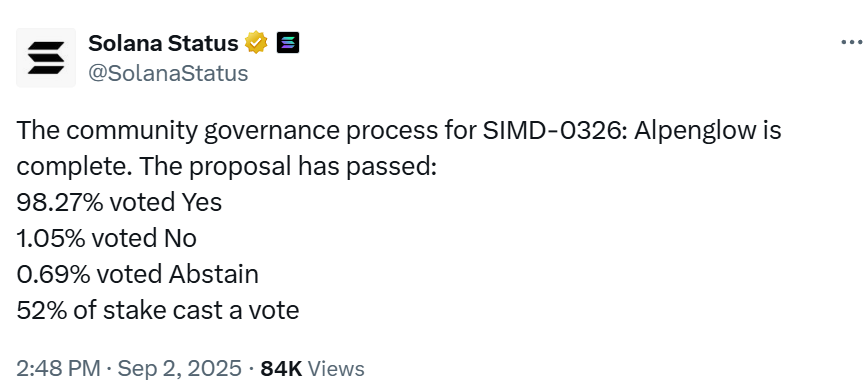
Voting for Solana’s Alpenglow Upgrade. | Source: @SolanaStatus on X
That architecture already made Solana one of the fastest chains around, with block finality at roughly 12 seconds. But twelve seconds in the world of high-frequency finance or real-time applications is an eternity. Developers and institutions want something that feels instant. With Alpenglow, that’s the goal.
What Is Solana’s Alpenglow Upgrade
Solana’s Alpenglow is the most significant protocol overhaul in the network’s history, designed to deliver millisecond-level transaction finality and radically improve network performance.
Try Our Recommended Crypto Exchanges
Sponsored
Disclosure
We sometimes use affiliate links in our content, when clicking on those we might receive a commission at no extra cost to you. By using this website you agree to our terms and conditions and privacy policy.
Consensus overhaul: Replaces PoH and TowerBFT with Votor (streamlined consensus voting) and Rotor (fast data propagation).
Speed leap: Cuts block finality from 12 seconds to 100–150 milliseconds, a 100× improvement.
Fault tolerance: Adds a “20+20” model, keeping the network secure even if 20% of validators act maliciously and another 20% go offline.
Validator economics: Expected to slash annual operating costs from around $60,000 to $1,000, plus monthly savings on voting.
Timeline: Testnet rollout in late 2025, with mainnet activation targeted for early 2026.
Features
Legacy Mechanism
Alpenglow Upgrade
Finality time
12–13 seconds
100–150 ms
Consensus
PoH + Tower-BFT
Votor (dual-round voting)
Data propagation
Turbine (multi-hop)
Rotor (direct stake-weighted relay)
Fault tolerance
Legacy BFT model
“20+20” resilience model
Use-case support
Limited by latency
Real-time applications possible
Solana Alpenglow Governance Upgrade: Community Vote and Validator Support
In the blockchain world, no upgrade of this scale succeeds without community support. Alpenglow was codified as SIMD-0326 and submitted to Solana’s governance process earlier this year.
The vote was not close: 98–99% of participants approved the upgrade, with more than half of the network’s staked tokens represented. That level of buy-in shows not only the technical confidence developers and validators have in the proposal, but also the growing maturity of Solana’s governance.
The announcement quickly influenced markets. News of Alpenglow’s approval pushed the SOL token up more than 6% in 24 hours, taking it close to $210.
Analysts have since speculated on further gains, with some forecasting $215 in September and as high as $250 by year-end if momentum continues.
$SOL looks like it's finally breaking out this pattern we've been watching.
Behind the price action lies a deeper dynamic: staking scarcity. With more tokens locked into securing the network and new institutional demand emerging, supply pressures may continue to favor price appreciation.
Why 150 Milliseconds of Blockchain Finality Matters
To appreciate just how radical 150 milliseconds of finality is, consider everyday benchmarks:
A credit card authorization on Visa clears in a few hundred milliseconds.
Cloudflare, one of the fastest content delivery networks on the internet, reports median latency under 10 milliseconds, but its 99th percentile responses hover around half a second.
Solana is aiming to lock in blockchain transactions within a similar window consistently.
That kind of responsiveness makes real-time blockchain use cases viable in a way they never were before. For high-frequency trading, it enables institutional-grade algorithms.
It ensures seamless asset transfers and in-game purchases for gaming and metaverse experiences. For DeFi, it turbocharges order books and arbitrage efficiency. The result is a blockchain that no longer feels like a compromise compared with Web2 performance.
How Solana Alpenglow Transforms Finance, Gaming, DeFi and Enterprise Use Cases
Solana’s Alpenglow upgrade unlocks real-world applications across finance, gaming, DeFi, enterprise systems, and global payments by delivering millisecond-level finality, lower costs, and Web2-level responsiveness.
Finance: High-frequency trading, instant settlement for tokenized assets, cross-border payments at Web2 speeds.
Gaming and metaverse: Real-time transactions for assets, skins, or upgrades with no perceptible lag.
DeFi: Faster arbitrage, more efficient order books, and higher liquidity turnover.
Enterprise: Use in mission-critical systems thanks to stronger fault tolerance and lower validator costs.
Global adoption: Bridges the gap between centralized systems like SWIFT or Visa and decentralized rails.
Solana’s Bid for Nasdaq-Level Performance via the Alpenglow Upgrade
Solana has long branded itself as the fastest layer-1 blockchain, and the Alpenglow upgrade brings that claim closer to reality. This upgrade marks Solana’s most ambitious attempt to push blockchain technology toward exchange-grade performance standards.
Today, Solana achieves finality in roughly 12–13 seconds, with “optimistic confirmations” in just a few seconds.
Alpenglow is designed to reduce this dramatically, targeting 100–150 millisecond finality, a 100× improvement that places blockchain responsiveness within the same latency window as Google searches, Visa authorizations, and even high-frequency trading systems.
The Solana Foundation has framed the change as achieving “Web2-level responsiveness with layer-1 finality,” a combination that could unlock entirely new applications across industries.
This leap comes from two key innovations:
Votor, a dual-round voting consensus that finalizes blocks deterministically in under 150 ms, and
Rotor, a one-hop data propagation protocol that ensures information moves efficiently across the network.
Combined with a “20+20” fault tolerance model, which allows the chain to remain secure even if 20% of validators misbehave and another 20% go offline, Alpenglow establishes the technical foundation for institution-grade blockchain reliability.
How Nasdaq Tokenization and Solana’s Alpenglow Upgrade Signal the Future of Institutional Finance
At the same time, Nasdaq itself is moving into tokenization; it has filed with regulators September 8, 2025 a rule change (SR-NASDAQ-2025-072) to list tokenized versions of equities and ETFs alongside their traditional counterparts. These tokenized securities would maintain the same rights and identifiers as their conventional versions, but gain the added benefit of blockchain-based settlement. If approved, Nasdaq expects token-settled trades to launch as early as 2026.
This comes alongside broader industry momentum: Galaxy Digital has tokenized its own stock, Coinbase has sought approval to offer blockchain-based equities, and exchanges like Kraken and Robinhood are rolling out tokenized stock products internationally.
Together, these developments show convergence from both directions, blockchains like Solana are racing to meet Wall Street-level performance, while traditional markets like Nasdaq are adopting blockchain rails for settlement. Alpenglow positions Solana as a credible platform for this future, where real-time tokenized finance becomes not only possible but inevitable.
Analysts suggest this leap could be decisive for institutional adoption, strengthening Solana’s status as one of the leading “Ethereum killer” contenders for capital flows.
Limitations of the Alpenglow Upgrade and Solana’s Ongoing Roadmap
It would be misleading to frame Alpenglow as a cure-all.
Solana’s history includes several high-profile outages, and the upgrade does not by itself eliminate the risk of downtime.
Consensus improvements help with speed and efficiency, but broader issues like redundancy, spam resistance, and network load balancing still require attention.
Critics also note that speed without reliability is of limited value. To maintain credibility with enterprises, Solana must demonstrate not only that it can achieve 150-millisecond finality, but that it can do so consistently under stress.
There is also the question of decentralization. The more a system optimizes for speed, the more it risks re-centralizing around powerful validators with high-performance hardware.
Solana’s engineering roadmap includes efforts to offset this, such as stake redistribution mechanisms and work on Firedancer, an independent validator client aimed at boosting diversity and robustness.
Looking ahead, Alpenglow is one piece of a broader evolution. Upcoming enhancements include horizontal scaling and new developer frameworks designed to make building on Solana simpler and safer. Combined with Alpenglow, these initiatives could create a reinforcing cycle of more developers, more users, and stronger network effects.
Solana (SOL) Price Outlook
From its April 7 low of $95.16, Solana has staged an impressive rebound, climbing to $217.95 on August 25—more than doubling in value. Still, the token remains well below its all-time peak and is currently testing a key resistance zone between the 0.5 and 0.618 Fibonacci retracement levels.
CHART HERE
The pace of the rally has slowed notably since June, raising questions about whether this upward move is a sustainable trend or merely a corrective bounce. Price action now places SOL near the tip of an ascending wedge, a bearish structure often preceding a breakdown. A decisive close above $220 would negate this setup, but current conditions favor the downside.
Technical indicators support the cautious view. The RSI is hovering below neutral at 50, and the MACD has crossed bearish, signaling waning momentum.
Elliott Wave Analysis: Bearish Setup Signals Possible SOL Correction
Elliott Wave analysis adds to the bearish case. The recent advance appears to have completed a five-wave leading diagonal, with wave three measuring 0.618 of wave one, and wave five aligning at 0.618 of wave three, classic proportions for this formation. Such a structure often marks the end of an upward cycle.
While there is still room for sub-wave five to stretch slightly higher, potentially nudging SOL toward $220, the overall pattern suggests that a correction is imminent. Should that correction unfold, the token could trace an A-B-C decline, pulling the price back toward $165 during September.
Conclusion
The Alpenglow upgrade represents one of the boldest experiments in blockchain infrastructure.
It promises to transform how users and institutions perceive blockchain networks by slashing finality times from seconds to milliseconds, introducing a more resilient consensus, and cutting validator costs.
If successful, Alpenglow will show that blockchain can be as fast as the internet services we use daily, sometimes quicker.
In doing so, it may redefine not only the technical capabilities of decentralized networks but also the imagination of what kinds of applications and industries they can support.
What makes Solana’s Alpenglow upgrade different from past improvements?
Unlike incremental optimizations, Alpenglow is a full consensus and data propagation overhaul, replacing PoH and TowerBFT with Votor and Rotor to achieve millisecond-level finality.
How does the “20+20” fault tolerance model improve security?
It allows the network to stay secure even if 20% of validators act maliciously and another 20% go offline, giving Solana resilience against both coordinated attacks and large-scale outages.
When will Alpenglow be available on the mainnet?
Testnet rollout is scheduled for late 2025, with mainnet activation targeted for early 2026, pending successful testing and validator adoption.
Could faster speeds make Solana more centralized?
Yes, speed optimizations can risk centralization if only high-performance validators can keep up. Solana plans to address this with initiatives like stake redistribution and the Firedancer client to preserve decentralization.
Disclaimer:
The information provided in this article is for informational purposes only. It is not intended to be, nor should it be construed as, financial advice. We do not make any warranties regarding the completeness, reliability, or accuracy of this information. All investments involve risk, and past performance does not guarantee future results. We recommend consulting a financial advisor before making any investment decisions.
Giuseppe Ciccomascolo began his career as an investigative journalist in Italy, where he contributed to both local and national newspapers, focusing on various financial sectors.
Upon relocating to London, he worked as an analyst for Fitch's CapitalStructure and later as a Senior Reporter for Alliance News. In 2017, Giuseppe transitioned to covering cryptocurrency-related news, producing documentaries and articles on Bitcoin and other emerging digital currencies. He also played a pivotal role in establishing the academy for a cryptocurrency exchange website. Crypto remained his primary area of interest throughout his tenure as a writer for ThirdFloor.


 Easy
Easy