6 USDH Bidders to Watch Ahead of Hyperliquid’s Sept. 14 Vote
Share
Key Takeaways
Hyperliquid is moving toward independence from external stablecoins by introducing USDH, a native dollar instrument.
This is not just a technical upgrade but a governance and economic milestone that could redefine who captures value in the ecosystem.
About $5B in USDC liquidity sits on Hyperliquid today, generating hundreds of millions in reserve yield.
The Sept. 14 validator vote is officially about governance and the USDH ticker, not final issuer privileges.
On Sept. 14, 2025, Hyperliquid will be on the cusp of a defining moment for its ecosystem. On that day, validators will cast their votes on “USDH,” a proposed natively issued dollar stablecoin that could reshape the platform’s reliance on external issuers and anchor future growth.
What emerges from this vote will not only determine the technical and regulatory framework of USDH, but also who captures value and influence within Hyperliquid’s rapidly expanding community.
Validator vote imminent: the decision centers on adopting “USDH,” a new native dollar stablecoin.
Purpose of USDH: reduce the ecosystem’s dependence on external stablecoin issuers.
Field of bidders: Paxos, Frax, Agora, and Native Markets (with others rumored or withdrawn).
Key differentiators: bidders vary across regulatory posture, reserve design, yield distribution, and value capture for the Hyperliquid community.
Current frontrunner (as of Sept. 12, 2025): Native Markets, the betting-market favorite after Ethena withdrew.
Remaining strong contenders: Paxos and Frax, both seen as formidable options.
Why Hyperliquid’s Sept. 14 Vote Matters
Hyperliquid today settles the vast majority of trading in USDC, creating a dependency on Circle’s off-chain issuer risk and policy decisions.
New Trending Crypto Wallet Offers
Sponsored
Disclosure
We sometimes use affiliate links in our content, when clicking on those we might receive a commission at no extra cost to you. By using this website you agree to our terms and conditions and privacy policy.
A native, chain-integrated stablecoin would aim to deepen on-chain liquidity, route reserve income and/or fees back to Hyperliquid users or its ecosystem, and simplify quote-asset permissions over time.
Some coverage frames the Sept. 14 decision as a validator vote to assign the “USDH” ticker (a governance test that confers no special privileges), while other reporting treats the same window as the moment validators indicate their preferred issuer proposal; in practice, the governance process has bundled proposal submissions (due Sept. 10), validator signaling (by Sept. 11), and a Sept. 14 vote as key checkpoints on Hyperliquid’s path to a native dollar.
Why the urgency? Because whoever operates USDH may compete for $5 billion in on-chain dollar flows currently anchored in USDC on Hyperliquid, reserves that generate meaningful yield when held in cash-equivalent instruments.
That upside is why the bidder slate includes regulated trust companies, crypto-native stablecoin builders, and market infrastructure teams.
Timeline: Key Dates in the USDH Vote
Sept. 10: Proposal deadline (bidders submit written offers/specs).
Sept. 11: Validators disclose initial support.
Sept. 14: On-chain validator vote tied to USDH governance/ticker—Hyperliquid Foundation to abstain and mirror the majority of non-Foundation votes for neutrality.
This vote won’t finalize every operational detail of USDH. Still, it is a pivotal sorting event: which team’s blueprint earns community trust to move forward, and under what optics (compliance-first, user-yield, neutrality, or native integrations).
6 Bidders Compete for USDH Stablecoin Rights on Hyperliquid
Below are the leading proposals ahead of the vote.
1. Agora (With Institutional Custody)
Public statements emphasize neutrality and routing 100% of net revenue from USDH to the Hyperliquid ecosystem—either the Assistance Fund (risk backstop) or HYPE token buybacks. Reporting also notes State Street custody for reserves in one configuration of the proposal.
What to watch:
Value capture vs. user yield: Direct funneling of net revenue into buybacks/funds can support HYPE’s reflexivity and platform safety nets, but may offer less direct APY to end users than a user-yield design.
Execution risk: Delivering a best-in-class, bank-custodied reserve program while optimizing on-chain UX requires deep ops and compliance muscle.
2) Frax Finance
A user-first yield model—coverage indicates 100% of treasury yield distributed to users. Frax has proposed interop with its stable assets and redemption pathways (e.g., frxUSD), aiming to make USDH composable across chains.
One summary pegs the theoretical revenue impact at ~$220M annualized given current deposit levels on Hyperliquid, implicitly showcasing the scale at stake.
What to watch:
Regulatory comfort: Frax’s design DNA is crypto-native and innovative; some validators may weigh that against the political predictability of a fully regulated trust issuer.
Sustainability of user yields: Passing through 100% of yield is compelling, but it compresses the pot available for buybacks, insurance funds, and future ecosystem incentives.
3) Native Markets (Bridge/Fiat Rails Angle)
A market-infrastructure-style plan with fiat on/off-ramp integrations; reporting links the issuance stack to Stripe’s Bridge and wallet infra (e.g., Privy) as potential rails, plus revenue sharing back to the ecosystem.
Crucially, Native Markets has become the odds-on favorite on Polymarket after Ethena publicly withdrew from the race following validator/community feedback. Recent prediction-market snapshots show over 90% implied probability that Native Markets prevails.
What to watch:
Platform neutrality: Some community voices have raised questions about ceding economic chokepoints to web2 payment giants; others see it as a feature—enterprise-grade rails and KYCability for institutions.
Onboarding velocity: If the rails are real and live quickly, USDH could achieve distribution fast among traders and fiat-linked flows.
4) Paxos
A regulated trust issuer pitching a fully compliant USDH, with a headline pledge to route 95% of interest income to HYPE buybacks (plus zero-fee USDC transitions).
Paxos also touts MiCA alignment and deep institutional reach. In other words: a conservative reserve model with outsized value capture for the native token and minimal friction for users migrating from USDC.
What to watch:
Regulatory predictability: If your top priority is regulator-friendly reserves, audits, and redemptions, Paxos is hard to ignore.
Direct user APY vs. buybacks: A buyback-heavy policy can lift HYPE and ecosystem funds, but users who prefer explicit yield in wallet may find Frax’s structure more attractive.
5) OpenEden
OpenEden has put forward a proposal centered on channeling maximum value back into the Hyperliquid ecosystem. The RWA platform pledged that all yield generated from USDH reserves will flow into ecosystem support, most notably through HYPE buybacks.
Beyond yield, OpenEden also committed to using proceeds from minting and redeeming USDH to repurchase HYPE tokens, which will then be distributed directly to Hyperliquid validators. To further sweeten its bid, the company has earmarked 3% of its native EDEN token supply as an incentive pool, with the option to expand this allocation over time.
USDH reserves under its model would be fully backed by a tokenized U.S. Treasury Bills Fund, with custody managed by The Bank of New York Mellon. Finally, OpenEden has announced partnerships with BNY Mellon, Chainlink, AEON Pay, and Monarq Asset Management to reinforce its adoption strategy and operational credibility.
What to watch:
Regulatory optics: Custody under BNY Mellon and use of tokenized Treasuries may appeal strongly to institutions.
Ecosystem alignment: Funneling both yield and mint/redeem fees into HYPE buybacks could strengthen validator incentives but limit direct user APY.
Token incentives: the EDEN token commitment adds a new layer of rewards—watch whether this aligns or conflicts with HYPE-centric value capture.
Adoption velocity: the mix of traditional finance partners (BNY Mellon) and crypto infra (Chainlink) positions Open Eden as a hybrid player, execution speed will be key.
Competitive trade-off: heavy ecosystem-first distribution may compete with Frax’s user-yield narrative and Paxos’ compliance-first approach.
6) Sky (formerly MakerDAO)
Sky, previously MakerDAO and issuer of the DAI stablecoin, has entered Hyperliquid’s USDH race with one of the most capitalized proposals. The team points to an $8 billion balance sheet and its long track record in decentralized collateralized stablecoins as proof of execution capacity.
Under its plan, all USDH minted on Hyperliquid would earn a 4.85% yield, with reserves backed by U.S. Treasuries and high-quality collateral. Sky has further pledged $2.2 billion in immediate redemption liquidity through mechanisms akin to its “Peg Stability Module,” offering traders strong assurance of redemption depth.
To support adoption, Sky unveiled a $25 million “Genesis Star” initiative to bootstrap liquidity and incentives on Hyperliquid. The team has also emphasized its recent B- credit rating from S&P Global (the first ever for a DeFi protocol) as a sign of institutional maturity.
What to watch:
Yield distribution: The advertised 4.85% return is competitive, but validators should scrutinize how it’s delivered (to all holders vs. specific channels).
Liquidity assurances: The $2.2 billion redemption pool is ambitious, execution and transparency on SLAs will be critical.
Governance credibility: Sky’s MakerDAO legacy brings years of experience, but also a history of governance debates that validators may weigh.
Institutional optics: The S&P rating and U.S. Treasurys backing could resonate with compliance-minded stakeholders.
Competitive positioning: Sky blends user yield (like Frax) with institutional trust markers (like Paxos), raising the question of whether a hybrid approach can capture validator support.
The Race for USDH on Hyperliquid (Ethena has withdrawn) | Source: @BanklessHQ on X
Ethena’s Withdrawal from the USDH Race
Ethena Labs, the team behind the USDe synthetic dollar, exited the USDH bidding process on Sept. 11–12 after engaging directly with validators and community members.
The decision marked a turning point in the contest: prediction markets quickly repriced in favor of Native Markets, with odds of their victory soaring once Ethena stepped aside.
The withdrawal reflected both strategic focus and ecosystem fit. Ethena has a broad roadmap that spans synthetic dollars, savings tools, and card products, and some community voices noted that its priorities were not exclusively tied to Hyperliquid.
By leaving the race, Ethena cleared the field for more Hyperliquid-native or compliance-driven proposals while signaling its intent to still collaborate with the ecosystem in other ways.
What Ethena Proposed Before Withdrawing
Before pulling out, Ethena’s pitch stood out for its community-friendly economics.
The team suggested backing USDH with USDtb, a token linked to BlackRock’s BUIDL fund via Anchorage Digital Bank, and pledged to return 95% of reserve revenues to Hyperliquid’s community.
Migration incentives from USDC to USDH and at least $75 million in ecosystem support were also part of the plan.
While the proposal ultimately did not move forward, its design helped sharpen the debate over how yield and governance should be structured for a native Hyperliquid stablecoin.
How the USDH Vote Works
Over the past week, the Hyperliquid community has reviewed and debated competing proposals to operate USDH. This is a ticker reserved at the protocol level for a natively issued, compliance-aligned stablecoin.
While still just a ticker, USDH has become a rallying point for governance: validators, teams, and users iterating on designs and aligning around the future direction of the ecosystem.
Key Points About the Vote
Date and time: Voting begins on September 14 at 10:00 UTC. Stakers must be delegated to a validator aligned with their preferred outcome before that time.
Validator declarations: Validators shared their intended votes and reasoning publicly in the governance forum ahead of the vote.
Changing validators: To switch, a staker must first unstake from their current validator and then stake to a new one. A one-day cooldown applies after staking before unstaking is allowed. Important: Moving HYPE from the staking balance to spot balance will remove voting power entirely.
Mechanics: The process is fully on-chain and stake-weighted. Once quorum (two-thirds) is met, the designated address can bid on the USDH ticker in the spot deploy gas auction.
Foundation’s role: Hyperliquid Foundation validators will not vote directly. Instead, they will mirror the validator choice that receives the most non-Foundation support, ensuring neutrality.
Regardless of the outcome, many of the ideas surfaced in this process are expected to move forward in some form, strengthening Hyperliquid’s ecosystem.
The Stakes: $5B in Liquidity, Hundreds of Millions in Annual Yield
One analysis framed the contest as a direct threat to Circle’s USDC share on Hyperliquid, noting the ecosystem’s $5 billion dollar base and the reputational impact of re-routing that float to a native instrument.
A separate update highlighted $220M annualized as a ballpark for reserve-income at prevailing sizes, context for why proposals are split between user yield and ecosystem capture (buybacks, funds, fee relief).
USDH’s reserve policy affects redemption speed and liquidity confidence; distribution policy affects whether you earn a yield stream or see value accrue to HYPE and ecosystem funds; and compliance posture affects which institutions will route flow through the chain. Different users will rank those priorities differently.
ChatGPT & Grok Agree: Native Markets Poised to Win USDH Race on Hyperliquid
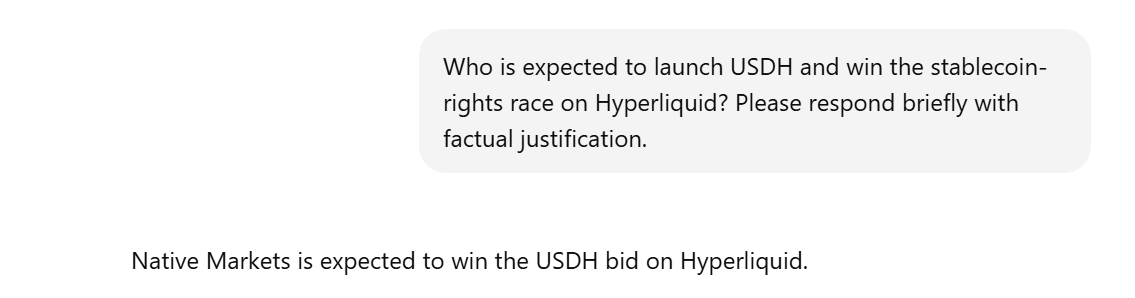
When asked who is expected to launch USDH and win the stablecoin-rights race on Hyperliquid, ChatGPT says:
“Native Markets is expected to launch USDH and win the stablecoin-rights race.”
ChatGPT’s response. | Credit: ChatGPT
Justification:
It currently leads in validator voting power (30-78% depending on source).
Ethena has withdrawn from the race, clearing a major competitor.
Prediction markets give Native Markets very high odds of winning (90-95%).
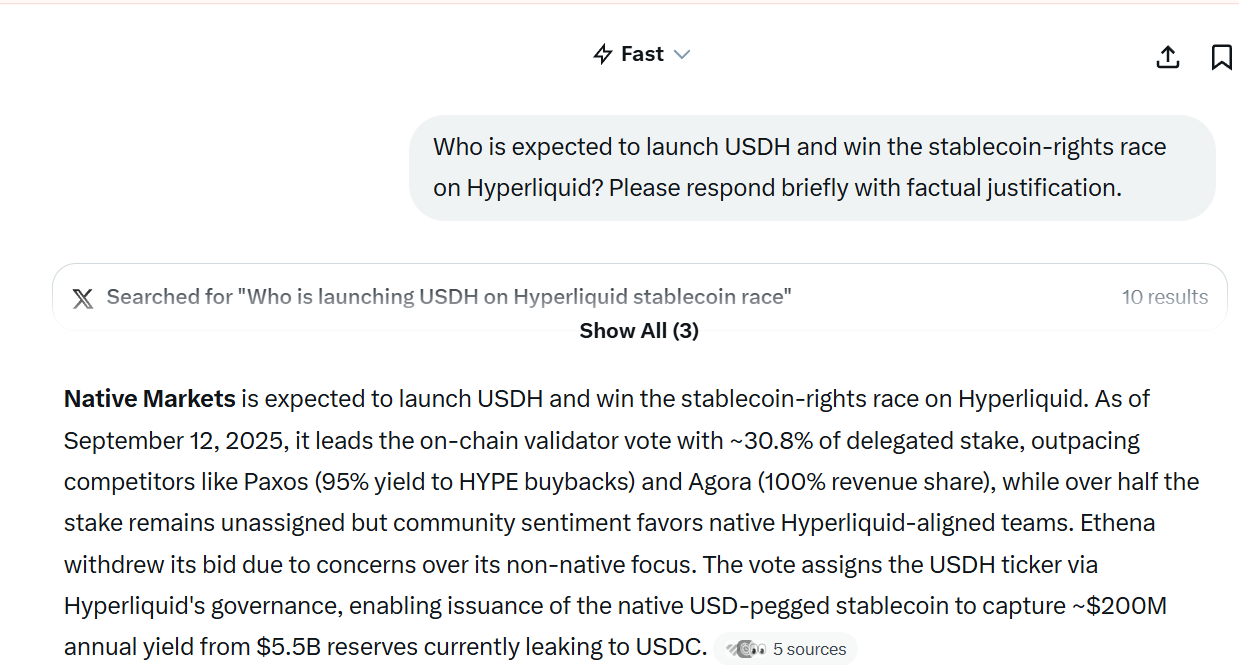
Even Grok aligns with ChatGPT that Native Markets is expected to launch USDH and win the stablecoin-rights race on Hyperliquid.
“As of September 12, 2025, it leads the on-chain validator vote with 30.8% of delegated stake, outpacing competitors like Paxos (95% yield to HYPE buybacks) and Agora (100% revenue share), while over half the stake remains unassigned but community sentiment favors native Hyperliquid-aligned teams. Ethena withdrew its bid due to concerns over its non-native focus. The vote assigns the USDH ticker via Hyperliquid’s governance, enabling issuance of the native USD-pegged stablecoin to capture $200M annual yield from $5.5B reserves currently leaking to USDC,” Grok noted.
Grok’s response. | Credit: Grok
What to Watch in the USDH Proposals
As Hyperliquid approaches its Sept. 14 vote, the competing bids to operate USDH can be compared across a handful of critical dimensions. Each reflects a different philosophy for how a native stablecoin should be built, governed, and integrated into the ecosystem.
1) Regulatory resilience & custody
Why it matters: On-ramp partners, market-makers, and larger treasuries care about KYC/AML, asset segregation, and auditability.
Signals to watch: Name-brand custody (e.g., State Street), issuer licensure (trust charter, MiCA roadmap), and clarity on redemption SLAs. Paxos and, by design, an Agora/State Street configuration score high on this axis; Frax emphasizes crypto-native composability; Native Markets leans on fiat-rail partnerships.
2) Yield distribution: to users or to the ecosystem?
Users first (Frax): Competitive APY directly in wallets supports sticky retail flow and programmatic use in DeFi.
Ecosystem first (Paxos/Agora variants): Buybacks/assistance-funds can fortify risk budgets and token value, arguably benefitting all users indirectly.
Hybrid possibilities: Expect follow-on governance to tune splits as USDH scales.
3) Liquidity migration & UX
Frictionless swaps: Zero-fee in USDC to USDH transitions (Paxos pitch) reduce switching costs.
Market coverage: Which spot/perp pairs, fiat ramps, and custody channels list USDH earliest? Native Markets’ payments rails could accelerate distribution; Frax’s DeFi ecosystem could seed on-chain venues beyond Hyperliquid.
4) Neutrality & platform risk
Concentration concerns: Some in the community caution against letting a single web2 payments stack sit between users and reserves; others argue enterprise rails are necessary to scale. This is at the heart of debate around Bridge/Privy integrations cited in commentary about Native Markets’ approach.
5) Governance clarity
No special privileges (for now): Hyperliquid’s messaging around the ticker vote keeps the playing field even while future upgrades aim to make quote assets permissionless, mitigating fears of “picking winners.”
Market Sentiment Right Now
Polymarket odds have swung decisively toward Native Markets (over 90% implied) after Ethena exited the race. That doesn’t guarantee the outcome, but it reflects where informed speculators are placing chips two days before the vote.
Media framing ranges from “ticker-only governance test” to “issuer competition,” but all agree Sept 14 is a meaningful milestone that will shape Hyperliquid’s dollar stack and competitive posture versus USDC.
Ecosystem optics: Analysts note the contest could pressure Circle’s revenue on Hyperliquid if USDH meaningfully displaces USDC as the quote asset, especially if migration is fee-free and liquidity coalesces.
How binding is the Sept. 14 vote? >>>>>>>>lass=”yoast-text-mark” />>It is framed as a governance/ticker decision with the Foundation abstaining; subsequent technical upgrades and agreements will still determine USDH’s day-to-day operations and market privileges. In other words, signal first, plumbing second.
Where does the reserve yield go? This is the philosophical fork: to users (Frax-style), to ecosystem (Paxos/Agora pitches), or to rails/integrator splits (Native Markets). Your stance likely mirrors whether you’re an active trader (prefers APY) or a HYPE holder/risk-manager (prefers buybacks/funds).
How quickly can USDH reach critical mass? Watch for USDC to USDH migration incentives, MM commitments, and fiat bridges. Early wins here snowball into dominance of the quote asset.
Will governance keep quote assets permissionless? Hyperliquid has signaled a path to permissionless quote assets, calming worries that blessing one issuer bakes in unfair advantages. The design choice here will influence how other stablecoins compete alongside USDH.
How to Prepare as a Hyperliquid User
With the September 14 vote approaching, users who want their stake to count should double-check a few basics:
If you’re a trader: Track migration terms (fees, auto-swap support), market-maker quotes in USDH pairs, and funding differentials as liquidity shifts. A user-yield USDH changes the cost of capital calculus. A buyback-centric USDH might tighten spreads if it attracts deeper MM commitments.
If you’re a builder or LP: Focus on integration guarantees (wallets, bridges, custodians), redemption SLAs, and accounting treatment with your compliance counsel. Paxos/Agora may shorten your enterprise approval loop. Frax or Native Markets might bring faster composability or customer acquisition via rails.
If you’re a HYPE holder: Understand how each bid allocates reserve income between buybacks, assistance funds, and user incentives. The mix determines whether value accretes immediately to HYPE or accrues via network effects (growth, TVL, volumes).
Conclusion
Hyperliquid’s Sept. 14 governance checkpoint won’t settle every implementation detail. However, it will reveal what the network values most in its native dollar: regulatory conservatism (Paxos), user yield (Frax), enterprise rails (Native Markets), or ecosystem reinforcement (Agora).
With billions in on-chain dollars at stake and nine-figure reserve income on the table, the decision will shape Hyperliquid’s market structure. But also user incentives and brand of decentralization for years to come.
If you operate on Hyperliquid, prepare contingencies for each endgame—and watch the vote closely.
USDH is a proposed natively issued dollar stablecoin for Hyperliquid, designed to reduce reliance on external issuers like Circle’s USDC and to capture reserve income within the ecosystem.
Why does Hyperliquid need its own stablecoin?
Currently, most trading settles in USDC, which exposes the platform to off-chain risks tied to Circle. A native stablecoin could deepen on-chain liquidity, simplify quote-asset permissions, and redirect reserve income or fees back to Hyperliquid users and the HYPE ecosystem.
What exactly are validators voting on September 14?
Validators will vote on USDH governance and ticker assignment. While framed as a governance test (not granting permanent privileges), the outcome signals community preference for one issuer’s design philosophy. The Hyperliquid Foundation will abstain and mirror the majority of non-Foundation votes.
How binding is this vote?
It is primarily a governance signal. The operational details—custody arrangements, reserve policies, distribution splits—will still require follow-on governance and technical upgrades.
Disclaimer:
The information provided in this article is for informational purposes only. It is not intended to be, nor should it be construed as, financial advice. We do not make any warranties regarding the completeness, reliability, or accuracy of this information. All investments involve risk, and past performance does not guarantee future results. We recommend consulting a financial advisor before making any investment decisions.
Giuseppe Ciccomascolo began his career as an investigative journalist in Italy, where he contributed to both local and national newspapers, focusing on various financial sectors.
Upon relocating to London, he worked as an analyst for Fitch's CapitalStructure and later as a Senior Reporter for Alliance News. In 2017, Giuseppe transitioned to covering cryptocurrency-related news, producing documentaries and articles on Bitcoin and other emerging digital currencies. He also played a pivotal role in establishing the academy for a cryptocurrency exchange website. Crypto remained his primary area of interest throughout his tenure as a writer for ThirdFloor.


 Easy
Easy