Key Takeaways
- Unlike neobanks, which still rely on legacy banking rails, WeFi founders built it entirely on crypto.
- WeFi designed its app to make everyday users feel familiar with it, offering cards, savings, and investments.
- Its CEO, Maksym Sakharov, sees digital banking and decentralized finance becoming the norm within a decade.
In an era where most fintech innovation still runs on traditional rails, WeFi positions itself as fundamentally different.
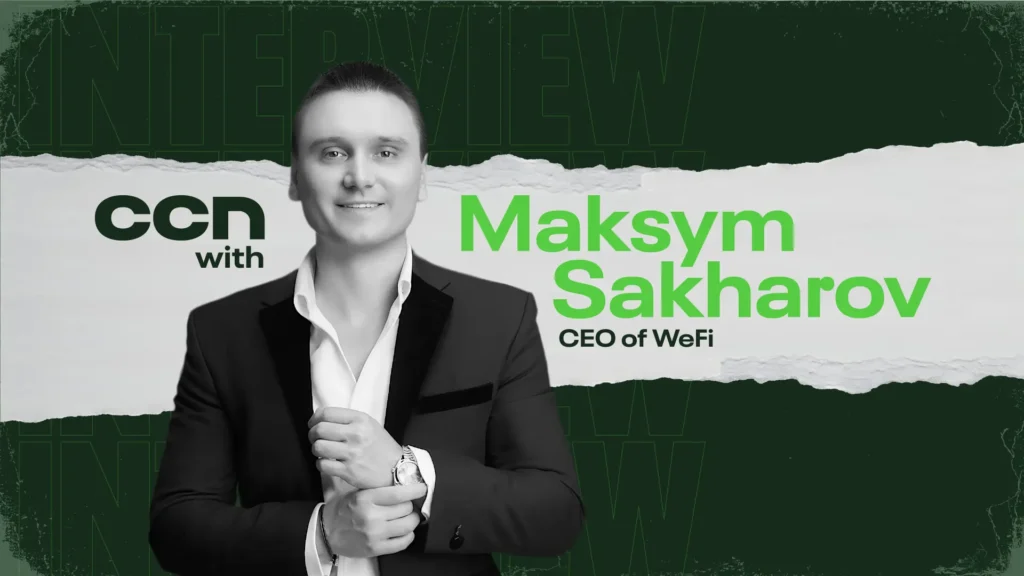
“Many crypto products are built on the same infrastructure as existing financial services. Take neobanks, for example, which are often built on traditional banking rails,” Maksym Sakharov, co-founder and CEO of WeFi, told CCN.
For the manager, as a result, traditional banking rails suffer from the same delays, red tape, and hidden fees that conventional banks have.
According to Sakharov, WeFi’s model is about breaking free of that dependency: “WeFi is the next evolution of that process: a completely decentralized crypto on-chain banking platform with global payments, yield, ATM withdrawals, and non-custodial accounts.”
Shakharov said the founders built WeFi entirely on crypto rails, and he believes these rails will eventually support all financial transactions.
Making Crypto Banking User-Friendly
Despite the complexity of blockchain infrastructure, WeFi wants to simplify the user journey.
“Our goal was to package a transparent and innovative product in a wrapper that wouldn’t intimidate users unfamiliar with crypto or traditional finance. The whole experience focuses on ease of use and puts mobile first, instead of treating it as an afterthought,” Sakharov explained.
WeFi mirrors familiar banking tools — cards, savings, and investments — but presented through a user interface inspired by mainstream mobile apps.
Educational explanations, built into the app itself, guide newcomers step by step.
Crypto-native rewards are also part of the offering: “We enable rewards through crypto staking and mining, eliminating the need for additional equipment or expert knowledge.”
“Through our loyalty program, asset holders can take advantage of lower fees, boosted APRs, and other exclusive benefits within the WeFi ecosystem,” Sakharov added.
Serving the Underbanked in Asia
For WeFi, one of the strongest use cases lies in regions where traditional banks have failed.
According to Sakharov, more than half of all unbanked people live in Asia and rely on cash, prepaid debit cards, money orders, and payday lenders.
“This exposes them to inefficient — and sometimes predatory — practices that people shouldn’t have to deal with in the modern world,” Sakharov said.
He pointed to countries like Malaysia and the Philippines, where mobile adoption is high but access to reliable banking is not:
“Extremely high rates of mobile phone penetration in countries like Malaysia and the Philippines make crypto and digital finance an ideal solution to bring these people into the banking system.”
“They don’t need to wait around for legacy players in the financial space to include them.”
For WeFi, financial inclusion means accessibility for everyone.
“For us, mainstream adoption means putting crypto at the fingertips of not only the tech-savvy generation, but also grandmas and grandpas, especially in underserved areas that many regular banks and financial institutions have neglected.”
Navigating Regulation While Staying Decentralized
Even with its decentralized model, WeFi recognizes the importance of regulatory frameworks.
“Although WeFi offers complete decentralization via blockchain, that doesn’t mean it simply ignores regulatory requirements.”
“Despite its absence of centralized oversight, WeFi is properly registered as a money services business, crypto exchange, and DeFi technology service,” Sakharov said.
Because the platform runs non-custodial accounts, it sidesteps traditional KYC/AML obligations, offering users more privacy while maintaining transparency.
“WeFi has already received Canada’s MSB license, the Czech Republic’s VASP license, the UAE Payment Solution license, and the EU’s EMI,” Sakharov noted, signaling the company’s strategy to gain credibility with regulators in multiple jurisdictions.
Looking Toward 2035
For Sakharov, the next decade will bring a fundamental shift in how people view and use money.
“We expect to see concepts like digital banking, crypto rails, and decentralized finance become the norm over the next decade. We plan to lead that wave, so we actively explore what’s next and invest in our infrastructure to ensure readiness,” he said.
WeFi’s roadmap includes high-yield stablecoin savings and collateralized and uncollateralized loans, with new asset integrations on the horizon.
However, the broader mission is clear: opening finance to historically excluded millions.
“We’re excited to see how the world will change as tens, or even hundreds, of millions of people who have historically been unbanked can enter the financial space on their own terms,” WeFi’s CEO said.
“In the meantime, we’ll still be here evangelizing about the benefits of DeFi, blockchain, and Web3.”
Top Trending Crypto Articles

Giuseppe Ciccomascolo began his career as an investigative journalist in Italy, where he contributed to both local and national newspapers, focusing on various financial sectors.
Upon relocating to London, he worked as an analyst for Fitch's CapitalStructure and later as a Senior Reporter for Alliance News. In 2017, Giuseppe transitioned to covering cryptocurrency-related news, producing documentaries and articles on Bitcoin and other emerging digital currencies. He also played a pivotal role in establishing the academy for a cryptocurrency exchange website. Crypto remained his primary area of interest throughout his tenure as a writer for ThirdFloor.