In an industry defined by complexity, Algorand has long positioned itself as the blockchain that just works: fast, efficient, and accessible to developers from all backgrounds. But how does a network designed by cryptography pioneer Silvio Micali stay true to that promise while scaling to global use cases?
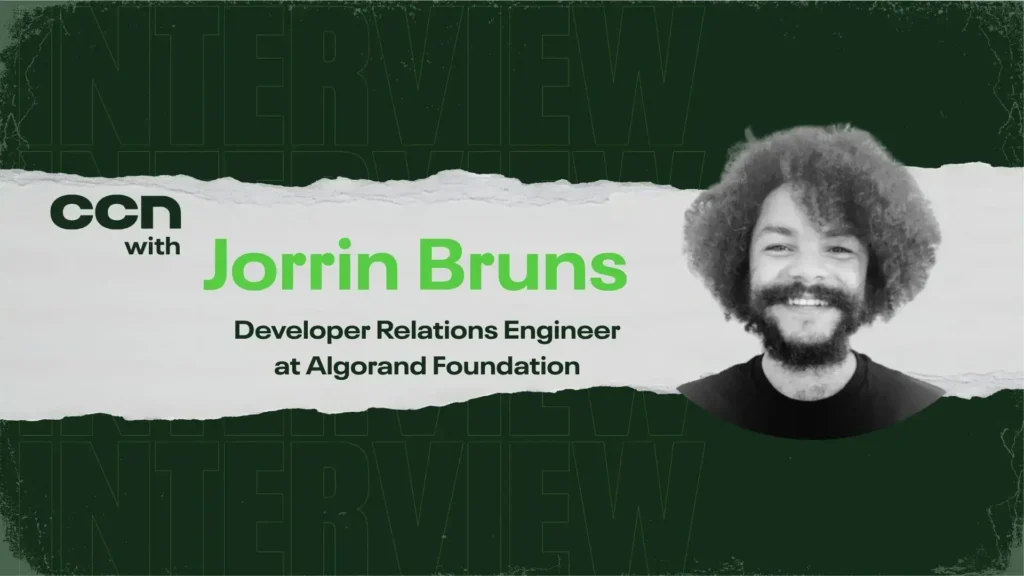
To find out, during the Blockchain Futurist Conference 2025 in Miami, CCN’s Dr. Guneet Kaur sat down with Jorrin Bruns, Developer Relations Engineer at the Algorand Foundation, who spends his days bridging the gap between the technology and the builders shaping its future.
From hackathons to zero-knowledge tools, Bruns shared how Algorand is making blockchain development more straightforward, faster, and more inclusive, and why, in his view, real innovation comes from giving everyday developers the confidence to experiment.
When Bruns joined the foundation, even he was surprised by how accessible the platform had become. “You can write smart contracts in Python or TypeScript,” he said, smiling.
“That immediately makes Algorand approachable to the largest group of developers in the world.”
How Algorand Makes Blockchain Development Easier
Bruns recalls demonstrating AlgoKit at recent hackathons, where developers unfamiliar with Algorand were able to spin up working prototypes within hours.
“People would come up to me afterward saying, ‘Wow, I can’t believe it was so easy,’” he said. “That’s not just a marketing line; it’s genuine feedback.”
He credits this ease to Algorand’s developer-first tools and precise documentation. “AlgoKit lets you spin up your own local Algorand blockchain on your laptop,” he explained. “You can deploy contracts, test them, and iterate quickly; it shortens the entire development loop.”
In a world where most blockchains still require navigating through unfamiliar languages like Solidity, Algorand’s focus on Python and TypeScript gives it a mainstream edge.
“It’s an easy on-ramp for anyone who’s already a software developer,” said Bruns. “You don’t have to be a crypto native to build on Algorand.”
Real-World Use Cases: How Algorand Supports Global Financial Inclusion
One of the examples Bruns highlighted was HesabPay, a payments project operating in Afghanistan. The app utilizes Algorand’s blockchain to facilitate mobile transactions for individuals who lack access to traditional banking systems.
“With just a smartphone and a QR code, users can buy what they need in local markets,” he said. “It’s a simple, elegant solution that removes barriers for those excluded from traditional finance.”
Beyond frontier economies, Algorand is investing in nurturing new startups globally. The Foundation’s Ecosystem Success Team runs an ongoing Startup Challenge, helping early-stage projects refine their ideas, build community, and pitch to investors.
“It’s like an accelerator,” Bruns said. “At the end, they get to present their projects in a kind of ‘battle of the startups,’ and some of them really do take off.”
Algorand’s Next Frontier: Real-World Assets, ZK Tools, and Scalability
As the blockchain world buzzes with terms like interoperability, zero-knowledge proofs, and real-world asset tokenization, Algorand isn’t standing still.
“Real-world assets like gold being tokenized by Meld and real estate by Lofty are already being built on Algorand,” said Bruns. “That’s not theoretical; it’s live.”
He’s particularly excited about a new toolkit called AlgoPlonk, which simplifies the creation of zero-knowledge circuits and their integration into smart contracts.
“It’s still early, but the potential for privacy-preserving transactions is huge,” he said. “I’m building prototypes myself and hope to teach others how to do it.”
For Bruns, Algorand’s Pure proof-of-stake consensus model remains its strongest technical asset. Developed by cryptographer Silvio Micali, it enables three-second block times, 10,000 transactions per second, and zero downtime since its inception, a trifecta few blockchains can claim.
“We balance scalability, decentralization, and security,” Bruns noted. “That was once called the blockchain trilemma; Algorand actually solves it.”
Why Developers Are Choosing Algorand Over Ethereum and Solana
When asked how Algorand compares with established giants like Ethereum or Solana, Bruns pointed to developer accessibility.
“TypeScript was a huge factor for me,” he admitted. “If you’re a web developer, you can bring your existing skills straight into blockchain. You don’t need to learn an entirely new language or architecture.”
That accessibility, he believes, will drive the next wave of adoption. “There are so many developers who don’t realize they already have the skills to build decentralized applications,” he said.
“They just need a reason and a platform that doesn’t make it painful.”
Encouraging Innovation: A Call for Bold Blockchain Builders
When the conversation turned philosophical, Bruns reflected on what he hopes to see change in the developer culture itself. “I’d love to see more risk-taking,” he said.
“There are so many developers who have great ideas but hold back because they think blockchain is too hard or too speculative.”
At traditional software events, Bruns often meets programmers who are curious but hesitant about crypto. “They ask me, ‘What can I actually build with blockchain?’” he recalled. “And I tell them, start with the problems you see in the world. Whether it’s data transparency, digital identity, or supply-chain trust, blockchain can enhance it.”
He paused before adding with conviction, “We’re just scratching the surface. The real innovation will come when people start applying blockchain’s core values, decentralization, transparency, verifiable data, to everyday problems. That’s where Algorand wants to be.”
A Message to Developers: Don’t Wait to Build
Bruns’ message to developers is clear: don’t wait. With approachable tools, a thriving global community, and a protocol built for speed and reliability, Algorand aims to lower the barrier between great ideas and working blockchain applications.
“Even if your first project doesn’t change the world,” he said with a smile, “you’ll learn something that leads to the next thing, and that’s how innovation happens.”
The information provided in this article is for informational purposes only. It is not intended to be, nor should it be construed as, financial advice. We do not make any warranties regarding the completeness, reliability, or accuracy of this information. All investments involve risk, and past performance does not guarantee future results. We recommend consulting a financial advisor before making any investment decisions.

Dr. Guneet Kaur is a senior editor at CCN.com and a Science Fellow at Exponential Science. She is a fintech and blockchain expert with extensive experience in digital finance education, blockchain ecosystems, and cryptocurrency markets. She has worked with global media such as Cointelegraph, as well as education and blockchain platforms, to design and lead strategic content and learning initiatives. As an educator and assessor for top-tier executive programs, she bridges real-world fintech trends with academic insight.
Dr. Kaur is also a published researcher and peer reviewer across fintech and data science journals, including Financial Innovation Journal and International Journal of Big Data Intelligence and Applications. Her work spans data-driven analysis, Web3 innovation, and technical content development. With a strong foundation in both industry and academia, she translates complex financial technologies into practical applications, empowering learners, professionals, and institutions across the rapidly evolving digital finance landscape.


 Easy
Easy