Crypto predictions for 2030 suggest Bitcoin may reach $500K, Ethereum $20K, XRP $20 as adoption and blockchain innovation reshape the market. | Credit: CCN.com
Share
Key Takeaways
Growing adoption drives real usage across networks such as Solana, Sui, and Celestia as activity and engagement rise.
Institutional traction increases through Chainlink and Ondo Finance as banks and regulated platforms test tokenized assets and secure data flows.
AI expansion accelerates on Bittensor and Render Network as decentralized compute and model incentives attract builders.
Stronger foundations support future cycles as throughput, modular design, tokenized assets, and AI networks build the base for long-term growth.
Bitcoin has changed the lives of many. Early buyers turned small bets into life-changing gains, and many others watched from the sidelines with long-lasting regret.
But Bitcoin is not alone. The market keeps moving forward. New ideas keep emerging, enriching the landscape.
Every cycle brings a fresh group of builders, stronger communities, and clearer use cases.
Which projects will shape 2026?
There is a huge number of projects that attract attention for what they have already delivered, and for the scale they could reach in the next two years. They develop tools, networks, and ecosystems that propel the industry forward.
This article addresses 7 projects that have already gained significant momentum and are poised to become leading names throughout 2026, 2027, and for many years beyond.
1. Solana – The Speed King Keeps Getting Faster
Solana built a reputation for high speed and low fees. Activity increased during 2024 and 2025 as consumer apps, wallets and memecoins pushed the chain to heavy use. Developers continued to build on Solana because the network stayed fast even during peak demand.
Public dashboards and validator reports show consistent strength in throughput and user growth.
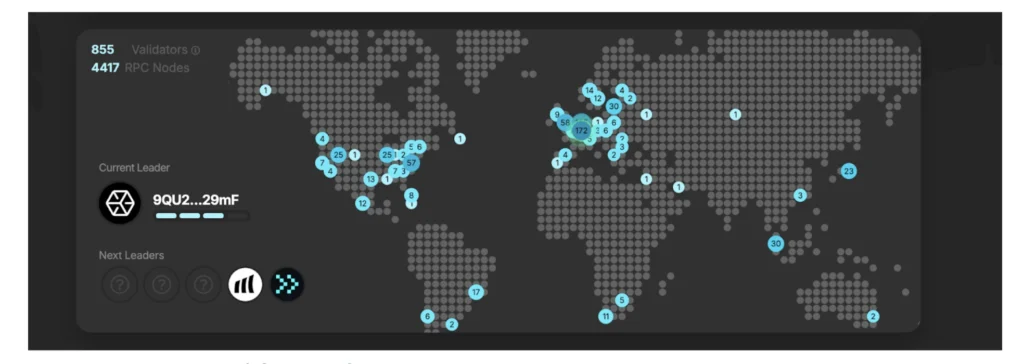
High throughput: Solana consistently processes thousands of transactions per second in real-world conditions. The Solana Foundation performance dashboard and Solana Beach show live Transactions Per Second (TPS) data.
Low fees: Solana fees stay far below one cent per transaction. Fee data remains available on the Solana Foundation dashboard.
Firedancer progress: It has achieved major performance milestones in testing. The team published technical updates and benchmarks in its public repository.
Mobile momentum: Phantom reported more than 15 million monthly active users (MAU) and continues to publish updated usage data on its website, stating that Solana plays a major role.
Solana enters 2026 with strong throughput, low fees and growing mobile activity. The next project in this lineup takes a different route to scale.
2. Chainlink – The Data Network Behind Real-World Adoption
Chainlink expanded its position as the leading oracle network as institutions, banks, and major blockchain teams adopted its data and computation layers.
Public dashboards show steady growth in the number of services, integrations, and Cross-Chain Interoperability Protocol (CCIP) transactions. Developers used Chainlink because it offered reliable data delivery and cross-chain connectivity across many ecosystems.
Public activity trackers such as Chainlink Ecosystem and Dune dashboards confirmed steady expansion in usage.
Chainlink’s Key Points for 2026
High integration count: Chainlink reported more than 2,400 integrations in its official ecosystem directory.
Cross-Chain Interoperability Protocol (CCIP) traction: CCIP activity increased during 2024 and 2025 as cross-chain token transfers and messaging grew.
Institutional partnerships: Swift, Australia and New Zealand Banking Group (ANZ), DTCC, and major banks continued to test, collaborate and publish results of experiments with Chainlink services.
Data feeds growth: Chainlink Price Feeds and Proof of Reserve feeds serve many decentralized platforms.
Chainlink enters 2026 as a core part of decentralized finance (DeFi) infrastructure and a bridge between traditional finance and blockchain networks. The next project in this list focuses on modular blockchain design.
3. Celestia – The Modular Blockchain Powering New Ecosystems
Celestia gained attention with its modular approach that separates data availability from execution. This design reduced the cost of launching rollups and allowed developers to build customized chains without creating new validator sets. Activity grew as teams launched rollups for gaming, social applications, and DeFi.
Public dashboards showed rising blob usage, strong validator participation, and expanding rollup deployments throughout 2024 and 2025.
Celestia’s Key Points for 2026
Rising blob demand: Data availability usage increased as more rollups published blobs.
Growing rollup ecosystem: New rollups frequently announced launches and posted updates in the Celestia forum and official channels. By mid-2025, there were more than 56 rollups used Celestia’s layer, including 37 on mainnet and 19 on testnet.
Data flow: Over 160 gigabytes of data have flowed through the network so far, with Eclipse alone posting more than 83 gigabytes.
Celestia enters 2026 with strong developer activity and a clear role in the modular blockchain stack. The next project in this lineup focuses on artificial intelligence and decentralized compute.
4. SUI – The New Contender Built for Mass Adoption
Launched in 2023 by the MystenLabs Team project, Sui focused on one question: how to make a chain that feels instant for games and consumer apps. The network uses an object-based model and parallel execution, so many transactions settle at the same time. That design attracted teams that need fast confirmation rather than just headline throughput.
Public reports show that Sui moved from a new entrant to a top group layer one in less than two years, with rising activity across DeFi, stablecoins, and gaming.
SUI’s Key Points for 2026
High throughput: Sui hit 297,000 transactions per second in tests with 390-millisecond finality.
TVL surge: Total value locked (TVL) topped $2.065 billion in January 2025, with DeFi TVL over $2.1 billion by June.
Stablecoin expansion: Sui stablecoin market cap rose from about 5.4 million dollars in January 2024 to more than $1.15 billion by May 2025.
Sui enters 2026 with strong throughput, deep DeFi liquidity, and growing stablecoin use. The next project in this lineup focuses on GPU compute for 3D graphics and artificial intelligence.
5. Render Network – The GPU Cloud for AI and 3D
Render Network connects artists, studios, and AI builders with a distributed pool of idle GPUs. Node operators contribute graphics cards and receive tokens when they complete rendering and compute jobs.
According to their vision, it allows creators to reduce costs and gain access to high-end hardware without running their own farms.
The project grew from a niche graphics tool to a wider compute network that supports film, games, live shows, and AI workloads.
The screens are ON at M2 Miami for @nolchashows. Visuals are unreal!
Frames rendered at scale: The Render Foundation and recent research reports state that the network has rendered more than 50–60 million image frames since launch, with usage that covers large displays such as the Las Vegas Sphere, major concerts including the Super Bowl, and even visual work for NASA.
Rapid usage growth: Network activity tripled in 2024, with frames rendered rising from about 10 million in 2023 to over 40 million in 2024. Burns increased 278.9% in the first nine months of 2025 compared to 2024, reaching 530,171.1 RENDER tokens.
Creative and AI focus: Project documentation and recent ecosystem overviews describe Render as a network that now targets both 3D graphics and machine learning, with governance proposals that add enterprise compute tiers and integration with tools such as Blender and Cinema 4D
Render Network enters 2026 as a specialized compute layer for graphics and AI, with real workloads and a visible presence in creative industries. The next project in this series concentrates on tokenized Treasuries and yield from traditional finance.
6. Ondo Finance – The Bridge Between Treasuries and on Chain Yield
Ondo Finance focuses on real-asset tokens that track United States Treasuries and cash-like instruments. The team structures the funds off-chain and then issues tokens that give exposure to those assets on-chain.
Qualified investors and platforms use these tokens to earn a yield that tracks short-term government debt, while still facilitating transactions on public blockchain networks.
The model attracted stronger demand during the high-rate environment, which helped Ondo become one of the largest platforms in the tokenized Treasury segment.
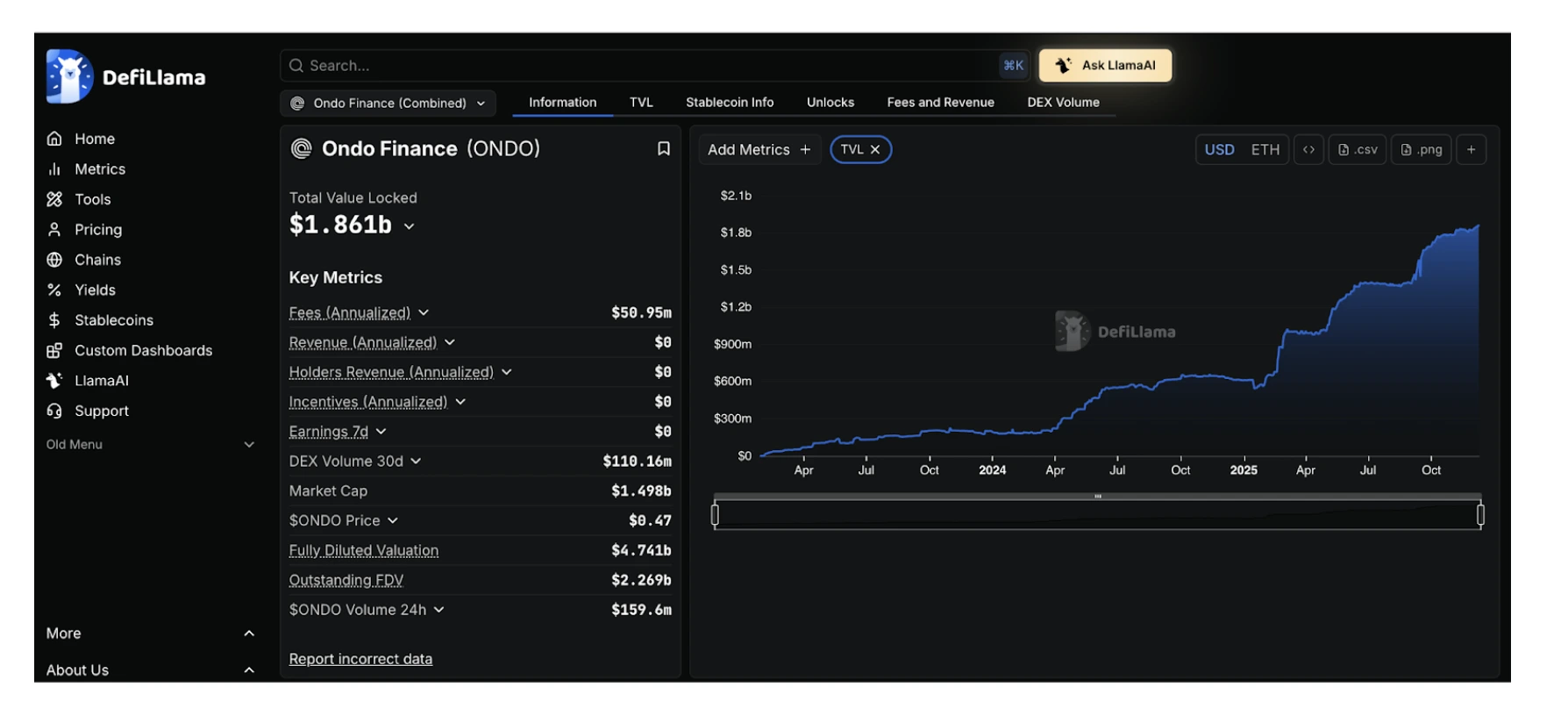
TVL milestones: A Ripple press release notes that Ondo became the first tokenized Treasury platform to pass 600 million dollars in total value locked. Later Ondo moved above 1 billion dollars, with growth of about 57% over a thirty-day period at one stage.
Market share in tokenized Treasuries:Reports estimate that tokenized US Treasuries reached around four billion dollars in mid-2025. Ondo’s one billion dollar TVL placed the project close to one quarter of the entire segment.
Product set and supported chains: Ondo offers products such as OUSG and USDY that hold short-term Treasuries and similar instruments while issuing tokens across multiple networks. Ripple’s announcement confirms that Ondo deployed its Treasury product on the XRP Ledger, adding to existing support on Ethereum and other chains.
Institutional focus: Press materials highlight that Ondo targets regulated institutions seeking familiar assets with on-chain settlement and daily interest accrual, rather than solely crypto-native collateral.
Ondo enters 2026 as a core player in real-asset tokenization, especially for Treasury-backed products. The final project in this list shifts back to artificial intelligence, with a network that treats AI models as an open commodity.
7. Bittensor – The Marketplace for Decentralized AI Models
Bittensor builds a network where independent teams train AI models and compete for rewards. The system organizes work into subnets, each with its own task and incentive logic. Miners provide model outputs, validators score the results, and TAO emissions move toward the most useful models.
This approach creates a live marketplace for intelligence.
Bittensor’s key points for 2026
Subnet expansion: Bankless and other analyses report that Bittensor moved from a few dozen subnets to more than fifty active subnets on mainnet in 2024, after the team raised the subnet limit several times. By early June 2025, data from Taostats, cited across media outlets, shows a new record with about 118 active subnets.
Economic scale: TaoRevenue, an analytics site that tracks the network, reports about 55,137 TAO of inflow over thirty days, valued at nearly $14.4 million at recent prices. That figure implies roughly 1,800 TAO and about $480,000 of inflow per day across subnets, although individual subnet profitability varies.
High-earning subnets: 51 subnets alone have reached more than $4 million in annual recurring revenue, with around 51 miners on that subnet earning over 270 TAO per day in total.
Bittensor enters 2026 with a growing set of AI-focused subnets, visible on-chain revenue, and a governance model that ties token rewards to model performance.
The Road Ahead for Crypto, AI, and Tokenized Assets in 2026
A diverse mix of networks now shows real traction with measurable usage, revenue, and adoption across multiple sectors. Solana strengthens its position in high-throughput consumer activity.
Chainlink supports banks and institutions that rely on secure data and cross-chain connectivity.
Celestia powers modular ecosystems that scale through customizable rollups. Sui grows its role in fast-settlement consumer applications. R
ender Network supports graphics and AI workloads through a distributed GPU market.
Ondo Finance expands tokenized Treasuries for regulated users.
Bittensor builds a competitive marketplace for intelligence with subnets that reward applicable models.
Together, these seven projects form a group of networks that develop fundamental tools, meet real demand, and create real value. Their progress sets the foundation for the next phase of growth across crypto, finance, and artificial intelligence through 2026 and beyond.
Which of these projects focuses most on institutional adoption?
Chainlink and Ondo Finance show the strongest institutional orientation, with partnerships across banking, custody, settlement, and tokenized asset markets.
What role does AI play in this group of projects?
Bittensor and Render Network provide decentralized compute and model incentives that support machine learning, with visible workload metrics and active contributors.
How does modular design help blockchain networks grow?
Celestia separates data availability from execution, which lowers costs for rollups and enables teams to launch customized chains that do not require new validator sets.
Which network showed the fastest growth in consumer activity?
Solana reported rising throughput, low fees, and growing mobile adoption, which helped the network capture strong demand from consumer-facing applications.
Disclaimer:
The information provided in this article is for informational purposes only. It is not intended to be, nor should it be construed as, financial advice. We do not make any warranties regarding the completeness, reliability, or accuracy of this information. All investments involve risk, and past performance does not guarantee future results. We recommend consulting a financial advisor before making any investment decisions.
Dr. Lorena Nessi is an award-winning journalist and media technology expert with 15 years of experience in digital culture and communication. Based in Oxfordshire, UK, she combines academic insight with hands-on media practice.
She holds a PhD in Communication, Sociology, and Digital Cultures, and an MA in Globalization, Identity, and Technology.
Lorena has taught at Fairleigh Dickinson University, Nottingham Trent University, and the University of Oxford. She is a former producer for the BBC in London, with additional experience creating television content in Mexico and Japan.
Her research focuses on digital cultures, social media, technology, capitalism, and the societal impact of blockchain innovation.
She has written extensively on digital media and emerging technologies, with her work featured in both academic and media platforms. Her Web3 expertise explores how blockchain technologies shape culture, economics, and decentralized systems.
Outside of work, Lorena enjoys reading science fiction, playing strategic board games, traveling, and chasing adventures that get her heart racing. A perfect day ends with a relaxing spa and a good family meal.


 Easy
Easy