Coinbase, Robinhood and others go dark after huge AWS outage. Here’s what happened and why your crypto funds remain safe. | Credit: CCN.com
Share
Key Takeaways
Amazon Web Services (AWS) suffered one of its largest disruptions in years, briefly taking down major apps like Coinbase, Robinhood, Reddit, MetaMask.
Despite the downtime, no customer funds were lost or compromised.
Crypto platforms like Coinbase and Robinhood confirmed that assets are stored in secure offline wallets, and only front-end access and transactions were affected.
The event highlights the need for multi-cloud, hybrid, and decentralized hosting strategies, ensuring that no single outage can freeze global operations.
On a quiet Monday morning (Oct. 20), what began as a routine cloud maintenance cycle quickly spiraled into one of the largest internet disruptions of the year.
Amazon Web Services (AWS), the cloud backbone powering a significant share of the modern internet, went down, taking with it some of the world’s most popular apps and financial platforms.
Within minutes, users across the globe reported being locked out of their accounts on Coinbase, Robinhood, MetaMask, Reddit, and Snapchat, while others found payment apps like Venmo and gaming platforms like Roblox and Fortnite unresponsive. Even Amazon’s own services, from Prime Video to Alexa, felt the impact.
Just days later, Microsoft suffered its own massive outage, disrupting Azure, Microsoft 365, and Xbox Live, further underscoring how fragile and centralized the web has become.
Together, the two incidents served as a sobering reminder of our dependence on a handful of cloud giants — and the growing call for more decentralized, resilient infrastructure.
New Trending Crypto Wallet Offers
Sponsored
Disclosure
We sometimes use affiliate links in our content, when clicking on those we might receive a commission at no extra cost to you. By using this website you agree to our terms and conditions and privacy policy.
AWS Outage Sparks Chaos Across Crypto and Finance Apps
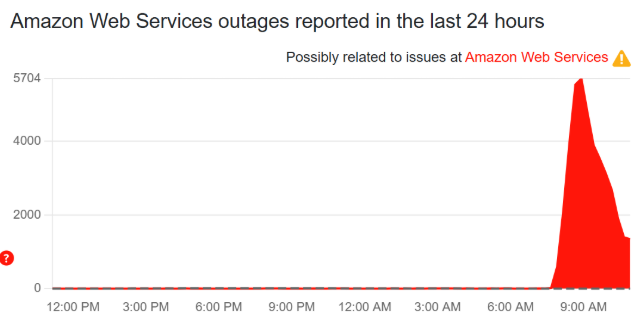
The outage began before dawn in the U.S. East Coast, spreading rapidly as web traffic rerouted through strained networks. Reports flooded into Downdetector, a popular outage-tracking site, showing over 4 million incidents globally.
At its peak, Snapchat logged more than 22,000 user reports, while Roblox exceeded 12,000. Financial platforms, including Coinbase, Robinhood, and Chime, all reported connectivity issues tied directly to AWS. Even Signal, the encrypted messaging app, confirmed downtime.
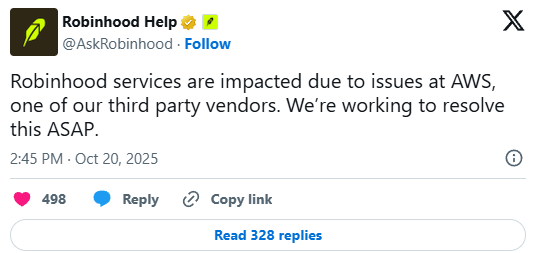
Robinhood announced the outage on X. | Credit: Robinhood Help X profile
For nearly three hours, vast corners of the web went dark. AWS later stated that “most requests should now be succeeding,” and that the company was working through a backlog of delayed operations. By mid-morning, systems were showing “significant signs of recovery.”
But for millions of users, especially those holding or trading crypto, the disruption reignited familiar anxieties: Is my money safe? Can I still trade? How could a single outage knock out so many platforms at once?
Platforms in Crypto & Finance Hit by the Amazon Web Services (AWS) Outage
Amazon Web Services’ (AWS) massive outage triggered connectivity breakdowns for numerous crypto and financial apps.
Here’s a breakdown of the major platforms that went down or experienced delays:
Coinbase: The leading U.S. crypto exchange faced login errors, delayed order executions, and failed withdrawals. Users couldn’t access balances or trade for several hours, though funds remained safe in offline storage.
Robinhood: Trading and API systems were impacted, causing temporary halts in crypto and stock transactions. Users reported delayed confirmations and “service unavailable” errors during the peak of the outage.
Venmo: The PayPal-owned payment app experienced slow or failed money transfers and login issues as AWS services powering its backend went offline.
Chime: The neobank reported user access problems and downtime in app connectivity, preventing some from checking balances or sending payments.
Lloyds Bank & Bank of Scotland (UK): Both saw online banking disruptions linked to AWS server issues, showing how far the impact reached across global finance.
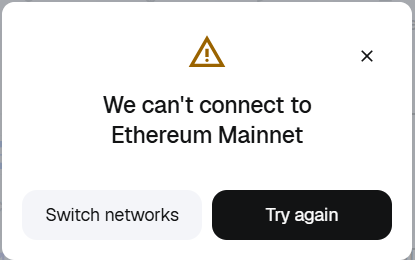
MetaMask: The platform has been showing some users empty or missing balances because a service provider that the wallet relies on to collect data from different blockchains experienced outages.
MetaMask showed empty balances to its users. | Credit: MetaMask
Are User Funds Safe on Coinbase or Robinhood?
Whenever crypto exchanges go down, whether due to a system overload, cyberattack, or infrastructure outage, users’ first thought is usually: Did I lose my funds?
The good news: Yes, your funds are safe.
Here’s why:
Coinbase, Robinhood, and most regulated trading platforms store customer assets in secure offline (cold) wallets, disconnected from the internet and unaffected by real-time outages.
Even when a website or app becomes inaccessible, the actual assets, whether in crypto or fiat, remain intact and properly accounted for in internal ledgers.
Outages like this affect front-end access and transaction execution, not the underlying asset custody.
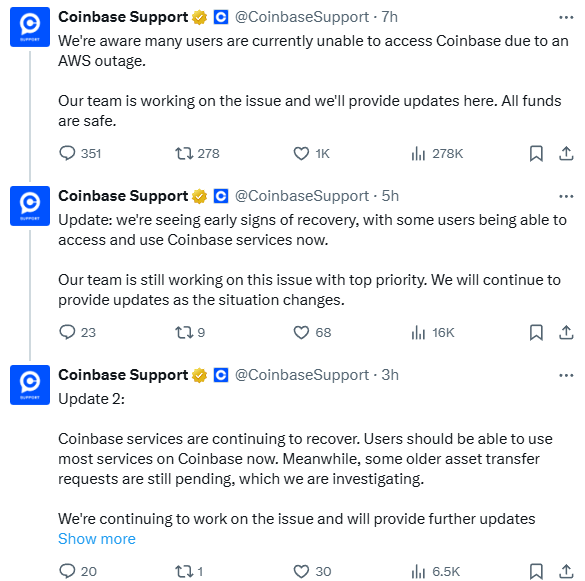
Coinbase posted updates on its status page during the event, noting that trades, deposits, and withdrawals were temporarily delayed, but user balances remained secure.
Robinhood issued similar reassurance, emphasizing that no funds were at risk.
Still, users faced frozen dashboards, stuck transactions, and delayed market orders, not ideal in a volatile trading environment.
Can You Still Withdraw, Deposit, or Trade Crypto During AWS Outage?
In most cases, no, not while the outage is active.
Because AWS hosts both front-end web interfaces and the back-end computing power that connects crypto exchanges to blockchain nodes, a full-scale AWS outage means transaction processing halts.
Delayed confirmations for deposits and withdrawals.
It’s similar to your bank’s online system going offline: the money is there, but you can’t access it until the systems reboot.
Coinbase, for example, relies heavily on AWS to scale server loads during market spikes. If AWS goes down, order books freeze, and API integrations (the ones used by traders and bots) stop responding.
This isn’t a vulnerability unique to crypto. Payment platforms like Venmo, social media sites like Reddit, and even gaming ecosystems like Roblox experienced identical issues. The outage underscores a key reality of our digital age: when AWS sneezes, the internet catches a cold.
Why Are Crypto Platforms Relying on Centralized Cloud Providers?
Cryptocurrency is built on decentralization, the idea that no single point of failure should be able to cripple an ecosystem.
Yet, ironically, many of the world’s largest crypto platforms depend on highly centralized cloud infrastructures like AWS.
There are several reasons for this:
Speed to market: Setting up your own data centers takes years; AWS lets startups scale globally within days.
Security and compliance: AWS provides built-in compliance frameworks and cybersecurity layers that satisfy regulators and auditors.
Cost efficiency: Renting resources on demand is cheaper than maintaining physical infrastructure that might sit idle.
However, the trade-off is stark: a single AWS outage can simultaneously knock out dozens of “decentralized” platforms.
This incident highlights the irony that even as blockchain networks remain resilient, the gateways to access them, the exchanges, wallets, and apps, remain centralized choke points.
On-chain performance analysis. | Credit: @SurfPilot on X
SurfCopilot, highlighting the AWS outage, said it “Exposed crypto’s hidden dependencies. Base lost 25% throughput when its AWS-hosted sequencer went down, while Arbitrum and Optimism stayed fully operational on multi-cloud setups. Decentralization proved to be real resilience.”
AltcoinPsycho on X added, “Gotta love seeing 95% of crypto down because of an AWS outage. Very decentralized – great work lads”.
The Ripple Effect: Who Else Was Hit By the AWS Outage
Beyond crypto platforms, the outage reverberated across multiple industries.
Social and messaging: Snapchat, Reddit, and Signal experienced widespread downtime.
Gaming: Roblox, Fortnite, Clash Royale, and Clash of Clans were knocked offline or suffered latency.
Finance: Coinbase, Robinhood, Chime, and even banking systems like Lloyds and Bank of Scotland in the UK reported issues.
Telecom: Vodafone and BT also appeared on outage trackers.
Government: The UK’s tax and customs authority, HMRC, faced disruptions.
Coinbase updated users on outage developments. | Credit: Coinbase Support X profile
Even Amazon wasn’t immune, its own retail website, Prime Video, and Alexa smart assistant temporarily malfunctioned.
The magnitude of this outage mirrors last year’s CrowdStrike malfunction, which disrupted systems across airports and hospitals worldwide. Both incidents remind us that our digital society rests on a fragile, shared foundation.
How Can Crypto Exchanges Prevent Future Outages?
To build resilience, crypto platforms need to move beyond a single-point dependency model.
Here’s how:
Multi-cloud strategies: Exchanges can distribute their infrastructure across multiple cloud providers, for instance, AWS, Google Cloud, and Azure, so that an outage in one doesn’t paralyze the system.
Hybrid infrastructure: Maintaining some on-premises servers alongside cloud environments ensures mission-critical operations can continue independently.
Edge computing and regional redundancy: By hosting regional nodes closer to users, platforms can reduce latency and isolate failures geographically.
Decentralized hosting innovations: Projects like Filecoin, Akash Network, and Sia are developing decentralized cloud solutions that could one day host exchange data in a distributed, peer-to-peer way, minimizing central dependency.
Transparent incident communication: Users panic most when left in the dark. Exchanges that issue clear, real-time updates during outages (as Coinbase did) retain trust even when systems falter.
What the AWS Outage Teaches About the Internet Itself
The AWS blackout was a technological wake-up call. It wasn’t a cyberattack, and it wasn’t the end of the internet. But it revealed something profound: the modern web, for all its complexity, remains fragilely centralized.
From crypto exchanges to social apps, the world’s digital backbone rests on just a few providers. And while Amazon, Microsoft, and Google have built extraordinary infrastructures, the concentration of power creates a systemic risk: one outage, millions affected.
For crypto enthusiasts, it’s an uncomfortable truth. The dream of decentralization is alive on the blockchain, but in practice, most of the ecosystem still leans on the same cloud-based pillars that support every other digital business.
What Exactly Is AWS?
Amazon Web Services (AWS) is a global infrastructure that provides cloud computing, on-demand servers, storage, and networking, to companies, governments, and startups.
Instead of maintaining their own physical servers, businesses rent computing power from AWS. This flexibility accelerates innovation but also creates dependency risk. If AWS goes down, every client running on it feels the pain simultaneously.
Amazon Web Services outages reported in the last 24 hours. | Credit: Newsweek
AWS competes primarily with Microsoft Azure and Google Cloud, though Amazon holds the largest market share.
Microsoft Outage Highlights Risks of Centralized Cloud Systems
The global Microsoft outage on Oct. 29, 2025 temporarily disrupted Azure, Microsoft 365, and Xbox Live, along with many companies that rely on Microsoft’s cloud infrastructure. The issue was traced to a configuration error in Azure’s Front Door network that caused widespread connectivity failures.
So far, no major crypto or blockchain projects have reported being directly affected, but the incident sparked renewed debate about centralization risks. When a single cloud provider hosts a large share of global infrastructure, even a small internal error can ripple across industries.
Blockchain technology could help reduce such risks. Its decentralized design distributes control and data across many nodes, preventing single points of failure. While blockchain alone can’t replace cloud platforms like Azure or AWS, integrating decentralized storage and validation layers could make future systems more resilient.
The outage serves as a reminder: the internet’s backbone is still too centralized, and a hybrid approach, combining cloud efficiency with blockchain’s decentralization, may be the key to stronger digital infrastructure.
Looking Ahead: Building a More Resilient Crypto Future
If there’s a silver lining, it’s that outages like this force innovation. Crypto companies are already experimenting with multi-cloud setups, distributed data storage, and decentralized hosting.
Some exchanges are developing “failover” protocols, automatic systems that reroute trading operations to alternate servers in real time. Others are exploring edge computing to bring portions of the network closer to users, ensuring that even if a central provider falters, localized systems stay online.
The endgame is clear: a robust, fault-tolerant digital economy where users can access funds and execute trades even when the biggest cloud in the sky goes dark.
Until then, the AWS outage serves as a cautionary tale, not just for crypto, but for every sector. The internet, vast as it seems, is still built on fragile interconnections.
Conclusion
The AWS outage that silenced Coinbase, Robinhood, and a host of global platforms was more than a temporary inconvenience, it was a reminder of our shared digital vulnerability.
User funds were safe, yes. Systems recovered, yes. But the lesson remains urgent: even decentralized finance depends on centralized infrastructure.
To truly secure the future of crypto and the internet at large resilience must be built into every layer of technology. Because in the end, no matter how advanced our systems become, it only takes one outage to remind us how connected and how fragile our digital world really is.
The outage was triggered by an issue in one of Amazon Web Services’ internal networking systems that controls a key database product. According to engineers, it was not a cyberattack but a technical fault that disrupted server communication across regions. AWS engineers isolated the problem and began recovery within hours, restoring most services by mid-morning.
Was my money or crypto at risk during the outage?
No. User funds on platforms like Coinbase and Robinhood remained completely safe. While users may have been temporarily unable to log in, trade, or view balances, actual assets are stored securely in offline (cold) wallets and protected by multi-layered custody systems that aren’t affected by short-term cloud outages.
Why did so many websites go down at once?
Because AWS is one of the largest cloud providers in the world, powering a huge portion of the internet, from startups to global corporations. When its infrastructure experiences a failure, millions of dependent systems can be affected simultaneously. This interconnectedness highlights how a single point of failure can ripple across industries.
Could I trade, deposit, or withdraw crypto during the outage?
Not reliably. Most crypto platforms paused or delayed transactions and API requests during the disruption. Orders placed right before the outage were queued and later executed or canceled once systems recovered. While access was limited, user assets remained safe and verifiable.
Disclaimer:
The information provided in this article is for informational purposes only. It is not intended to be, nor should it be construed as, financial advice. We do not make any warranties regarding the completeness, reliability, or accuracy of this information. All investments involve risk, and past performance does not guarantee future results. We recommend consulting a financial advisor before making any investment decisions.
Giuseppe Ciccomascolo began his career as an investigative journalist in Italy, where he contributed to both local and national newspapers, focusing on various financial sectors.
Upon relocating to London, he worked as an analyst for Fitch's CapitalStructure and later as a Senior Reporter for Alliance News. In 2017, Giuseppe transitioned to covering cryptocurrency-related news, producing documentaries and articles on Bitcoin and other emerging digital currencies. He also played a pivotal role in establishing the academy for a cryptocurrency exchange website. Crypto remained his primary area of interest throughout his tenure as a writer for ThirdFloor.


 Easy
Easy