Paul Tudor Jones says Bitcoin remains the best inflation hedge but warns quantum computing and cyber warfare could threaten its long-term security. | Credit: CCN.com
Share
Key Takeaways
Paul Tudor Jones called Bitcoin “unequivocally the best inflation hedge.”
He warned that quantum computing and cyber warfare could eventually threaten Bitcoin security.
Jones believes the AI-driven market rally still has another one to two years left.
The billionaire investor compared today’s AI boom to the internet boom of the 1990s.
Veteran hedge fund manager Paul Tudor Jones has once again reignited debate around Bitcoin’s long-term role in the global financial system, calling the cryptocurrency “unequivocally the best inflation hedge that there is” while simultaneously warning that quantum computing and cyber warfare could pose existential threats to the network in the decades ahead.
The comments came during a wide-ranging interview and podcast appearance that touched on macro markets, artificial intelligence, the future of investing, and Bitcoin’s evolving place in institutional portfolios.
Jones, the billionaire founder of Tudor Investment Corporation and one of the most respected macro traders of the last half century, has remained one of Wall Street’s most influential Bitcoin supporters since first publicly embracing the asset in 2020.
For crypto investors, however, the significance of his latest remarks lies not only in his continued endorsement of Bitcoin as a hedge against inflation, but also in his renewed focus on the technological risks that could eventually challenge the security assumptions underpinning the world’s largest cryptocurrency.
Why Paul Tudor Jones Believes Bitcoin Is the Best Inflation Hedge
Jones’ latest endorsement of Bitcoin reinforces a thesis he has championed for years: that scarce digital assets are uniquely positioned to protect wealth in an era of aggressive monetary expansion and fiscal instability.
Speaking during the interview, Jones reiterated that Bitcoin stands apart from traditional inflation hedges such as gold because of its fixed supply, portability, and growing global acceptance.
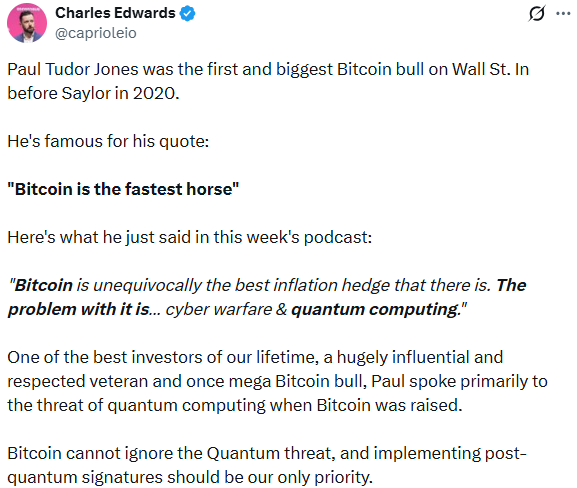
“Bitcoin is unequivocally the best inflation hedge that there is,” Jones said, according to remarks highlighted by Capriole Investments founder Charles Edwards.
The statement is particularly notable given Jones’ stature in global macro investing. Widely regarded as one of the greatest discretionary traders of all time, Jones built his reputation by correctly predicting and profiting from the 1987 Black Monday stock market crash and later shorting the Japanese asset bubble in the early 1990s.
His flagship fund has maintained a negative correlation to the S&P 500 over decades, a rare achievement that has cemented his reputation as one of finance’s elite risk managers.
Jones first publicly revealed his Bitcoin position in 2020 during the COVID-era monetary stimulus boom. At the time, central banks around the world were injecting unprecedented liquidity into markets while governments dramatically expanded spending.
In that environment, Jones famously described Bitcoin as “the fastest horse” in the race against inflation.
The phrase quickly became one of the defining institutional endorsements of Bitcoin during the previous bull cycle and helped legitimize crypto among hedge funds and professional investors.
While many institutional figures have since embraced Bitcoin, Jones was among the earliest major Wall Street macro investors to publicly allocate capital to the asset. His endorsement predated the aggressive corporate Bitcoin accumulation strategies later popularized by figures such as Michael Saylor.
Inflation Concerns Remain Central to Bitcoin’s Appeal
Jones’ renewed support for Bitcoin comes at a time when investors continue grappling with the long-term consequences of rising government debt, persistent fiscal deficits, and structurally higher inflation expectations.
Although inflation has cooled from the highs reached after the pandemic, many macro investors believe the global economy has entered a new era where price pressures may remain elevated relative to the ultra-low inflation environment that dominated the 2010s.
Bitcoin proponents argue that the cryptocurrency’s hard cap of 21 million coins makes it uniquely resistant to the monetary debasement that can weaken fiat currencies over time.
My guest today is Paul Tudor Jones (@ptj_official), one of the greatest macro traders of all time.
He correctly predicted the 1987 stock market crash and shorted the Japanese bubble in 1990. For over 40 years, his flagship fund has had a negative correlation to the S&P 500. 100%… pic.twitter.com/pLu1u1BIBL
Unlike central bank currencies, which can be expanded through monetary policy, Bitcoin’s issuance schedule is algorithmically fixed and becomes increasingly scarce through periodic halving events.
This scarcity narrative has become a cornerstone of institutional Bitcoin adoption.
Increasing institutional adoption through ETFs and treasury allocations
Independence from central bank monetary policy
Growing global liquidity and accessibility
Strong performance during periods of monetary expansion
Spot Bitcoin ETFs in the US have accelerated mainstream access to the asset, while sovereign wealth funds, pension managers, and public companies have increasingly explored Bitcoin exposure as part of diversified treasury and portfolio strategies.
Jones’ comments may further reinforce confidence among institutional allocators who view Bitcoin as a long-term macro hedge rather than merely a speculative technology trade.
Paul Tudor Jones Warns Bitcoin Faces Quantum Computing Risks
Potential risks posed by advanced quantum computing include:
The ability to crack private keys faster than classical computers
Weakening trust in blockchain security infrastructure
Increasing the sophistication of cyber warfare attacks
Forcing networks to migrate toward post-quantum cryptography
Despite his bullishness, Jones also delivered a stark warning about what he sees as Bitcoin’s greatest long-term vulnerability: quantum computing.
“The problem with it is… cyber warfare and quantum computing,” Jones said.
The concern centers around the possibility that sufficiently advanced quantum computers could eventually break the cryptographic systems used to secure Bitcoin wallets and transactions.
Bitcoin currently relies on elliptic curve cryptography, which is considered secure against classical computers. However, quantum machines capable of running algorithms such as Shor’s algorithm at scale could theoretically crack private keys far more efficiently than traditional computing systems.
If that became possible, attackers might gain the ability to compromise wallets, forge signatures, or undermine confidence in the broader Bitcoin network.
For years, quantum computing risks have largely been viewed as distant theoretical concerns rather than immediate threats. However, rapid advances in artificial intelligence and computing power have pushed the issue further into mainstream discussion.
Bitcoin Developers Urged to Prioritize Quantum Security Upgrades
Edwards argued that Bitcoin developers and the broader crypto industry should prioritize post-quantum cryptographic upgrades.
Crypto community reacts to Tudor Jones words. | Credit: Charles Edwards X profile
“Bitcoin cannot ignore the quantum threat, and implementing post-quantum signatures should be our only priority,” Edwards wrote.
Researchers within the Bitcoin ecosystem have increasingly explored potential migration paths toward quantum-resistant cryptography, though such changes would likely require extensive coordination and consensus across the network.
Transitioning Bitcoin to post-quantum security standards would not be simple.
Any major cryptographic overhaul would involve technical, governance, and compatibility challenges, particularly given Bitcoin’s conservative development culture and emphasis on minimizing protocol changes.
Still, Jones’ remarks underscore a growing recognition that technological risks may eventually become as important to Bitcoin’s future as monetary policy and adoption trends.
Paul Tudor Jones Says the AI Bull Market Still Has Room to Run
Jones’ current AI market thesis includes several major themes:
AI could trigger a multi-year productivity boom
The current cycle resembles the internet expansion of the 1990s
Technology stocks may still have significant upside remaining
Market valuations could eventually become dangerously overheated
Severe corrections are likely after peak speculative conditions
Jones’ Bitcoin comments emerged within a broader discussion about financial markets and the artificial intelligence-driven investment boom currently powering global equities.
During a CNBC appearance, Jones said he believes the AI bull market still has room to run, comparing today’s environment to the transformative technology cycles that accompanied the rise of Microsoft in the 1980s and the commercialization of the internet in the mid-1990s.
“I kind of think Claude, January of this year, would be the equivalent of when Microsoft came out in ’81,” Jones said.
He also compared the current phase of AI development to 1995, when the launch of Windows 95 helped accelerate mass internet adoption and triggered years of productivity gains.
“Those were both the beginning of productivity miracles that lasted four to five and a half years,” Jones explained. “We’re kind of, I’d say, 50 or 60%. If I had to pick a period, we’ve got another year or two to run.”
The comments highlight Jones’ broader macro framework, which often relies on identifying historical parallels to understand current market cycles.
AI Boom Could End in “Breathtaking” Market Correction
The rapid rise of AI-linked equities has become one of the dominant themes in global markets over the past several years, driving enormous gains in semiconductor manufacturers, cloud computing firms, and generative AI developers.
Yet Jones also warned that speculative excesses could eventually produce severe corrections.
“Just imagine the stock market went up another 40%. The stock market GDP is going to probably be good lord 300%, 350%. You just know that there’ll be some … breathtaking kind of corrections,” he said.
Even so, Jones revealed that he has continued adding exposure to AI-related investments through diversified baskets of stocks.
Inside Paul Tudor Jones’ Macro Investing Philosophy and Daily Routine
Beyond the financial insights, the interview also offered a glimpse into the relentless discipline and energy that have defined Jones’ career.
Some of the habits and traits highlighted during the interview include:
Waking up at 2:30 AM daily to trade the London market open
Spending roughly two hours per day exercising
Taking evening walks with his wife as part of his routine
Traveling across the US chasing peak spring and fall scenery
Maintaining deep curiosity about markets, history, and technology even at 71 years old
According to investor and podcast host Patrick O’Shaughnessy, Jones still follows an intense daily schedule despite decades of success in global finance.
O’Shaughnessy described Jones as someone who has “lived five lifetimes in one,” adding that the veteran investor remains deeply passionate about both markets and life itself.
Key characteristics that continue to define Jones’ investing philosophy include:
Disciplined risk management during volatile market cycles
Constant search for asymmetric investment opportunities
Willingness to adapt to emerging technological trends
Long-term curiosity about transformational economic shifts
Even after decades at the top of Wall Street, Jones continues searching for historical analogies, emerging trends, and new market opportunities.
That same mindset may explain why he remains constructive on Bitcoin despite the volatility, regulatory uncertainty, and technological risks surrounding the asset class.
How Bitcoin’s Institutional Investment Narrative Continues to Grow
Jones’ latest comments reflect how Bitcoin’s narrative has matured among institutional investors.
In its early years, Bitcoin was often viewed primarily as a speculative experiment associated with retail traders and fringe internet communities.
Today, many of the world’s largest financial institutions offer crypto products, custody solutions, and research coverage.
At the same time, Bitcoin increasingly occupies a dual identity.
For some investors, it remains a high-beta technology asset tied closely to liquidity conditions and risk appetite. For others, it represents a long-term store of value designed to hedge against currency debasement and sovereign debt expansion.
Jones appears firmly aligned with the latter view.
Yet his warning about quantum computing highlights a crucial reality: Bitcoin’s future will depend not only on adoption and macroeconomics, but also on its ability to evolve technologically.
As artificial intelligence, cybersecurity, and computing capabilities advance, the crypto industry may face new security challenges that were barely imaginable when Bitcoin was first created in 2009.
For now, however, Jones still appears convinced that Bitcoin remains one of the strongest macro trades of the modern era.
His endorsement matters because it comes from a figure whose career has been defined by navigating paradigm shifts, identifying market dislocations, and understanding how technological and monetary transformations reshape global finance.
Whether Bitcoin ultimately fulfills its promise as digital gold or encounters new technological hurdles, Jones’ remarks demonstrate that the asset continues to command attention at the highest levels of institutional investing.
And for one of Wall Street’s most respected macro traders, the verdict remains clear: Bitcoin is still the “fastest horse” when it comes to protecting against inflation, even if the race ahead may include entirely new risks.
FAQs
Why does Paul Tudor Jones consider Bitcoin the best inflation hedge?
Jones believes Bitcoin’s fixed supply of 21 million coins makes it uniquely resistant to inflation and currency debasement, especially compared to fiat currencies that can be expanded through central bank monetary policy.
What risks did Paul Tudor Jones highlight for Bitcoin?
Jones warned that future advances in quantum computing and cyber warfare could eventually threaten Bitcoin’s cryptographic security, potentially allowing attackers to compromise wallets or forge transactions.
What is the quantum computing threat to Bitcoin?
Quantum computers could theoretically break the cryptographic algorithms securing Bitcoin wallets and transactions much faster than classical computers, forcing the network to adopt quantum-resistant security upgrades.
Has Bitcoin faced quantum computing threats before?
The threat has long been discussed in academic and crypto circles, but it has generally been viewed as a distant risk. However, recent advances in AI and computing power have made the issue more prominent.
Disclaimer:
The information provided in this article is for informational purposes only. It is not intended to be, nor should it be construed as, financial advice. We do not make any warranties regarding the completeness, reliability, or accuracy of this information. All investments involve risk, and past performance does not guarantee future results. We recommend consulting a financial advisor before making any investment decisions.
Giuseppe Ciccomascolo began his career as an investigative journalist in Italy, where he contributed to both local and national newspapers, focusing on various financial sectors.
Upon relocating to London, he worked as an analyst for Fitch's CapitalStructure and later as a Senior Reporter for Alliance News. In 2017, Giuseppe transitioned to covering cryptocurrency-related news, producing documentaries and articles on Bitcoin and other emerging digital currencies. He also played a pivotal role in establishing the academy for a cryptocurrency exchange website. Crypto remained his primary area of interest throughout his tenure as a writer for ThirdFloor.


 Easy
Easy