VanEck CEO Warns Quantum Computing Could Destroy Bitcoin — Will the Firm Walk Away and Flee to Zcash?
Share
Key Takeaways
VanEck Warning, CEO Jan van Eck cautions that quantum computing could destroy Bitcoin’s encryption, saying the firm may walk away soon.
BlackRock Concern, BlackRock’s Bitcoin ETF filing highlights quantum computing as a real threat to Bitcoin’s cryptography and long-term network security.
Zcash Advantage, Zcash attracts attention as a privacy coin exploring quantum-resistant cryptography, offering potential safety if Bitcoin fails to adapt.
Quantum Countdown, Experts warn Bitcoin must adopt quantum-resistant technology quickly, as advancing quantum computers could soon compromise existing encryption systems.
For years, Bitcoin’s biggest challenges were thought to come from regulation, volatility, and energy consumption. But now, a different kind of threat is emerging, quantum computing, and it’s catching the attention of some of the world’s largest asset managers.
In a recent interview with CNBC on November 23, 2025, Jan van Eck, CEO of global investment firm VanEck, issued a stark warning: “We will walk away from Bitcoin if we think the thesis is fundamentally broken.”
🚨 Bitcoin Worst Nightmare Is THIS! 🚨
“Ultimately, VanEck was here before Bitcoin, we will walk away from Bitcoin if we feel the thesis is fundamentally broken.” pic.twitter.com/FHnDez0kOn
His comments centered on two growing concerns, whether Bitcoin has enough encryption to withstand the coming era of quantum computing, and whether its lack of privacy could undermine its long-term use case.
VanEck: From Bitcoin Believer to Cautious Skeptic
VanEck has long been one of the more vocal institutional supporters of Bitcoin. The firm’s VanEck Bitcoin Trust (HODL) helped open the floodgates for mainstream exposure to digital assets. But van Eck’s recent remarks show a tone shift, one focused less on price and more on technological survival.
He questioned Bitcoin’s resilience in a post-quantum world, warning that quantum computers could one day break the cryptographic signatures that secure the Bitcoin network. Once that happens, the foundation of Bitcoin’s security, its elliptic-curve cryptography, could become vulnerable.
“If quantum machines can reverse engineer private keys or forge signatures, Bitcoin as we know it could be compromised,” van Eck explained.
That would allow attackers to fake transactions, steal coins, or rewrite portions of the blockchain, all of which would undermine Bitcoin’s integrity.
Quantum Threat 101: Why It Matters
To understand VanEck’s alarm, it helps to know what quantum computing does differently. Unlike traditional computers that use bits (0 or 1), quantum systems use qubits, which can represent multiple states at once. That gives them exponential power for solving certain types of mathematical problems, including the ones protecting cryptocurrencies.
Bitcoin relies on elliptic-curve cryptography (ECC), a mathematical structure that’s considered nearly impossible for classical computers to crack. But quantum computers running Shor’s algorithm could, in theory, break ECC in seconds once they reach sufficient scale, potentially exposing all Bitcoin addresses whose public keys have been revealed.
Although experts estimate this level of capability may still be 5 to 10 years away, VanEck’s concern is about the window of adaptation. Bitcoin’s decentralized nature means that upgrading its cryptography is slow and politically complex, requiring broad consensus across miners, developers, and node operators.
Why Zcash Is Suddenly in the Conversation
When asked about potential alternatives, van Eck pointed to Zcash (ZEC), a privacy-focused cryptocurrency that uses advanced cryptographic proofs known as zero-knowledge proofs (zk-SNARKs).
Unlike Bitcoin, where every transaction is publicly visible, Zcash allows users to shield addresses and transaction amounts, offering stronger privacy guarantees.
This privacy advantage, combined with ongoing research into quantum-resistant encryption schemes, is one reason van Eck mentioned that “some Bitcoin OGs are looking at Zcash” as a potential hedge.
For institutional investors who value privacy, Zcash could be seen as a technologically adaptive complement or even a contingency plan if Bitcoin’s core cryptography proves too slow to evolve.
BlackRock Raised the Same Flag Months Earlier
VanEck isn’t the first major firm to raise the quantum alarm. BlackRock, the world’s largest asset manager, quietly updated its iShares Bitcoin Trust (IBIT) filing with the U.S. Securities and Exchange Commission in May 2025 to include explicit references to quantum computing as a material risk factor.
In that amended prospectus, BlackRock warned that “future advances in quantum computing could compromise Bitcoin’s cryptography,” noting that the network might need a “broad consensus upgrade” to remain secure.
🧠 Warning In a recent update to its iShares Bitcoin Trust $IBIT ETF filing, BlackRock—the world’s largest asset manager—flagged quantum computing as a serious long-term risk to Bitcoin’s security. Specifically, they warned that:
“Quantum computing could render Bitcoin’s source…
— Global Contrarian Energy Construct 𓃵 🏹 ♨ 𓂀 (@BakkenShale) October 28, 2025
The addition wasn’t just legal boilerplate. It was a rare acknowledgment by a traditional finance giant that the long-term viability of Bitcoin’s cryptography is not guaranteed.
By formally listing quantum computing among potential risks, BlackRock gave institutional legitimacy to a concern that had previously circulated mostly in academic or crypto-developer circles.
The Clock Is Ticking for Quantum Safety
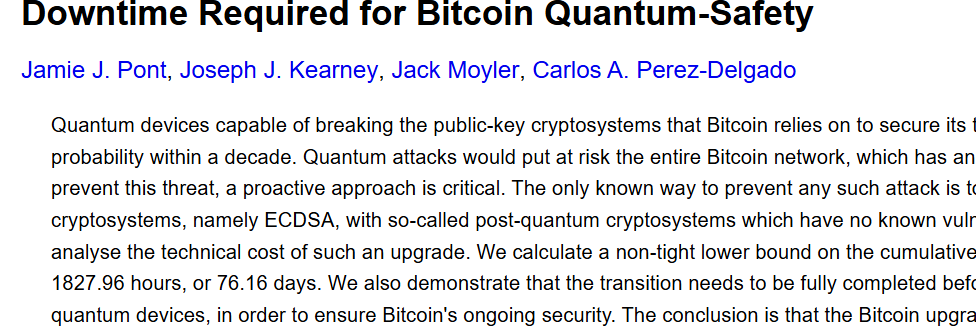
Academic research reinforces these concerns. A 2024 study titled “Downtime Required for Bitcoin Quantum-Safety” published on arXiv estimated that transitioning Bitcoin to quantum-resistant cryptography could take years of coordination, and that the process could involve temporary network downtime or reduced throughput.
Downtime required for Bitcoin quantum-safety | Source: arxiv
The problem isn’t just theoretical. If quantum breakthroughs come faster than expected, there could be a dangerous “uncertainty window” in which Bitcoin is vulnerable but not yet upgraded.
During that window, attackers with access to quantum power could harvest exposed public keys or pre-sign transactions, posing catastrophic risks to the network’s stability.
Institutional Anxiety and Market Implications
VanEck’s comments and BlackRock’s filing represent more than cautious footnotes; they signal a shift in how major institutions view crypto risk.
Until recently, institutional focus was dominated by regulatory clarity, custody infrastructure, and volatility management. Now, the conversation is expanding into technological sustainability, how secure these assets really are over the next decade.
If large firms begin to doubt Bitcoin’s long-term security, it could reduce institutional inflows, trigger portfolio reallocations, or accelerate research into post-quantum blockchain architectures.
For investors, it means Bitcoin is no longer just a question of “digital gold.” It’s a test of whether a decentralized system can adapt fast enough to survive the next computing revolution.
Quantum-Resistant Efforts Are Underway
Notably, Bitcoin developers are not ignoring the issue. The Bitcoin community has discussed post-quantum cryptography (PQC) options for years, such as lattice-based, hash-based, or multivariate schemes.
Today we publish a Bitcoin Improvement Proposal addressing incentive & safety issues for migrating the ecosystem to post quantum cryptography.
BIP timeframes are relative to a future point at which quantum computers are deemed a significant threat.https://t.co/xUuig5YWNE
However, any change to Bitcoin’s core signature algorithm (currently ECDSA) requires an overwhelming network consensus and extensive testing to avoid security regressions or centralization risks.
Projects like Quantum Resistant Ledger (QRL) and NTRU already use post-quantum cryptography, but Bitcoin’s sheer scale makes any similar transition exponentially harder.
Zcash and the Privacy-Security Nexus
Zcash’s potential advantage lies in both privacy and adaptability. Its developers have already explored integrating quantum-resistant primitives such as zk-STARKs, which could eventually remove trust assumptions from zero-knowledge proofs and withstand quantum attacks.
This dual focus on privacy and future-proof cryptography may be why institutional investors like VanEck are mentioning it as a possible haven if Bitcoin fails to evolve.
Still, Zcash faces its own hurdles, smaller market cap, limited adoption, and regulatory uncertainty around privacy coins. But in the context of quantum threat awareness, it’s gaining renewed relevance.
What Happens Next?
At present, VanEck hasn’t exited Bitcoin. Their stance is cautionary, not reactionary. The firm continues to operate Bitcoin investment products while signaling that its commitment depends on Bitcoin’s technological adaptability.
If Bitcoin developers introduce credible quantum-resistant upgrade paths, perhaps via soft forks or new address formats, the institutional fear may ease.
But the message is clear: the clock is ticking, and institutions are watching. The quantum era may still be years away, yet its economic impact is already unfolding today in the boardrooms of major asset managers.
What did Tom Lee say about the recent Bitcoin glitch?
Tom Lee blamed a sudden Bitcoin price drop on an exchange glitch and auto-deleveraging, not market panic, showing how tech flaws can still shake crypto markets.
Why is VanEck warning about quantum computing?
VanEck’s CEO warned that quantum computing could destroy Bitcoin’s encryption, saying the firm may walk away if Bitcoin fails to stay technologically secure.
What was BlackRock’s Bitcoin quantum warning?
In May 2025, BlackRock updated its Bitcoin ETF filing to include a formal warning that future quantum computers could break Bitcoin’s cryptography.
Why are investors mentioning Zcash now?
Zcash is gaining attention for its strong privacy and potential quantum-resistant tech, making it a possible safe haven if Bitcoin’s encryption ever fails.
Disclaimer:
The information provided in this article is for informational purposes only. It is not intended to be, nor should it be construed as, financial advice. We do not make any warranties regarding the completeness, reliability, or accuracy of this information. All investments involve risk, and past performance does not guarantee future results. We recommend consulting a financial advisor before making any investment decisions.
Onkar Singh has three years of experience as a digital finance content creator. Throughout his career, he has collaborated with various DeFi projects and crypto media outlets. In his leisure time, he enjoys fitness activities at the gym and watching movies across different genres. Balancing his professional and personal interests, Onkar continues to contribute to the digital finance landscape while pursuing his hobbies.


 Easy
Easy