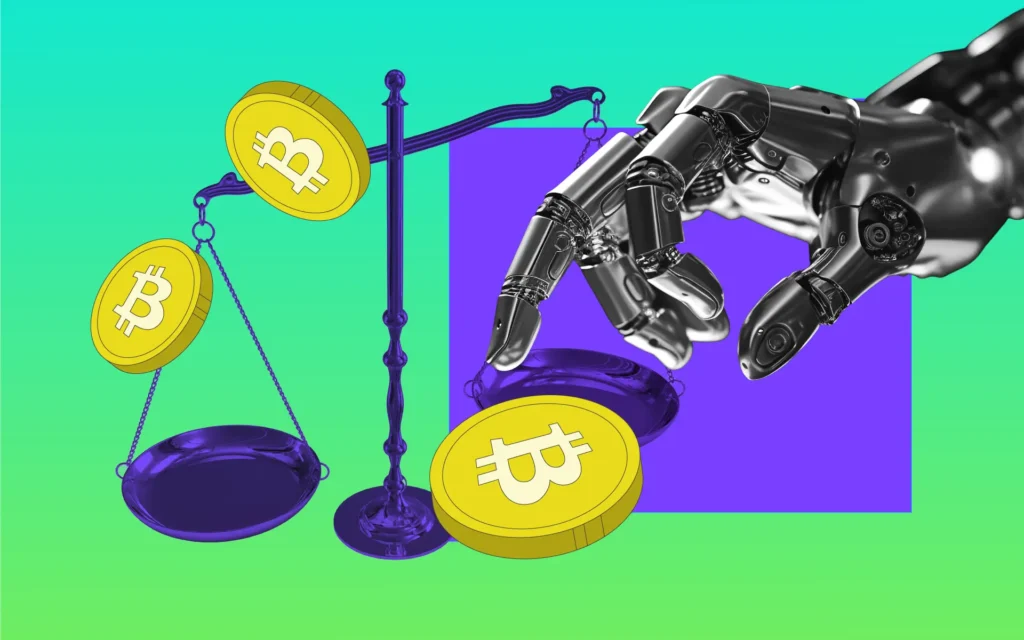
Whether AI is bullish for Bitcoin has divided opinion. | Source: CCN
Share
Key Takeaways
AI may accelerate capital flows into Bitcoin by increasing wealth concentration and demand for scarce assets.
Jordi Visser argues AI destroys traditional “moats,” making scarcity-based assets like Bitcoin more valuable.
Bitcoin could see a more sustained rally as institutional adoption strengthens its ownership base.
AI could accelerate capital flows into Bitcoin by eroding traditional competitive advantages and store-of-value functions, AI researcher Jordi Visser has claimed.
However, critics argue that the same technology may have the opposite effect.
The debate highlights a growing divide over how rapid advances in AI will reshape financial markets, corporate profits and the long-term role of decentralized assets.
Sponsored
Disclosure
We sometimes use affiliate links in our content, when clicking on those we might receive a commission at no extra cost to you. By using this website you agree to our terms and conditions and privacy policy.
Speaking on a recent episode of the Bankless podcast, investor Jordi Visser laid out a bullish case for Bitcoin, arguing that AI is amplifying structural economic shifts that ultimately favor scarce digital assets.
Visser framed Bitcoin as the endpoint of a long-running transition away from labor-driven income toward capital concentration, a process he said AI is accelerating.
“This is not a forecast. This is an inevitability… I’ll take Bitcoin as the inevitability.”
In his view, AI intensifies inequality by boosting productivity while reducing the need for labor, pushing more wealth into capital ownership.
That dynamic, he argued, increases demand for assets outside the traditional financial system—positioning Bitcoin as the default alternative.
“AI destroys every moat… except scarcity,” he said.
Visser’s central argument links AI directly to the erosion of traditional business models and investment theses.
He said AI is rapidly commoditizing software, intellectual property and other historically defensible “moats,” undermining corporate profitability over time.
“Every single thing that people own as a store of value gets disrupted by AI… So the question comes in… where does it go? It goes into store of value.”
According to Visser, as AI makes code and digital products abundant, investors will increasingly favor assets defined by genuine scarcity.
In that framework, Bitcoin stands apart.
“It is considered something that is scarce, and scarcity has value,” he said.
He argued markets have not yet fully repriced Bitcoin as a scarcity asset, suggesting a potential shift in perception could drive significant capital inflows.
Adding: “So the question is, when does Bitcoin get treated less like abundance and more like scarcity? And I believe that time is coming soon.”
A More Sustained Bitcoin Rally?
Visser also predicted that Bitcoin’s next climb would be more sustained, arguing that its ownership base has evolved in ways that could support a stronger price cycle.
He described recent years as a “distribution” phase, where early holders sold into demand from institutions, exchange-traded funds (ETFs) and long-term allocators.
“The next time it breaks higher, this time, if it does, when it does whatever the case is, I don’t think this one is going to stop as quickly,” he said.
“The next time it breaks higher… I don’t think this one is going to stop,” he added.
Tom Lee, Another AI Bull
Visser’s outlook aligns with other bullish voices linking AI, macro trends and Bitcoin adoption.
Fundstrat co-founder Tom Lee said he expects Bitcoin to reach $250,000 this year and potentially set new all-time highs, citing strong long-term adoption trends.
“We think Bitcoin will make a new high this year,” Lee said, adding that the asset’s trajectory depends on moving past prior deleveraging shocks.
He also argued that technological progress—including AI—will reinforce US leadership and accelerate blockchain adoption across financial services.
Other long-term advocates, including Strategy’s Michael Saylor and Pixelmatic CEO Samson Mow, have continued to project eventual seven-figure Bitcoin valuations.
AI Could Undermine Bitcoin
Not all analysts agree that AI strengthens Bitcoin’s case.
Thor Torrens, a technology entrepreneur and former adviser to Trump-aligned political efforts, argued that AI could limit Bitcoin’s upside by increasing transparency.
“Bitcoin is never going to $1,000,000 a coin,” Torrens said in a post on X, pointing to the cryptocurrency’s public ledger.
Kurt Robson is a London-based reporter at CCN, specialising in the fast-moving worlds of crypto and emerging technology. He began his career covering local news in Cornwall after graduating from Falmouth University with First Class Honours in Journalism. There, he cut his teeth on everything from council meetings to missing swans.
He quickly rose through the ranks to become a frontline journalist at several of the UK’s leading national newspapers. Over the years, he has interviewed musicians and celebrities, reported from courtrooms and crime scenes, and secured multiple front-page exclusives.
Following the upheaval of the COVID-19 pandemic, Kurt shifted his focus to technology journalism—just ahead of the AI boom. With a natural curiosity and a trained eye for emerging trends, he has found a new rhythm in reporting on innovation.
At CCN, Kurt's work focuses on the cutting edge of crypto, blockchain, AI, and the evolving digital world. Drawing on his background in people-first reporting and his deep interest in disruptive tech, Kurt delivers stories that are insightful, entertaining, and human-centric.