Charles Edwards says institutional investors are dumping Bitcoin again as spot ETF outflows hit $1.5 billion amid inflation fears and geopolitical uncertainty. | Credit: CCN.com
Share
Key Takeaways
Charles Edwards warns that quantum computing could depress Bitcoin price below $50,000 if the network does not address quantum issues.
His view is provocative but not universally shared; other leaders like Adam Back and Michael Saylor see the threat as distant or manageable.
Figures like Vitalik Buterin echo concerns about future quantum impacts, but with different timelines and contexts.
Quantum computing research has not yet produced machines capable of breaking Bitcoin, but the industry acknowledges the need for future-proof cryptographic design.
Bitcoin analyst Charles Edwards, known for a strong market cycle track record, recently warned that delays in addressing the emerging quantum computing threat could have serious implications for Bitcoin’s price and market confidence over the next few years.
Starting to think we will just need a huge bear market to wash out the idiots who think the Quantum threat to Bitcoin is a joke, and to incentive the maxis into taking action to upgrade the network. If We haven't deployed a fix by 2028, I expect Bitcoin will be sub $50K and…
His commentary has sparked debate within the crypto community about timelines, risk severity, and appropriate responses.
Who Is Charles Edwards and What Did He Say?
Charles Edwards is the founder of quantitative Bitcoin investment firm Capriole and has gained attention in crypto circles for his market cycle analysis. He has claimed a 77.8% accuracy score in capturing past Bitcoin cyclical tops and bottoms according to unbiased market consensus tracking.
This guy perfectly captured cyclical tops and bottoms in every cycle. https://t.co/txEXSblCJ8
In December 2025, Edwards raised concerns that quantum computing could pose an existential security challenge to Bitcoin’s current cryptographic protections and that failure to deploy quantum-resistant upgrades could pressure Bitcoin’s price significantly.
Specifically, Edwards has argued:
A quantum-capable computer may reach a level of capability that could break Bitcoin’s cryptography within the next few years, potentially as soon as 2026–2028.
If Bitcoin is not made quantum-resistant by that timeframe, the loss of investor confidence could lead to a prolonged bear market and price declines below $50,000.
He suggests a major bear market might be necessary to force the ecosystem to adopt quantum-secure technologies and that a fix should begin rolling out by 2026.
Importantly, Edwards’ warnings focus on confidence and market pressure, rather than asserting that quantum computers are currently breaking Bitcoin. He frames the issue as a future risk that the network should prepare for.
A quantum computer will break Bitcoin in just 2-9 years if we don't upgrade. With high probability in the 4-5 years range. This is the timeframe all quantum experts converge on. Don't believe the naysayers. We have already entered the Quantum Event Horizon: the frontier risk of a… pic.twitter.com/Alm939Ky7t
Bitcoin’s security relies heavily on elliptic-curve cryptography (ECDSA) and the SHA-256 hashing algorithm to secure transactions and wallets. These systems are extremely secure against today’s classical computers.
However, quantum computers, once sufficiently advanced and error-corrected, could run algorithms like Shor’s algorithm to break the underlying math that makes ECDSA safe, essentially deriving a private key from a public key much faster than conventional machines.
This would make it theoretically possible for an adversary to forge signatures and unauthorized transactions if they had access to the right hardware.
In neutral terms, cryptography research has shown that quantum attacks pose a long-term security challenge for many public-key systems, including those used widely in blockchain technologies.
Where Edwards’ Quantum Threat to Bitcoin View Fits Into Broader Expert Opinion
More Urgent Quantum Risk Views
Some figures in the crypto world take quantum risk seriously and argue for proactive upgrades:
Analyst Willy Woo recently urged Bitcoin holders to move funds from certain types of addresses to mitigate exposure to quantum vulnerabilities, a suggestion that has sparked technical debate about effectiveness.
Ethereum co-founder Vitalik Buterin has publicly outlined that quantum computing poses a 20% chance of becoming a threat to cryptographic systems before 2030, and argues for preparation now rather than reactive upgrades.
Vitalik Buterin Warns 20% Quantum Risk by 2030. | Source: @Vincebtc54999 on X
These views emphasize that preparatory work on post-quantum cryptography should begin well in advance of any theoretical breakthrough, given the time required for network upgrades.
Ray Dalio: The Macro and Institutional View
In his latest communications, Dalio remains a “rational skeptic.” While he admits Bitcoin has value as a diversifier, he views the current technical and regulatory landscape as a barrier to true institutional dominance.
RAY DALIO ON BITCOIN AND CRYPTO 🔥
During the recent podcast with Nikhil Kamath… Ray Dalio, founder of the world’s largest hedge fund shared his views on $BTC.
KEY POINTS: • Bitcoin is scarce but transactions are traceable & open to government interference • Dalio is… pic.twitter.com/8SRfWsgltT
The quantum “kill switch”: Dalio recently warned that Bitcoin could be “broken” by quantum computing. His concern isn’t just about a potential hack, but about the loss of confidence. He argues that if the underlying cryptography is even perceived as vulnerable, the “store of value” thesis collapses instantly for big-money players.
Central banks and neutrality: Dalio continues to argue that central banks will not adopt Bitcoin as a reserve asset. He cites two main reasons:
Transparency: He believes central banks and sovereign states require a level of privacy and control that a public ledger does not allow.
Tracking: He noted in November 2025 that Bitcoin is “too easy to track,” making it a poor tool for nations trying to bypass the hegemony of rival powers.
The “debt doom loop”: Despite these fears, Dalio recommended in late 2025 that individuals hold about 15% of their portfolio in “hard assets,” which he defines as a mix of Gold and Bitcoin. He views this as necessary protection against the devaluation of the US dollar as national debt surpasses $37 trillion.
Jameson Lopp: The Technical & Engineering View
Jameson Lopp, co-founder of Casa, provided a detailed technical response to the “Quantum Threat” on December 21, 2025. He shifts the conversation from “if” it can be broken to “how” the network must adapt.
No, quantum computers won't break Bitcoin in the near future. We'll keep observing their evolution.
Yet, making thoughtful changes to the protocol (and an unprecedented migration of funds) could easily take 5 to 10 years.
We should hope for the best, but prepare for the worst.
The 5–10 year migration: Lopp agrees that quantum computing is a long-term risk, but he emphasizes that it will not “crack” Bitcoin in the short term. He estimates that a full transition to quantum-resistant signatures would take the network 5 to 10 years to implement.
The “unprecedented migration”: Lopp’s biggest concern is the logistics of moving funds. He warns that a “post-quantum overhaul” would require an unprecedented migration of coins from old, vulnerable addresses (like those used by Satoshi) to new quantum-safe ones.
The Satoshi address proposal: Lopp has floated a controversial meta-discussion: freezing legacy addresses (P2PK) that are mathematically vulnerable to quantum discovery. He suggests a soft fork might be necessary to prevent a “quantum-supreme entity” from stealing early coins, though he admits this raises massive ethical questions about “immutability.”
Cautious optimism: Unlike Dalio’s “broken” scenario, Lopp views this as a high-stakes engineering challenge. His stance is: “Hold out the best hope, but prepare for the worst-case scenario.”
More Skeptical or Long-Term Views
Other respected figures in the crypto ecosystem take a more measured view on immediacy:
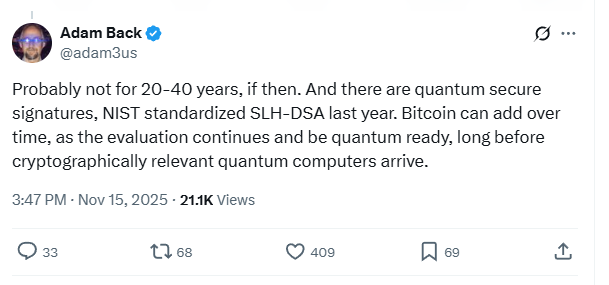
Adam Back, CEO of Blockstream and early Bitcoin developer, has argued that quantum computing risks are likely decades away and not an imminent problem for Bitcoin, cautioning against panic-driven protocol changes.
Quantum is not an immediate threat to Bitcoin, per Adam Back. | Source: @adam3us on X.
Cryptography pioneer Nick Szabo has suggested that legal, governance, and economic threats pose more immediate challenges to blockchain systems than quantum computing, which he sees as a long-term issue.
Nick Szabo warns Bitcoin is not safe from legal pressure. | Source: @NickSzabo4 on X.
Other industry observers place quantum-capable cryptanalysis much farther into the future, often beyond 2030, based on current progress in quantum hardware and the massive engineering hurdles that remain.
These views highlight that while quantum computing poses a theoretical risk, the practical timeline is contested.
Current State of Quantum Computers Explained
As of late 2025, quantum computers exist in early, noisy, and low-qubit forms. No public machine has demonstrated the ability to break Bitcoin’s cryptography. Realistically, breaking ECDSA on an actively used public key would require millions of stable, error-corrected qubits, far beyond current capabilities.
Institutions like the U.S. National Institute of Standards and Technology (NIST) have already published post-quantum cryptographic standards, indicating the long-term importance of quantum-resistant security, but adoption timelines for decentralized networks are complex.
Importantly, a quantum capable of cracking public-key signatures does not exist today; the threat is speculative based on projections of technological progress.
Technical and Governance Challenges of a Quantum Upgrade
Transitioning a global blockchain like Bitcoin to quantum-resistant cryptography is a monumental task. Key challenges include:
Consensus requirements: Bitcoin’s decentralized governance requires agreement from miners, developers, node operators, and economic actors to adopt a hard fork or protocol upgrade.
Wallet and key migration: Even with post-quantum cryptography in place, existing unspent outputs would need to be safely migrated to new quantum-resistant keys.
Network downtime risks: Some research suggests a full quantum upgrade could require coordinated downtime or complex transition paths.
These obstacles inform why many in the industry urge early planning, even if the threat timeline is uncertain.
How Quantum Computing Fears Could Impact Bitcoin Price and Investor Confidence
Edwards’ warning ties the quantum risk to market psychology and price pressure: if the community fails to act, erosion of confidence could weigh on Bitcoin price, a scenario he views as a potential catalyst for a large bear market.
By contrast:
Michael Saylor of Strategy has publicly downplayed near-term quantum risk, arguing that it could strengthen Bitcoin’s security posture through future upgrades and should not be viewed as fundamentally destructive.
Major asset managers like Grayscale have characterized quantum computing as a longer-term, manageable risk rather than an immediate valuation threat.
This illustrates that even among bullish crypto proponents, there is no singular consensus on how quantum threats should influence price expectations today.
What Bitcoin Developers and Protocol Engineers Are Doing
Bitcoin developers have discussed proposals like BIP-360 and other quantum-resistant mechanisms, but these ideas have not yet been adopted into the Bitcoin protocol. Developers typically emphasize that any upgrade must be carefully vetted, tested, and consensually adopted by the community.
Protocol upgrades are often debated extensively over years before implementation.
This is why voices like Edwards argue for earlier action, not because a quantum computer exists today, but because wide-scale testing and adoption can take years.
How Serious Is the Quantum Threat to Bitcoin?
Measuring the real quantum risk involves balancing two points:
Long-term technical risk: Cryptography experts agree that quantum computers could eventually break current public-key systems, including those used by Bitcoin, if sufficient qubit scale and error correction are achieved.
Uncertain timeline: Most credible forecasts still place impactful quantum capability beyond the immediate horizon, often 10–15+ years away, meaning urgency should be calibrated accordingly.
Thus, while Edwards emphasizes urgency and a specific 2026–2028 window, other experts highlight the speculative nature and technical hurdles that remain.
What does the “quantum threat” to Bitcoin actually mean?
The quantum threat refers to the possibility that sufficiently advanced quantum computers could one day break the cryptographic algorithms Bitcoin currently uses to secure private keys and authorize transactions. This risk is theoretical today, as no known quantum computer has the required scale or stability. However, cryptographers widely agree that public-key cryptography will eventually need quantum-resistant alternatives.
Is there evidence that quantum computers can break Bitcoin today?
No. As of now, there is no public or verified evidence that any quantum computer can break Bitcoin’s cryptography. Current quantum machines are limited in qubit count, error correction, and operational stability. The concern discussed by analysts is about future preparedness, not an active or imminent attack.
Why does Charles Edwards link quantum risk to Bitcoin’s price?
Charles Edwards argues that market confidence matters as much as technical reality. His view is that if investors believe Bitcoin is unprepared for a known long-term cryptographic risk, uncertainty alone could pressure price and liquidity, even before any technical breakthrough occurs. His warning focuses on sentiment, risk perception, and delayed upgrades, not a guaranteed technical failure.
Do all Bitcoin experts agree with this quantum risk timeline?
No. There is significant disagreement. Some figures argue Bitcoin should begin preparing now for quantum-resistant upgrades, while others believe the threat is decades away and does not justify urgent changes. This debate reflects uncertainty around quantum computing timelines, Bitcoin’s upgrade process, and how markets respond to perceived versus actual risks.
Disclaimer:
The information provided in this article is for informational purposes only. It is not intended to be, nor should it be construed as, financial advice. We do not make any warranties regarding the completeness, reliability, or accuracy of this information. All investments involve risk, and past performance does not guarantee future results. We recommend consulting a financial advisor before making any investment decisions.
Giuseppe Ciccomascolo began his career as an investigative journalist in Italy, where he contributed to both local and national newspapers, focusing on various financial sectors.
Upon relocating to London, he worked as an analyst for Fitch's CapitalStructure and later as a Senior Reporter for Alliance News. In 2017, Giuseppe transitioned to covering cryptocurrency-related news, producing documentaries and articles on Bitcoin and other emerging digital currencies. He also played a pivotal role in establishing the academy for a cryptocurrency exchange website. Crypto remained his primary area of interest throughout his tenure as a writer for ThirdFloor.


 Easy
Easy