Google Warns Quantum Computers Could Break Bitcoin and Ethereum Encryption in 9 Minutes — Are Your BTC and ETH at Risk?
Share
Key Takeaways
Bitcoin’s current security relies on ECDSA cryptography, which protects coin ownership through public–private key pairs.
Quantum computers could eventually break ECDSA by using algorithms like Shor’s to derive private keys from public keys, potentially enabling theft of funds.
More than 186 million Bitcoin UTXOs are currently vulnerable and must migrate to quantum-safe cryptographic systems to remain secure.
Even in an unrealistic best-case scenario where the entire network is used solely for migration, the process would still take at least 76 days of continuous block space.
Bitcoin is often described as one of the most secure financial networks ever created. Its security is built on strong cryptography, specifically, the Elliptic Curve Digital Signature Algorithm (ECDSA-256), which protects coin ownership and verifies transactions.
However, a new technological frontier could challenge that security model: quantum computing.
Researchers and cryptographers increasingly warn that powerful quantum computers could eventually break the mathematical assumptions that protect Bitcoin today. If that happens, attackers could potentially forge signatures, steal coins, or compromise the network’s integrity.
Recent research suggests the scale of the challenge is enormous. According to estimates, at least 186.7 million Bitcoin UTXOs (unspent transaction outputs) would need to migrate to post-quantum cryptography before quantum computers can break ECDSA.
Even under ideal conditions, that migration would take at least 76 days of full Bitcoin network capacity, making the timing and coordination of such an upgrade one of the most important long-term issues facing the protocol.
How Quantum Computers Could Break Bitcoin’s ECDSA Security
Bitcoin’s security relies heavily on cryptography that is extremely difficult for classical computers to break.
When someone owns Bitcoin, their funds are locked by a public–private key pair. The private key proves ownership, while the public key allows others to verify transactions.
Today, Bitcoin mainly uses ECDSA (Elliptic Curve Digital Signature Algorithm) for this process.
Bitcoin has at least 186.7 million UTXOs that need migrating to post-quantum cryptography before quantum computers break ECDSA-256. | Credit: Joseph Kearney X profile
The security of ECDSA depends on a mathematical problem called the elliptic curve discrete logarithm problem, which is extremely difficult for traditional computers to solve.
Public key: A visible cryptographic key used to verify transactions.
ECDSA signatures: Mathematical proofs that confirm a transaction was authorized by the private key.
Quantum computers, however, operate differently.
Using quantum algorithms such as Shor’s algorithm, sufficiently powerful quantum machines could solve these problems far faster than classical computers. That means a strong quantum computer could theoretically derive a private key from a public key, allowing an attacker to take control of funds.
Researchers often summarize the potential quantum threat to Bitcoin as follows:
Quantum computers can solve certain mathematical problems exponentially faster than classical machines.
ECDSA relies on one of these vulnerable problems (discrete logarithms).
Breaking ECDSA would allow attackers to forge digital signatures.
Forged signatures could let attackers spend coins they do not own.
This is not just a theoretical issue. Surveys of quantum computing experts estimate there is roughly a 31% probability that quantum computers capable of breaking current public-key cryptography could emerge within the next decade.
If that happened, Bitcoin would face a serious security threat.
Unlike banks or centralized financial services, Bitcoin cannot simply shut down systems and patch vulnerabilities. The cryptographic rules are embedded directly in the protocol, meaning any change requires a coordinated network-wide upgrade.
Why Bitcoin’s 186 Million UTXOs Must Migrate to Post-Quantum Cryptography
Making Bitcoin quantum-safe would require replacing current cryptographic systems with post-quantum cryptography, a class of cryptographic methods believed to resist quantum attacks.
Step 2: All existing Bitcoin funds must be moved from vulnerable addresses to new quantum-secure ones.
The second step is the real challenge.
Each UTXO (Unspent Transaction Output) represents a piece of Bitcoin that has not yet been spent, essentially the blockchain’s version of an account balance. Every time Bitcoin is sent, old UTXOs are consumed, and new ones are created.
Today, Bitcoin has more than 186 million UTXOs that still rely on cryptography vulnerable to quantum attacks.
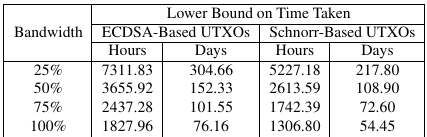
Lower bound on time taken. | Credit: Downtime Required for Bitcoin Quantum-Safety research paper
To upgrade them, each UTXO must be spent and recreated using a quantum-safe signature scheme. This means the network must process millions of migration transactions, competing with normal payments for block space.
In simple terms, the process would involve:
Spending an existing UTXO
Creating a new quantum-safe UTXO
Recording the upgrade transaction on the blockchain
However, Bitcoin’s capacity is limited:
Blocks are produced roughly every 10 minutes.
Each block can only include a limited number of transactions.
Upgrade transactions must compete with normal activity.
Because of these constraints, the migration cannot happen instantly.
Even under extremely optimistic assumptions, where every block is filled with upgrade transactions and no regular transactions occur, researchers estimate the process would still require at least 1,827.96 hours of network processing, or about 76.16 days of continuous block space.
In reality, the network cannot pause normal activity for months, meaning the transition would likely take significantly longer.
How Bitcoin Block Space Limits a Quantum-Safe Upgrade
Bitcoin’s block space is scarce. Each block can only include a limited number of transactions.
Because of this, upgrade transactions would need to coexist with everyday activities such as payments, exchange transfers, and Lightning channel openings.
Researchers describe this trade-off as network throttling.
If 100% of block space were dedicated to migration, the upgrade could theoretically finish in about 76 days.
But if the network allows normal transactions to continue, the process stretches significantly.
For example:
Network bandwidth used for migration
Estimated upgrade time
100% of block space
76 days
75% of block space
101 days
50% of block space
152 days
25% of block space
305 days
Even these numbers represent optimistic scenarios.
They assume perfect transaction packing, zero overhead, and immediate network coordination, conditions that rarely exist in practice.
In reality, the upgrade could take years depending on adoption rates and governance decisions.
When Could Quantum Computers Break Bitcoin Encryption?
Some researchers point to aggressive industry roadmaps from quantum hardware companies.
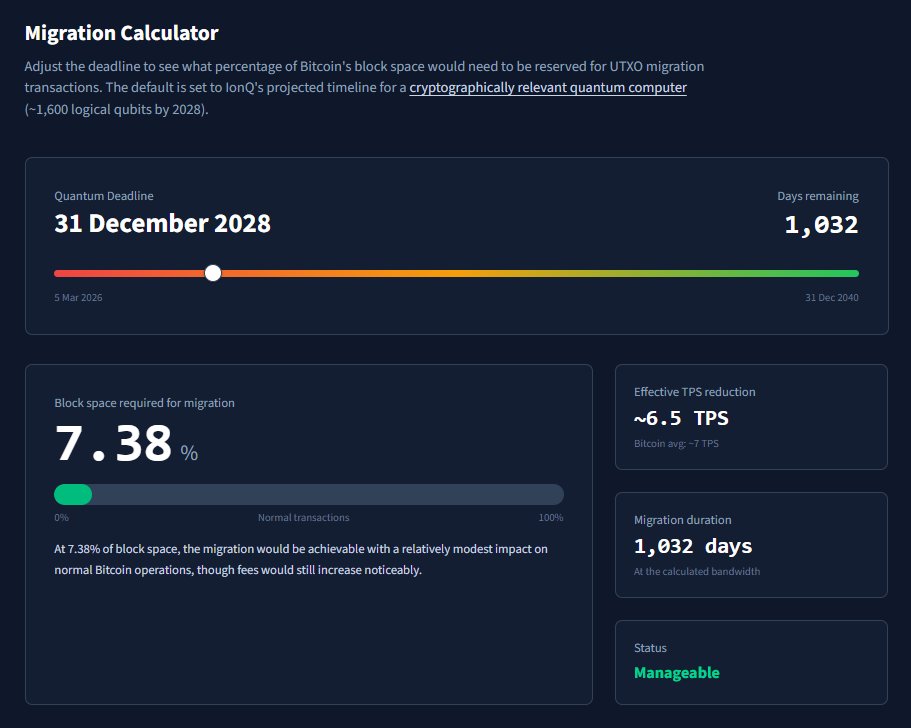
For example, IonQ has outlined plans to reach roughly 1,600 logical qubits by 2028.
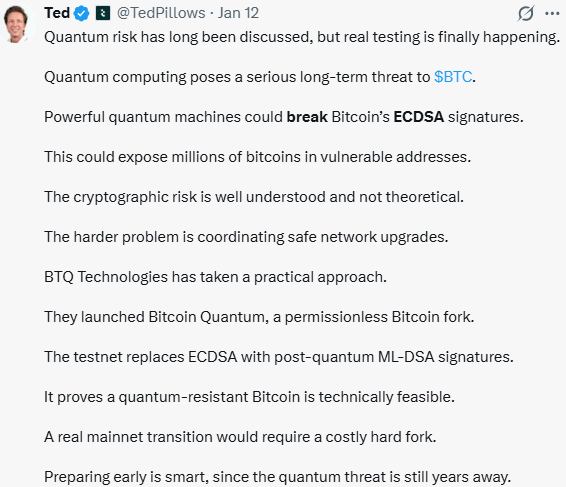
Quantum computing poses a serious threat to Bitcoin. | Credit: Ted Pillows X profile
While that does not guarantee immediate cryptographic breakthroughs, it illustrates the field’s rapid pace of development.
If quantum hardware reached the threshold needed to break ECDSA, the consequences could be severe.
Attackers could theoretically monitor the blockchain, identify exposed public keys, and derive private keys fast enough to steal funds before legitimate transactions confirm.
Researchers call this type of attack a “Just-In-Time” quantum attack, where a quantum computer derives the private key immediately after a transaction reveals the public key.
This means the network upgrade must be completed before quantum attacks become feasible, not after.
In other words, Bitcoin cannot wait until quantum computers arrive to start preparing.
Why Upgrading Bitcoin to Post-Quantum Security Will Take Years
Even if the technical solution were clear, deploying it across Bitcoin would still be difficult.
Bitcoin upgrades typically require years of debate, testing, and consensus-building among developers, miners, node operators, and the broader community.
The Segregated Witness (SegWit) upgrade, for example, took years of discussion before it was activated in 2017.
A quantum-safe migration is likely more complex because it affects every Bitcoin holder.
Key questions still remain unresolved, including:
Which post-quantum signature scheme should Bitcoin adopt.
Whether upgrades should occur through soft forks or hard forks.
How to incentivize users to migrate funds quickly.
How to handle lost coins or inactive wallets.
Without widespread participation, vulnerable UTXOs could remain exposed to quantum attacks.
What Is Post-Quantum Cryptography and How Could It Protect Bitcoin?
Post-quantum cryptography refers to cryptographic systems that are believed to resist both classical and quantum attacks.
Unlike ECDSA or RSA, which rely on factoring or discrete logarithm problems, post-quantum systems are based on different mathematical foundations.
However, integrating these systems into Bitcoin is not trivial.
Many post-quantum signatures are much larger, potentially significantly increasing transaction and block sizes.
This raises new design challenges around scalability, bandwidth, and storage.
Why Bitcoin Must Begin Its Quantum-Safe Upgrade Now
The research highlights a simple but important conclusion: the transition to quantum-safe cryptography cannot happen overnight.
Even under best-case assumptions, migrating the existing Bitcoin network would require months of dedicated blockchain capacity.
Given the time required to design, debate, and deploy protocol upgrades, preparation likely needs to begin years in advance.
The longer the community waits, the more block space must be dedicated to upgrading transactions to finish before a potential quantum deadline.
For example, if migration began immediately and had roughly 1,032 days until a quantum threat emerged, only about 7.4% of each block might need to be reserved for upgrade transactions.
But if migration is delayed by years, that percentage could rise dramatically, potentially overwhelming normal network activity.
Can Bitcoin Survive the Quantum Computing Era?
Quantum computing does not represent an immediate crisis for Bitcoin today. Current quantum machines remain far from the scale required to break modern cryptography.
However, the time required to upgrade the network means preparation cannot wait until the technology becomes practical.
Bitcoin has already demonstrated its ability to evolve through upgrades such as SegWit and Taproot, but quantum resistance may represent one of the protocol’s most complex challenges.
If the transition is handled carefully, Bitcoin could eventually move to cryptographic systems that remain secure even in a quantum world.
But doing so will require global coordination, technical innovation, and long-term planning.
The quantum clock may still be ticking slowly, but for Bitcoin’s 186 million vulnerable UTXOs, the countdown has already begun.
Quantum computing could break the cryptographic algorithms that secure Bitcoin transactions. Bitcoin currently relies on ECDSA (Elliptic Curve Digital Signature Algorithm) to protect coin ownership. A sufficiently powerful quantum computer could use algorithms such as Shor’s algorithm to derive private keys from public keys, potentially allowing attackers to steal funds.
How many Bitcoin addresses are vulnerable to quantum attacks?
Researchers estimate that over 186 million UTXOs (unspent transaction outputs) currently rely on cryptographic systems that could eventually be vulnerable to quantum attacks. Each of these UTXOs would need to be moved to quantum-safe addresses before large-scale quantum computers can break ECDSA.
What is a UTXO in Bitcoin?
A UTXO (Unspent Transaction Output) represents a portion of Bitcoin that has not yet been spent. It functions similarly to a bank account balance. Every Bitcoin transaction consumes existing UTXOs and creates new ones. These UTXOs are protected by cryptographic keys that prove ownership.
How long would it take Bitcoin to upgrade to quantum-safe cryptography?
Even under ideal conditions where every block is filled only with upgrade transactions, researchers estimate it would take at least 76 days of full network capacity to migrate all vulnerable UTXOs. In reality, because normal transactions must continue, the upgrade process could take months or even years.
Disclaimer:
The information provided in this article is for informational purposes only. It is not intended to be, nor should it be construed as, financial advice. We do not make any warranties regarding the completeness, reliability, or accuracy of this information. All investments involve risk, and past performance does not guarantee future results. We recommend consulting a financial advisor before making any investment decisions.
Giuseppe Ciccomascolo began his career as an investigative journalist in Italy, where he contributed to both local and national newspapers, focusing on various financial sectors.
Upon relocating to London, he worked as an analyst for Fitch's CapitalStructure and later as a Senior Reporter for Alliance News. In 2017, Giuseppe transitioned to covering cryptocurrency-related news, producing documentaries and articles on Bitcoin and other emerging digital currencies. He also played a pivotal role in establishing the academy for a cryptocurrency exchange website. Crypto remained his primary area of interest throughout his tenure as a writer for ThirdFloor.


 Easy
Easy