Bloomberg's Mike McGlone warns Bitcoin’s break from stock trends signals weakening risk appetite and potential cracks in financial markets. | Credit: CCN.com
Share
Key Takeaways
Bloomberg analyst Mike McGlone warns that Bitcoin’s recent break from moving in sync with equities could signal weakening risk appetite in global markets.
Bitcoin trades around $73,400, remaining near cycle highs but showing different price behavior compared with major stock indices like the Nasdaq and S&P 500.
Between 2020 and 2021, massive monetary stimulus and a roughly 30% surge in U.S. M2 money supply pushed both Bitcoin and stocks to record highs.
If Bitcoin weakens while equities remain strong, some analysts believe it could indicate a potential downturn in broader risk assets.
Bitcoin has often been described as a “risk asset,” meaning its price tends to rise and fall alongside stocks and other speculative investments. For much of the past decade, especially after the pandemic stimulus era, the world’s largest cryptocurrency frequently moved in the same direction as major equity indices like the Nasdaq and S&P 500.
But that pattern may now be breaking.
According to Bloomberg Intelligence senior commodity strategist Mike McGlone, Bitcoin’s recent decoupling from the stock market could be an early warning sign that global financial markets are entering a new phase of instability. While Bitcoin currently trades around $73,400, the shift in its relationship with equities has sparked debate among analysts about what it means for the broader economy.
For some, the divergence may simply reflect short-term market noise. But for McGlone, the break in correlation could signal something deeper: a potential weakening of risk appetite across global markets.
Why Bitcoin Usually Moves With the Stock Market
In traditional finance, correlations between assets often reveal how investors perceive risk.
When global liquidity is high, meaning central banks are injecting money into the economy—investors tend to buy riskier assets such as stocks, cryptocurrencies, and high-growth technology companies. During those periods, Bitcoin has often behaved like a high-beta technology asset, rising alongside the Nasdaq.
This was particularly visible between 2020 and 2021, when unprecedented monetary stimulus flooded global markets.
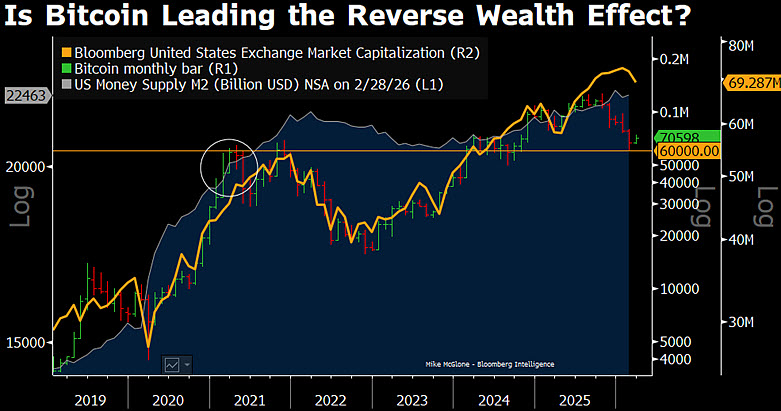
Bitcoin’s hangover could have severe implications. Credit: Mike McGlone X profile/Bloomberg
During the COVID-19 pandemic, governments and central banks launched massive stimulus programs to stabilize the economy. The U.S. money supply, measured by M2, expanded dramatically, jumping by roughly 30%, the largest increase in modern financial history.
That surge in liquidity helped push both stocks and cryptocurrencies to record highs.
Key drivers behind the synchronized rally included:
“The biggest money pump in history was Bitcoin’s time to shine,” McGlone noted in recent commentary.
Now, however, the environment appears to be shifting.
Bitcoin and the Post-Stimulus “Liquidity Hangover”
McGlone describes the current period as a financial hangover following years of extreme stimulus.
While Bitcoin remains far above its early historical levels, its performance since the 2021 peak has been more subdued compared with the explosive gains seen during the pandemic bull market.
At the same time, global financial markets have expanded dramatically. U.S. exchange-listed market capitalization, for example, has climbed to roughly $69 trillion, nearly double its level when Bitcoin first reached $60,000 in 2021.
For McGlone, the divergence between Bitcoin and stocks raises an important question: is Bitcoin signaling that risk assets are nearing a turning point?
If Bitcoin begins to weaken while equities continue rising, it could suggest that the underlying liquidity that fueled the last bull cycle is fading.
Bitcoin has often been described as a leading indicator for speculative markets because it trades continuously, globally, and without the same regulatory constraints as traditional financial assets.
Some analysts believe crypto markets react earlier to changes such as:
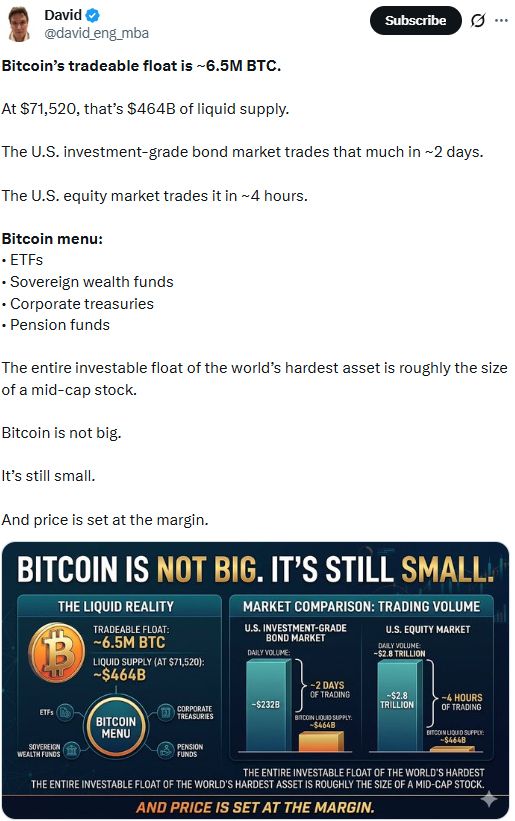
While Bitcoin is the largest cryptocurrency by market capitalization, the amount of Bitcoin actually available for trading, known as the tradeable float, is surprisingly limited.
According to market estimates, the total tradeable supply of Bitcoin is roughly 6.5 million BTC.
Historically, Bitcoin has sometimes acted as an early indicator of broader market shifts.
Because it trades around the clock and responds quickly to changes in liquidity and investor sentiment, it can occasionally move ahead of traditional markets.
For example, Bitcoin’s sharp decline in early 2022 preceded the broader sell-off in technology stocks and risk assets later that year.
If Bitcoin were to weaken again while stocks remain near record highs, it could suggest that the risk appetite supporting equities is beginning to fade.
Because of these variables, Bitcoin’s divergence from equities does not automatically imply a broader market correction.
Global Liquidity, Interest Rates, and Bitcoin’s Role as a Market Indicator
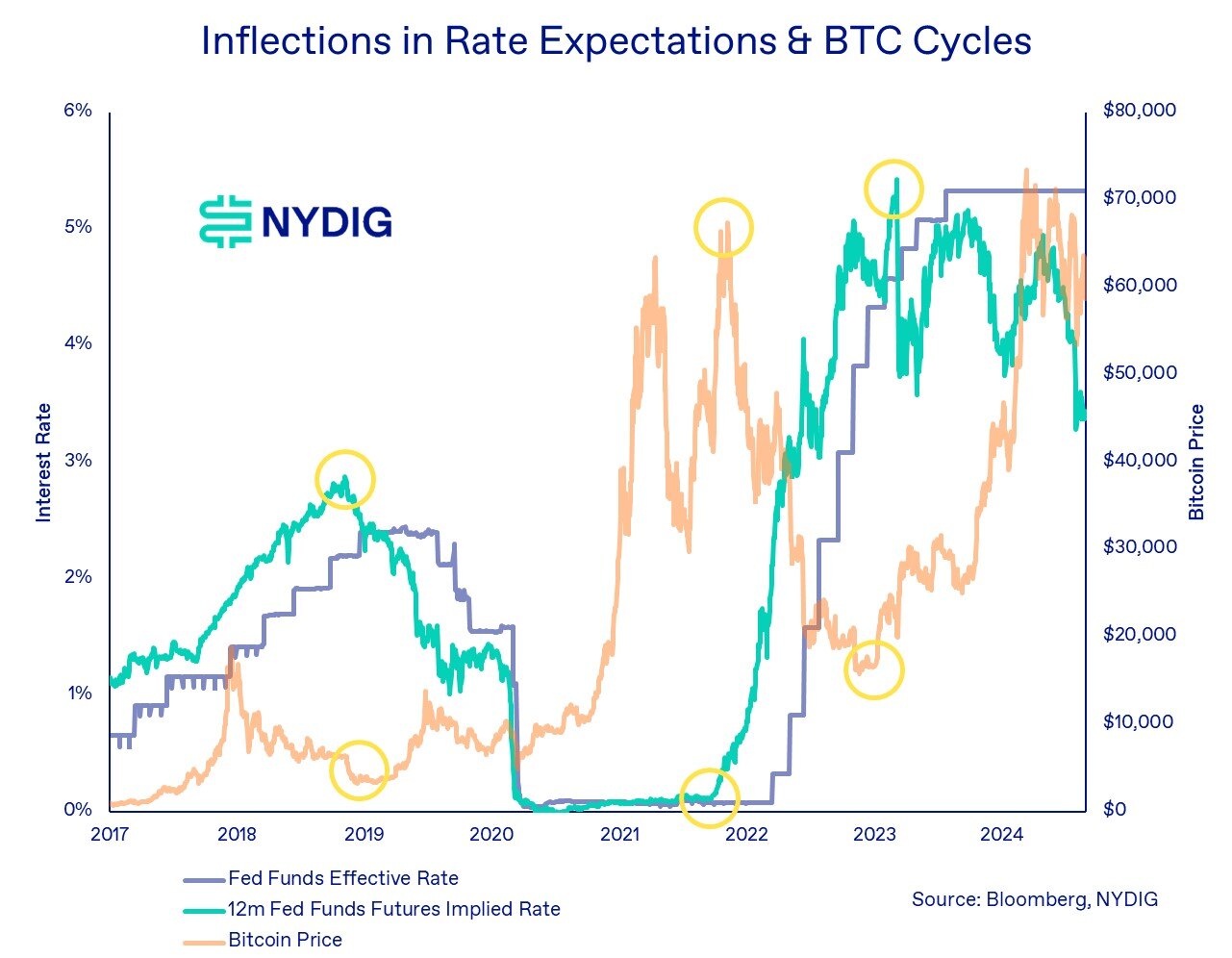
Ultimately, the relationship between Bitcoin and traditional financial markets often comes down to one central factor: global liquidity.
When central banks expand money supply and keep interest rates low, speculative assets tend to perform well. When liquidity tightens, those same assets often face pressure.
Inflections in rate expectations and BTC cycles. | Credit: Bloomberg/NYDIG
The past few years have seen a dramatic shift in this environment.
After the stimulus surge of 2020-2021, central banks around the world tightened monetary policy to combat inflation.
In that context, Bitcoin’s recent divergence from stocks could reflect a broader adjustment to a new financial environment with less easy money.
Why Bitcoin’s Decoupling From Stocks Could Matter for Global Markets
For now, Bitcoin remains near $73,400, well above its previous cycle highs and far from the levels seen just a few years ago.
But the break in its historical relationship with equities has caught the attention of analysts across both crypto and traditional finance.
Whether the divergence proves to be a temporary anomaly or a meaningful signal about the direction of global markets remains uncertain.
Still, McGlone’s warning highlights an important point: Bitcoin’s behavior may offer clues about the health of the financial system.
If its decoupling from stocks continues, investors may begin watching it more closely, not just as a cryptocurrency, but as a potential barometer of broader economic trends.
In a world where financial markets are increasingly interconnected, even a relatively small asset like Bitcoin could provide early signals of stress in much larger systems.
What does it mean that Bitcoin is “decoupling” from stocks?
Decoupling means that Bitcoin’s price is no longer moving in the same direction as major stock indices like the Nasdaq or S&P 500. In recent years, Bitcoin often rose and fell together with tech stocks. If that relationship weakens, it suggests the two markets may be responding to different economic forces.
Why do analysts watch the relationship between Bitcoin and stocks?
Bitcoin is often seen as a risk asset, meaning it typically performs well when investors are willing to take risks. When Bitcoin and stocks move together, it usually signals strong investor confidence. If Bitcoin starts moving differently from equities, it could indicate changing market sentiment or shifting liquidity conditions.
Why does Mike McGlone believe Bitcoin’s divergence could be a warning sign?
Mike McGlone argues that Bitcoin may act as a leading indicator for risk assets. Because the crypto market trades globally and 24/7, it can react faster to changes in liquidity and investor sentiment. If Bitcoin begins weakening while stocks remain high, it might suggest broader markets could follow later.
What role did money printing during the pandemic play in Bitcoin’s rise?
During the pandemic, central banks injected massive liquidity into the economy. The U.S. money supply (M2) grew by about 30%, the largest increase in history. This flood of liquidity helped push both stocks and cryptocurrencies to record highs in 2020-2021.
Disclaimer:
The information provided in this article is for informational purposes only. It is not intended to be, nor should it be construed as, financial advice. We do not make any warranties regarding the completeness, reliability, or accuracy of this information. All investments involve risk, and past performance does not guarantee future results. We recommend consulting a financial advisor before making any investment decisions.
Giuseppe Ciccomascolo began his career as an investigative journalist in Italy, where he contributed to both local and national newspapers, focusing on various financial sectors.
Upon relocating to London, he worked as an analyst for Fitch's CapitalStructure and later as a Senior Reporter for Alliance News. In 2017, Giuseppe transitioned to covering cryptocurrency-related news, producing documentaries and articles on Bitcoin and other emerging digital currencies. He also played a pivotal role in establishing the academy for a cryptocurrency exchange website. Crypto remained his primary area of interest throughout his tenure as a writer for ThirdFloor.


 Easy
Easy