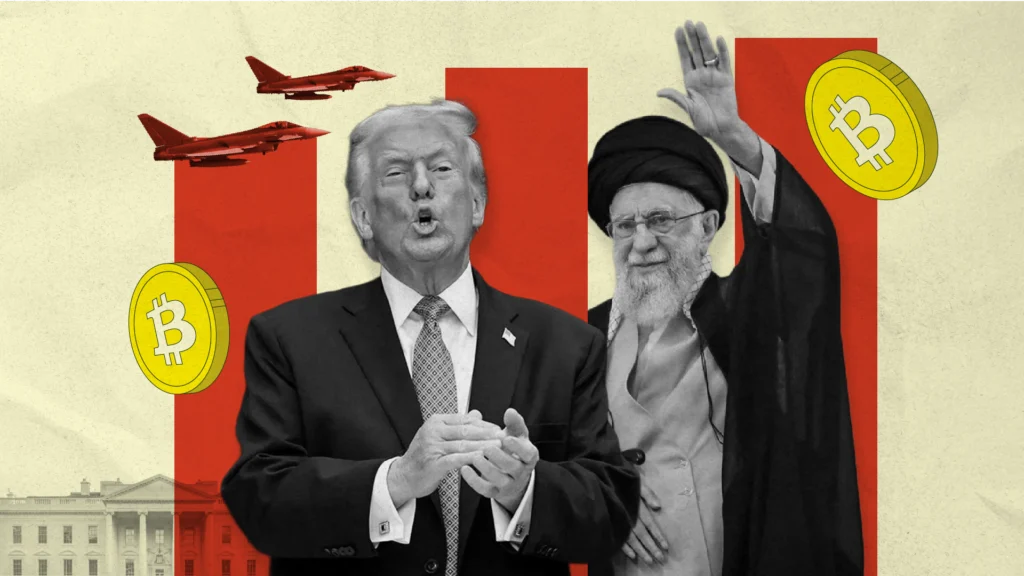
Donals Trump and Iran could impact how Bitcoin's price performs over the next few weeks | Credit: Hameem Sarwar
Share
Key Takeaways
Trump is considering military action against Iran, and this could put BTC at risk of further downturn.
History shows that a possible strike tends to send Bitcoin’s price lower, but it rebounds within a few days.
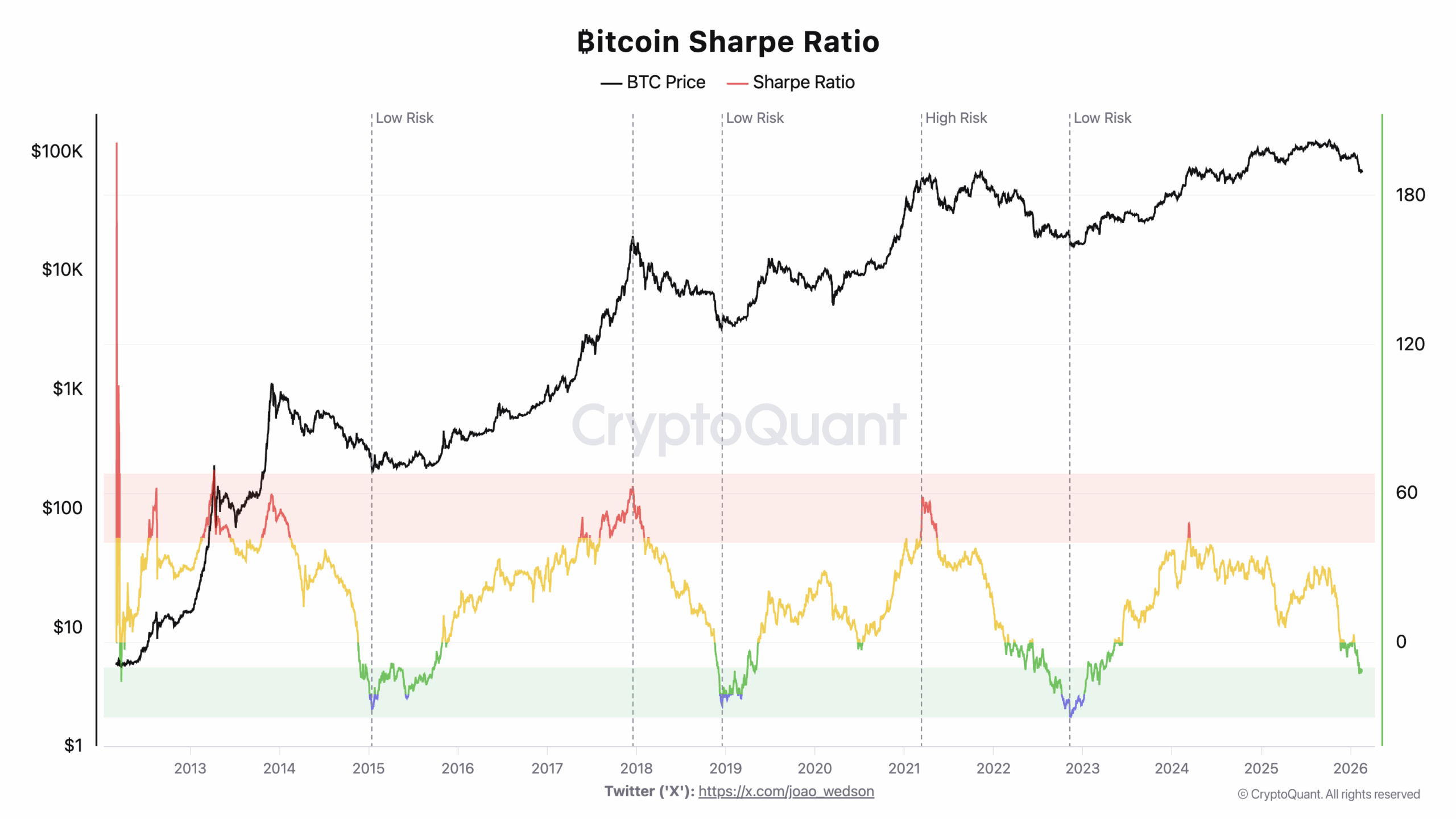
The Sharpe ratio shows that BTC is edging toward a notable accumulation zone amid the development.
The technical setup suggests Bitcoin’s price could slide below the crucial $60,000 support level soon.
However, if the parties agree to a deal, the cryptocurrency’s value might surge past $70,000.
The clock is ticking.
On Thursday, Feb. 19, President Donald Trump issued a stark 10-day ultimatum to Iran: strike a “meaningful deal” on its nuclear program or face military action.
For Bitcoin’s (BTC) price and crypto markets already battered by months of selling, this geopolitical powder keg could trigger the next major move.
Bitcoin is currently trading around $67,822, down 47% from its October 2025 all-time high of $126,198.
Now, amid intensifying war fears, traders are asking a critical question: Will BTC crash further, or is this the bottom?
The Ultimatum Is Real, and the Military Is Ready
Trump’s deadline isn’t a bluff. Speaking at the inaugural Board of Peace meeting in Washington, D.C., the president made it clear that patience has run out.
“We may have to take it a step further, or we may not,” Trump said. “You’re going to be finding out over the next probably 10 days.” Trump emphasized.
Behind the scenes, the buildup is massive. Two U.S. aircraft carriers (the USS Abraham Lincoln and USS Gerald R. Ford) are now positioned in the region alongside 12 warships and hundreds of fighter jets.
Multiple reports confirm that U.S. military officials have told Trump that strike options are ready and could be executed as early as this weekend.
According to Axios, if diplomacy fails, this won’t be a limited strike. It would be a weeks-long, full-scale military campaign targeting Iran’s nuclear infrastructure, potentially the largest U.S. operation in the Middle East since the 2003 Iraq invasion.
Bitcoin’s Historical Reaction to Iran Strikes
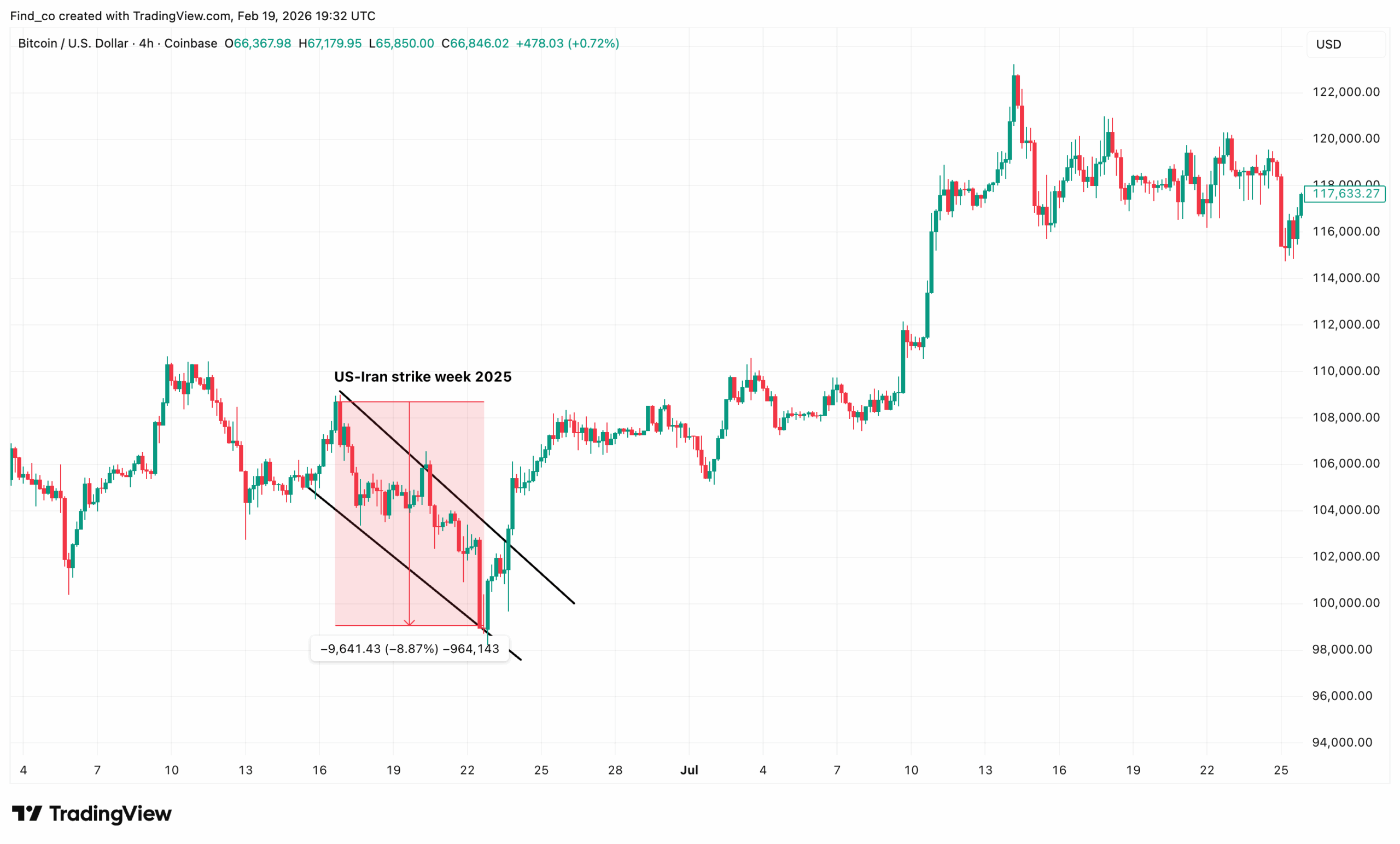
This isn’t the first time. In June 2025, when the U.S. and Israel launched coordinated strikes on Iranian nuclear sites, Bitcoin’s price initially dropped from $104,000 to $100,945.
However, within hours, BTC rebounded above $102,000 before falling back below the psychological $100,000 mark.
The pattern is clear. Bitcoin behaves like a high-risk asset during the initial shock of geopolitical escalation.
If Trump authorizes strikes, expect immediate chaos.
A 2026 invasion would likely trigger a massive liquidation of leveraged long positions, potentially driving Bitcoin down to its primary support zones near $60,000.
Get These Top Crypto Casino Offers Now!
Sponsored
Disclosure
We sometimes use affiliate links in our content, when clicking on those we might receive a commission at no extra cost to you. By using this website you agree to our terms and conditions and privacy policy.
But the damage may stop with Bitcoin. In a full-scale invasion, Ethereum (ETH) could test support levels around $1,600.
Here is what happened the last time:
Bitcoin dropped 4% to $99,300 and fell below $100,000 for the first time in over a month after US airstrikes on Iranian nuclear facilities.
Ethereum plummeted 7% while the crypto sell-off triggered liquidations exceeding $512 million in 24 hours, affecting over 151,000 traders.
Following the ceasefire announcement, Bitcoin’s price rebounded 2% from $104,000 to $106,000. However, the damage to market sentiment was already done.
Interestingly, privacy coins like Monero (XMR), Zcash (ZEC), and DASH may see speculative inflows.
As citizens in conflict zones seek ways to move capital outside of sanctioned or failing banking systems, the utility of privacy coins becomes increasingly apparent.
Market analysts are divided. On one side, some warn that a U.S. strike could push Bitcoin below $60,000, potentially testing support at $50,000 if panic selling accelerates.
Short-term holder data shows that many recent buyers are already selling at a loss, adding to downward pressure.
On the other side, Bitcoin’s short-term Sharpe ratio has hit levels historically associated with “generational buying zones.”
This suggests that the asset is already deeply oversold. If a strike happens and Bitcoin’s price drops, the sell-off could be short-lived as buyers step in and begin accumulating in large volume.
Should that be the case, then a Trump strike on Iran could send Bitcoin to multi-year lows.
At the same time, it could also drive the beginning of the cryptocurrency’s recovery.
Meanwhile, gold is trading near $5,000 per ounce. Oil prices have surged by more than 4% amid fears of supply disruptions.
Both are outperforming Bitcoin in the current risk-off environment, weakening the “digital gold” narrative.
BTC Price Prediction
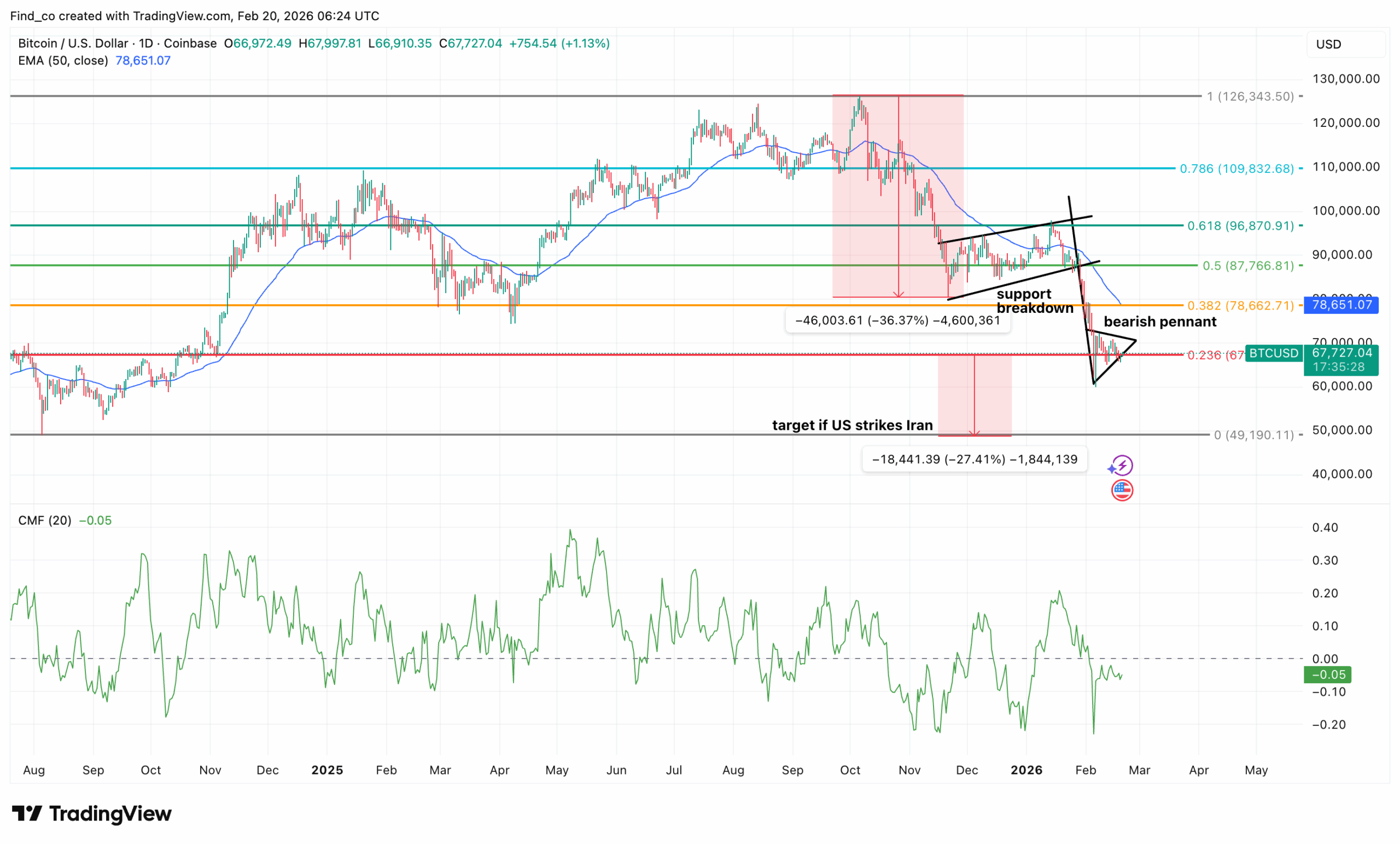
From a technical perspective, the daily chart shows that Bitcoin’s price is attempting to stabilize after a breakdown below the 0.382 Fibonacci level near $78,662.
However, the broader daily structure remains bearish.
The chart shows a clear loss of horizontal support, followed by a selloff that carved out a local low near the 0.236 retracement zone.
After that flush, the BTC price compressed into a small bearish pennant formation. This pattern typically forms after a move lower and resolves in the direction of the prior trend.
Therefore, until proven otherwise, that keeps continuation risk on the table.
The 50-day EMA sits well above the current price, around $78,662, and is sloping downward. Furthermore, Bitcoin is trading significantly below it, which confirms short-term bearish momentum.
Any rally would first need to reclaim the $70,000 support.
As it stands, the Chaikin Money Flow (CMF) is slightly negative, reflecting mild capital outflow rather than strong accumulation.
There is no strong bullish divergence visible on this timeframe yet. Momentum has slowed since the initial breakdown, but it has not convincingly flipped positive.
The key support remains the recent swing low around $60,000. If the pennant breaks downward, that zone could be retested quickly.
A loss of that level and a Trump strike on Iran would expose Bitcoin’s price toward the next major liquidity pocket at the $50,000 region, which aligns with the macro zero Fibonacci level from the broader move.
On the contrary, an increase in buying pressure could invalidate this structure.
Also, if Trump and Iran make a deal before the deadline, Bitcoin might not slide this low. Instead, the cryptocurrency’s price could surge to the 0.382 Fib level above $78,000.
What Happens Next?
The next 10 days are critical. If Iran and Trump agree to dismantle its nuclear enrichment facilities and submit a written proposal by the end of February, diplomacy may prevail, and Bitcoin could stabilize or recover.
If talks collapse and strikes begin, expect immediate volatility.
Bitcoin will likely test lower support levels around $60,000. A breach below $60,000 could trigger further liquidations and push BTC into the high $50,000.
The next 48 hours are critical. U.S. officials told Axios that Iran has two weeks to submit a detailed proposal for nuclear negotiations, but diplomacy appears to be failing as both sides remain far apart on key demands.
For Bitcoin’s price, three scenarios emerge:
Scenario 1 (Diplomatic breakthrough): Swift relief rally back above $70,000 as risk appetite returns.
Scenario 2 (Limited strikes): Continued consolidation between $60,000 and $68,000 as markets digest targeted military action.
Scenario 3 (Full-scale conflict): A sharp drop to below $55,000 as crypto behaves like a high-risk asset amid prolonged uncertainty.
The Macro Picture Is Already Fragile
Bitcoin doesn’t exist in a vacuum.
Since October 2025, an estimated $8.5 billion has exited US-listed spot Bitcoin exchange-traded funds (ETFs), suggesting that the initial wave of institutional euphoria has given way to a period of consolidation or profit-taking.
Add to that the Crypto Fear and Greed Index, which is at 8 out of 100, indicating extreme fear and near all-time lows.
Institutional demand has reversed. Retail traders are paralyzed. And now, geopolitical risk is spiking.
U.S. Treasury yields are already near 4.4% on the 10-year note and may rise further if war spending expands fiscal deficits.
A rising dollar has historically been bearish for Bitcoin, especially in emerging markets where capital outflows follow dollar surges.
Will Bitcoin Price Recover?
Maybe. But not immediately. While the first 48 hours are usually bearish, Bitcoin’s price has a history of rebounding faster than traditional equities once the initial shock subsides, as it happened the last time Trump-led U.S. struck Iran.
If the U.S. intervention is brief and leads to a quick ceasefire, markets may stabilize within four to six weeks.
However, Iran has warned that any U.S. attack will lead to a prolonged regional war, which could result in higher crude oil prices and extended geopolitical tensions.
That’s not a 48-hour problem. That’s a multi-month drag on risk assets.
Disclaimer:
The information provided in this article is for informational purposes only. It is not intended to be, nor should it be construed as, financial advice. We do not make any warranties regarding the completeness, reliability, or accuracy of this information. All investments involve risk, and past performance does not guarantee future results. We recommend consulting a financial advisor before making any investment decisions.
Victor Olanrewaju is a crypto analyst and reporter at CCN with deep roots in on-chain research and technical analysis. His crypto journey began in 2017, but it was the 2020 Uniswap airdrop that sparked a full-time pivot into the space.
With a foundation in copywriting, Victor honed his craft creating high-converting content for leading crypto brokers — most notably an XRP price prediction that ranked #1 on Google during the 2021 bull run.
He later joined AMBCrypto in 2022, where he combined storytelling with technical and on-chain analysis to cover key market narratives.
In 2024, he expanded his expertise at BeInCrypto, collaborating with analysts and using tools like Glassnode, Santiment, and IntoTheBlock to break down Bitcoin and altcoin trends.
At CCN, Victor covers the top cryptocurrencies, memecoins, macro shifts, blending real-time insights with deep-dive metrics.
He holds a Bachelor’s degree in Physics from the University of Ibadan, equipping him to simplify complex data for a wide audience. Follow his work or connect on LinkedIn or X.