Binance CEO Richard Teng has publicly called recent Iran-linked crypto claims as "defamatory."
Share
Key Takeaways
Binance denies Wall Street Journal reporting alleging the exchange dismantled an internal probe into $1 billion in Iran-linked crypto transfers.
The CEO called the claims “false” and “defamatory” and demanded a full retraction.
Binance made strong claims that its compliance was the best in industry.
Binance Chief Executive Richard Teng has publicly rebuked a Wall Street Journal report alleging that the world’s largest crypto exchange dismantled an internal probe into more than $1 billion in crypto transfers linked to Iran-backed groups, calling the newspaper’s claims “defamatory” and demanding a full retraction.
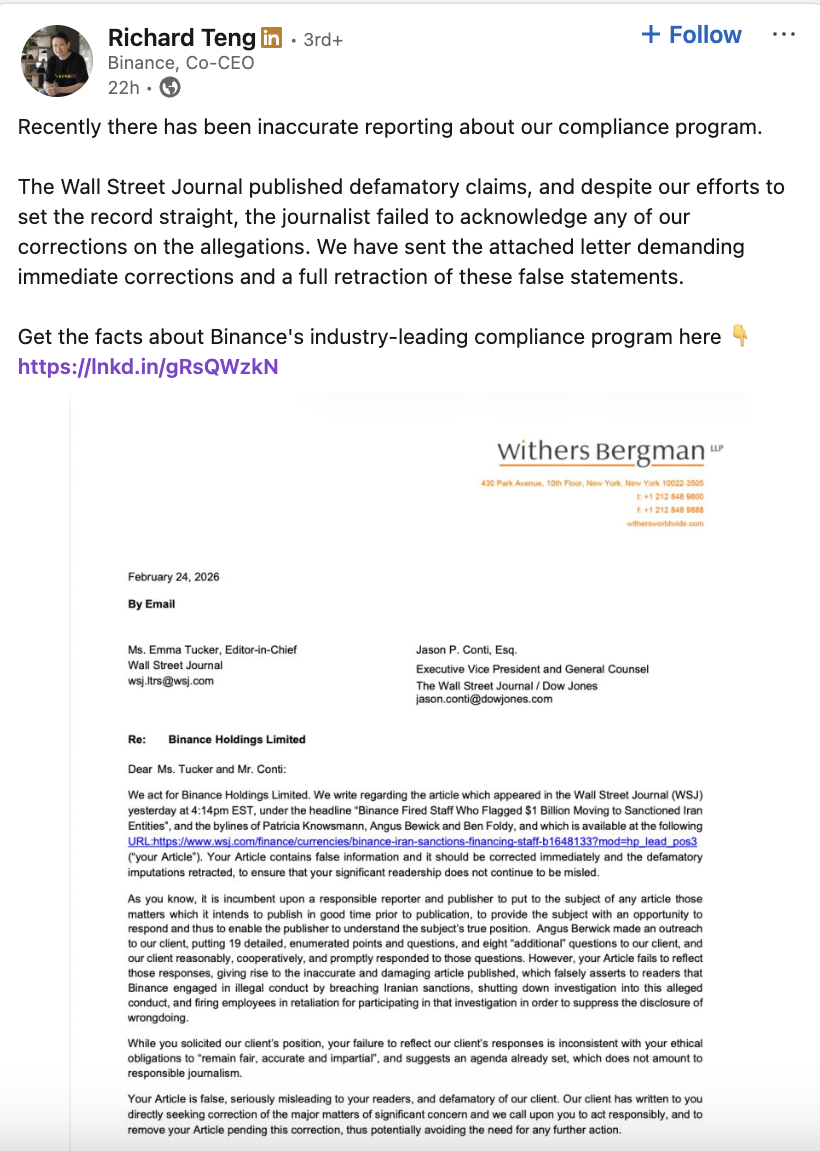
In a LinkedIn post on Tuesday, Teng said the Journal had published “inaccurate reporting” about Binance’s compliance program and failed to incorporate corrections provided by the company.
The dispute marks the latest chapter in ongoing scrutiny of Binance’s compliance controls, following its 2023 guilty plea to U.S. charges.
Try Our Recommended Crypto Exchanges
Sponsored
Disclosure
We sometimes use affiliate links in our content, when clicking on those we might receive a commission at no extra cost to you. By using this website you agree to our terms and conditions and privacy policy.
On Monday, Feb. 23, the Wall Street Journal reported that weeks after President Donald Trump pardoned Binance founder Changpeng Zhao in October, senior executives at the exchange dismantled a staff investigation into roughly $1 billion that had flowed through Binance to a network financing Iran-backed militant groups.
The newspaper said a trading account belonging to a close Binance business partner, Hong Kong-based payments firm Blessed Trust, had been identified as a primary channel moving crypto to a network allegedly tied to Iran’s Islamic Revolutionary Guard Corps (IRGC).
Binance’s internal financial-crime investigations team traced accounts held by Chinese clients. U.S. and Israeli authorities said these accounts funded Iranian proxy groups through digital wallets.
The Journal said $1.7 billion flowed in 2024 and 2025 through accounts linked to the network, with more than $1 billion allegedly originating from Blessed Trust.
The newspaper further reported that investigators shared their findings with Teng and Chief Compliance Officer Noah Perlman in October, but were suspended in November and later dismissed.
Binance’s Rebuttal
In his LinkedIn post, Teng rejected the Journal’s characterization of Binance’s compliance practices.
“Recently there has been inaccurate reporting about our compliance program,” Teng wrote.
“The Wall Street Journal published defamatory claims, and despite our efforts to set the record straight, the journalist failed to acknowledge any of our corrections on the allegations.”
Teng said Binance had sent a letter to the newspaper demanding immediate corrections and a full retraction.
Binance has claimed Wall Street Journal’s report is “defamatory” | Source: LinkedIn
The letter, shared publicly, disputes the claim that Binance terminated investigators for escalating compliance concerns.
“Your article is false, seriously misleading to your readers, and defamatory of our client,” the letter reads.
It further demands that the Journal “immediately remove the Article from your website, issue a full retraction and apology, and take steps to prevent further publication of these false statements.”
Binance has maintained that its internal investigation did not establish that any user directly transacted with sanctioned Iranian organizations, but rather that funds moved through multiple intermediary wallets.
Binance Claims ‘Industry Best’ Compliance
Separately, Binance sought to reinforce its compliance credentials in blog post titled “Setting the Record Straight,” published days before Teng’s public rebuttal.
In the post, the exchange described its controls as “the most rigorous compliance measures in the industry” and said it has outperformed its top-10 global peers in managing sanctions-related risks.
Binance said its exposure to sanctioned entities fell from 0.284% of total trading volume in January 2024 to 0.009% by July 2025 — a roughly 97% decrease.
Direct interactions with four major Iranian crypto exchanges declined from $4.19 million in January 2024 to $110,000 by January 2026, according to the company.
“Compliance investigations at Binance are handled independently and are not subject to interference from shareholders or executive leadership,” the company wrote.
“While the Chief Compliance Officer provides reports to the management committee, compliance decisions are based on law and established procedures — not commercial considerations.”
“Some media use negative narratives (from fired employees). Binance uses data. Best compliance program in the industry, by far!” Zhao said.
2023 Plea Deal and Compliance Overhaul
The latest allegations echo concerns that led to a landmark U.S. enforcement action in 2023.
That year, Binance pleaded guilty to violating U.S. sanctions and anti-money-laundering laws, agreeing to pay a record $4.3 billion penalty.
U.S. authorities said the exchange had allowed transactions involving sanctioned jurisdictions, including Iran, and had failed to maintain an effective anti-money-laundering program.
Zhao was sentenced to four months in prison for failing to implement adequate compliance controls and later received a presidential pardon in October.
Singapore’s former regulator Teng took the helm as CEO, tasked with strengthening compliance and rebuilding trust with regulators.
Binance has said it has significantly expanded its investigations team and invested heavily in systems to detect illicit finance.
Kurt Robson is a London-based reporter at CCN, specialising in the fast-moving worlds of crypto and emerging technology. He began his career covering local news in Cornwall after graduating from Falmouth University with First Class Honours in Journalism. There, he cut his teeth on everything from council meetings to missing swans.
He quickly rose through the ranks to become a frontline journalist at several of the UK’s leading national newspapers. Over the years, he has interviewed musicians and celebrities, reported from courtrooms and crime scenes, and secured multiple front-page exclusives.
Following the upheaval of the COVID-19 pandemic, Kurt shifted his focus to technology journalism—just ahead of the AI boom. With a natural curiosity and a trained eye for emerging trends, he has found a new rhythm in reporting on innovation.
At CCN, Kurt's work focuses on the cutting edge of crypto, blockchain, AI, and the evolving digital world. Drawing on his background in people-first reporting and his deep interest in disruptive tech, Kurt delivers stories that are insightful, entertaining, and human-centric.














 Binance Claims It Cut Sanctioned Exposure by 97% Amid Iran-Linked Billion-Dollar Fund Flow Allegations