71 Years of Bitcoin-Funded Dividends — Yet S&P 500 Rejected It and MSCI Might Dump It: Strategy’s Wild Bitcoin Reality
Share
Key Takeaways
Since its pivot to Bitcoin in August 2020, MSTR’s share price has risen much more than the S&P 500.
Over the last five years, MSTR has also beat Nvidia, the top performer of the AI boom.
MSTR stock acts as a leveraged proxy for Bitcoin, often moving faster than BTC itself in both directions.
Strategy’s bold repositioning shows how aligning a company’s balance sheet and narrative around a macro bet can create outsized returns.
In late 2020, MicroStrategy shocked the market by turning a routine software company into the public market’s boldest proxy for Bitcoin.
In 2025, the firm led by Michael Saylor completed its rebrand to Strategy Inc. while keeping the MSTR ticker, an identity change that reflects what the market already understood: this is a Bitcoin-treasury company wrapped in a software shell.
Despite its size, profitability, and record returns, MSTR was not added to the S&P 500 during the latest rebalancing, a decision that surprised many analysts given its performance. Yet, even outside the index, Strategy has outpaced it, delivering multi-year gains that eclipse both broad benchmarks and marquee names like NVIDIA.
This piece explains how and why MSTR’s performance stands out against major stocks and indexes and also the risks, because the same forces that supercharge returns can cut the other way.
Try Our Recommended Crypto Exchanges
Sponsored
Disclosure
We sometimes use affiliate links in our content, when clicking on those we might receive a commission at no extra cost to you. By using this website you agree to our terms and conditions and privacy policy.
Strategy (MSTR) Outpaces Wall Street Heavyweights: 1,540% Gain Since Bitcoin Pivot
Before diving into the details, it’s worth looking at the raw performance figures that have captured Wall Street’s attention.
Since rebranding as Strategy (MSTR) and doubling down on Bitcoin as a corporate treasury asset, the company’s stock has delivered returns that outshine even the market’s biggest names.
Whether you compare it to the S&P 500, tech giants like NVIDIA, or the broader equity landscape, MSTR’s performance has been extraordinary, fueled by Bitcoin’s rally and the firm’s bold conviction in digital assets.
Multi-year outperformance since the “Bitcoin pivot” (August 2020):
From August 2020 through 2024, MSTR rose by 1,540%, while the S&P 500 gained around 111% over roughly the same span. Several analyses sum it up bluntly: MicroStrategy/Strategy “outperformed every company in the S&P 500” since the pivot window.
Five-year comparison against a top mega-cap winner (NVIDIA):
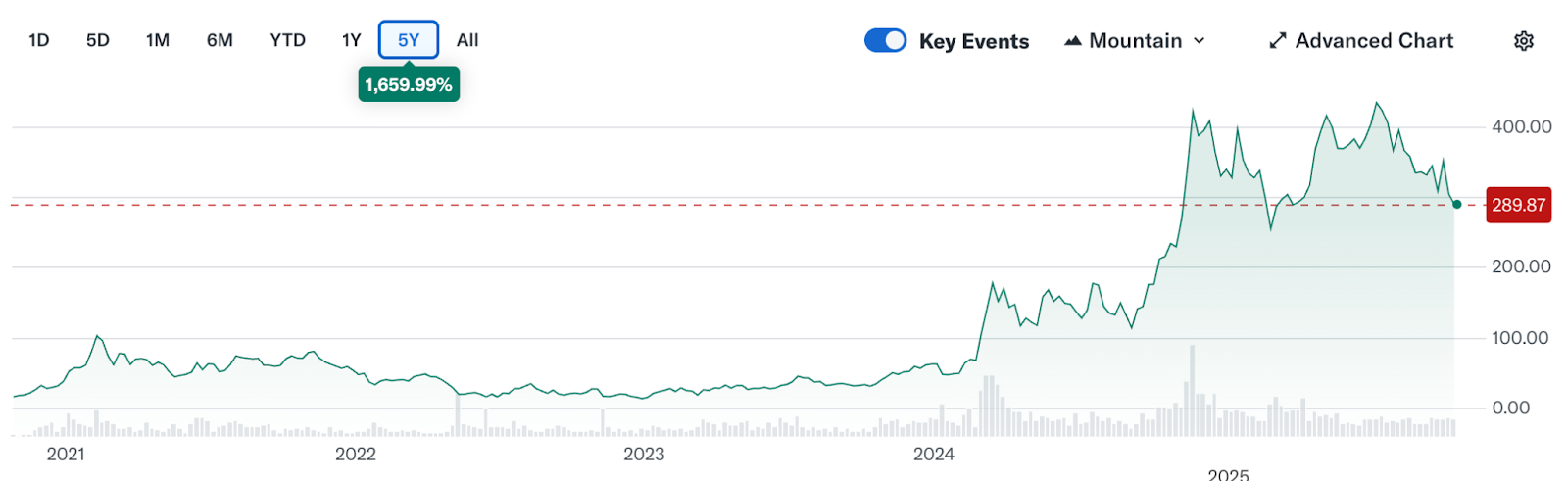
Over the five years ending Oct. 20, 2025, MSTR returned 1,660% against 1,248% for NVDA, beating even the AI cycle’s most iconic winner on a comparable timeframe.
MSTR performance over the last five years. | Credit: Yahoo! Finance
Recent trailing performance vs broad market:
Over the last 12 months, MSTR total return amounts at 49.9% while the S&P 500 increased by 13.6%. These figures include price change and reinvested dividends.
These snapshots don’t mean MSTR “beats everyone, all the time.” They do illustrate that, over pivotal windows (since August 2020; across five years; over the latest trailing year), MSTR has substantially outpaced widely watched benchmarks and marquee stocks.
Why Strategy (MSTR) Trades Like a Bitcoin Amplifier
Strategy’s remarkable stock performance isn’t a mystery, it’s the result of a deliberate and unconventional corporate strategy. The company transformed from a traditional software firm into a Bitcoin-powered treasury and tech hybrid, aligning its identity, balance sheet, and brand around a single conviction: that Bitcoin is digital capital.
This bold shift explains why MSTR’s returns often move faster, in both directions, than the market. The sections below break down how its Bitcoin leverage, strategic rebrand, and role as a regulated proxy for BTC exposure combine to create this powerful performance engine.
A. The “Bitcoin Leverage” Effect
Strategy Inc. isn’t a typical software name. It deliberately accumulated one of the largest corporate Bitcoin treasuries on earth and now operates as a de-facto, publicly traded levered bet on BTC, plus a software business.
By September 2025, Strategy’s Bitcoin holdings amounted to 640,250 BTC, and major business press regularly frames MSTR’s equity moves in the context of its BTC stack. When Bitcoin rises, the equity often amplifies those gains; when BTC falls, the reverse can happen.
Strategy holds over 640,000 Bitcoin. | Credit: Strategy
B. The Rebrand Made The Narrative Explicit
In February 2025, the company said it would do business as Strategy. In August 2025, it completed the legal name change from MicroStrategy to Strategy Inc., while retaining ticker MSTR. That formalized what investors already priced in: a Bitcoin treasury company with public-equity access and liquidity.
C. A “Regulated Wrapper” For BTC Exposure
Some investors prefer avoiding direct self-custody of BTC but still want upside. MSTR offers a regulated, exchange-traded wrapper to BTC beta (and more), and so it can attract flows when crypto momentum returns, further juicing performance in up-cycles.
Recent financials also reflect new US accounting rules that mark BTC at fair value through earnings, another way the treasury exposure shows in results.
MSTR vs. Major Stocks And Indexes
Strategy’s market performance continues to stand out across multiple time horizons. Whether measured against the broad S&P 500 or the most celebrated tech leaders of the AI era, MSTR has repeatedly delivered outsized returns that mirror and often amplify Bitcoin’s market cycles.
In September 2025, Strategy met market-cap thresholds and reported a strong Q2 2025 with $10 billion net income and $14 billion operating income. However, the S&P 500 index committee opted to add companies like APP (AppLovin), HOOD (Robinhood) and EME (Emcor) instead.
The following snapshots highlight how its performance has stacked up across key benchmarks and periods.
MSTR vs. S&P 500 (broad market)
Since pivot (Aug 2020-2024): MSTR +1,540% vs. S&P 500 +111%.
Last 12 months: MSTR +69.6% total return vs. S&P 500 +18.9%.
MSTR vs. Magnificent Seven leaders
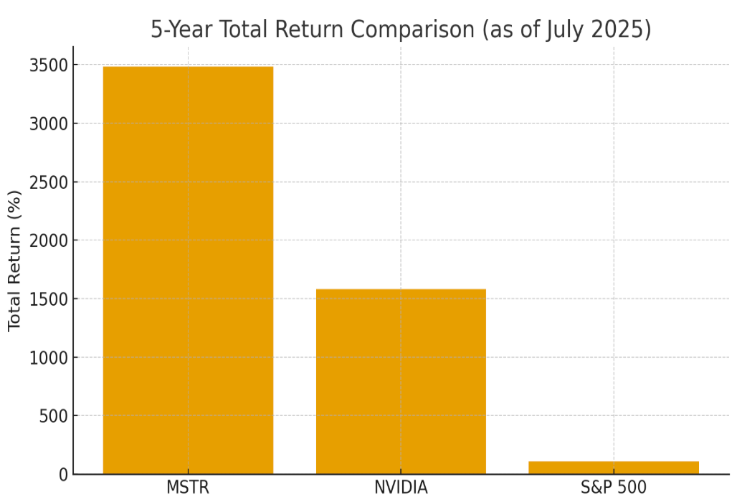
Five-year comp: MSTR +3,483.6% vs. NVDA +1,583.6%. That’s outperforming arguably the strongest mega-cap of the AI era over a long window.
A range of 2024–2025 roundups observed that while the Mag-7’s performance diverged, MSTR routinely surfaced among top performers in league-table style summaries.
Recent quarter snapshot vs market
Q2 2025 comparison cited in coverage: MSTR +40% vs. S&P 500 +11% in the quarter. Quarterly figures fluctuate, but the disparity illustrates the “beta on BTC” effect in strong crypto months.
MSTR vs. NVDA vs. S&P 500. | Credit: CCN.com
What to remember: Your conclusion depends on the time frame. Over multi-year windows since 2020, the outperformance is clear. Over shorter slices, MSTR can lead or lag depending on Bitcoin’s path and equity risk appetite.
MSTR’s Dual Engines: Bitcoin Treasury and Analytics Platform
Think of MSTR as having two engines:
Bitcoin treasury engine: The dominant driver of equity value swings. Add BTC at a given cost basis; benefit (or suffer) as fair value moves. Rebrand communications and press coverage consistently present MSTR as the largest corporate holder of Bitcoin, which keeps the market focused on this engine.
Software or analytics engine: The legacy BI platform. It contributes revenue and optionality, but growth is not the primary valuation anchor the market uses in 2025. New U.S. accounting for digital assets, ASU 2023-08, also means BTC fair-value changes hit reported earnings, making the linkage to price more explicit.
As long as investors want exchange-listed BTC exposure with liquidity, and as long as Bitcoin trends up over time, MSTR’s structure can out-compound index peers, especially in windows when BTC accelerates.
How $MSTR Beat Every S&P 500 Stock — and the Risks Behind That Feat
Many headlines emphasize that since 2020 MSTR has outpaced every S&P 500 component, a striking claim that’s backed by multiple analyses and media write-ups. But that claim is timeframe-dependent and rests on a riskier return profile than the average large-cap.
What Makes It True
Magnitude of BTC cycle: The 2020-2024 BTC appreciation, multiplied through a large corporate treasury, created equity returns few operating businesses could match.
Flows and narrative: When crypto risk appetite improves, investors often chase equity proxies, and MSTR is the purest. That can create momentum beyond “BTC beta” alone.
Why It’s Risky
Downside is amplified: BTC drawdowns can drive steep equity drawdowns. Financial press has highlighted double-digit declines in short spans when crypto risk sours.
Dilution tools: Building the BTC stack sometimes involves ATM share sales or convertibles, which can dilute holders during certain cycles.
Accounting and policy: New rules (fair-value marking) increase earnings volatility; regulatory shifts could change access or tax treatment.
MSTR’s ability to “beat major stocks” over meaningful periods comes with meaningfully higher volatility than those stocks.
What You’re Really Buying with $MSTR
When you buy MSTR, you are buying:
BTC exposure (at corporate scale), with all the upside/downside that implies.
A software business that adds some revenue base, distribution, developer ties, and optionality.
If BTC rises over time, MSTR can outpace the market by a wide margin, just as it has since 2020 and over the last five years versus Nvidia.
If BTC falls, MSTR can lag sharply, sometimes more than BTC itself due to equity market dynamics, issuance choices, or risk-off sentiment toward crypto-exposed names.
Even record-breaking performance comes with trade-offs. Strategy’s success story is built on bold, high-conviction bets, the same qualities that make it powerful also make it volatile.
Before drawing conclusions from its market-beating returns, it’s essential to understand the risks beneath the surface.
From Bitcoin’s wild price swings to corporate leverage and accounting volatility, here are the key factors investors need to keep in mind.
Crypto drawdowns: 20-50% BTC declines are not rare; MSTR can fall as much or more in those phases. Recent selloffs show how quickly crypto-exposed equities can give back gains.
Dilution and leverage: To grow BTC holdings, the firm has periodically issued shares/convertibles. Great when timed in bull markets; painful if done into weakness. Watch filings and press releases.
Accounting and earnings volatility: New ASU 2023-08 fair-value accounting makes reported P&L swing with BTC price, expect choppy quarters.
Concentration: Unlike diversified mega-caps, MSTR’s thesis is concentrated. That’s the point, and the risk.
Conclusion
Strategy (MSTR), led by Michael Saylor, has become one of the most fascinating case studies in modern finance, a reminder that sometimes, vision and conviction can transform an ordinary company into a market phenomenon. By aligning its balance sheet and identity around Bitcoin, Strategy turned a traditional software firm into a high-octane proxy for digital assets.
The results speak for themselves: since its 2020 pivot, MSTR’s stock has outperformed the S&P 500 and even marquee names like NVIDIA over multiple timeframes. Yet, this success is not just a story of numbers, it’s a story of strategy, timing, and belief in a macro trend few corporations were brave enough to embrace.
Still, investors should remember that extraordinary returns come with extraordinary risk. MSTR’s performance is tightly tethered to Bitcoin’s price, market sentiment, and corporate leverage decisions. The same forces that propelled it to record highs could just as easily magnify losses during downturns.
For observers and investors alike, the takeaway is simple: Strategy’s rise isn’t luck, it’s leverage. It’s what happens when a company bets its future on a defining technology and the market rewards that conviction. Whether you see it as genius or gamble, MSTR’s journey illustrates how financial innovation and bold positioning can rewrite what’s possible in corporate strategy.
Why is Strategy’s stock (MSTR) performing so well?
Strategy’s performance is mainly tied to its massive Bitcoin holdings. When Bitcoin’s price rises, the value of Strategy’s assets, and by extension its stock, often rises even faster. This creates what analysts call “leveraged Bitcoin exposure.” Investors who want exposure to Bitcoin but prefer a publicly listed stock often choose MSTR as an alternative.
Does MSTR always outperform the market?
No. MSTR tends to outperform during Bitcoin bull markets but can fall sharply during downturns. Because much of its value is tied to Bitcoin, the stock’s price can swing far more than typical tech or index names.
Is Strategy still a software company?
Yes, but that side of the business now plays a smaller role in valuation. Strategy still sells business intelligence and analytics tools, but the Bitcoin treasury strategy is the main reason investors follow the stock.
Will MSTR keep beating other stocks?
No one knows for sure. If Bitcoin continues rising, MSTR may remain a market leader. If Bitcoin stalls or declines, MSTR could fall behind other equities quickly. Its long-term performance will depend on both Bitcoin’s price and how Strategy manages its treasury and capital structure.
Disclaimer:
The information provided in this article is for informational purposes only. It is not intended to be, nor should it be construed as, financial advice. We do not make any warranties regarding the completeness, reliability, or accuracy of this information. All investments involve risk, and past performance does not guarantee future results. We recommend consulting a financial advisor before making any investment decisions.
Giuseppe Ciccomascolo began his career as an investigative journalist in Italy, where he contributed to both local and national newspapers, focusing on various financial sectors.
Upon relocating to London, he worked as an analyst for Fitch's CapitalStructure and later as a Senior Reporter for Alliance News. In 2017, Giuseppe transitioned to covering cryptocurrency-related news, producing documentaries and articles on Bitcoin and other emerging digital currencies. He also played a pivotal role in establishing the academy for a cryptocurrency exchange website. Crypto remained his primary area of interest throughout his tenure as a writer for ThirdFloor.


 Easy
Easy