MSTR’s Net Bitcoin Holdings Now Exceed Its Market Cap by $3.4B — Here’s Why That’s Extremely Risky.
Share
Key Takeaways
Strategy met the S&P 500 inclusion criteria but was skipped, which reflects the committee’s caution with Bitcoin-centric risk.
Robinhood joins on Sept. 22, validating fintech and crypto-adjacent models with diversified revenues.
AppLovin and Emcor also added, while Caesars, MarketAxess, and Enphase exit.
S&P inclusion is discretionary: eligibility opens the door, but the committee decides who walks through.
The S&P 500’s latest reshuffle delivered a plot twist tailor-made for searchers tracking “S&P 500 additions,” “Robinhood S&P 500,” and “MicroStrategy/Strategy S&P 500 inclusion.”
In short: Robinhood Markets (HOOD) won a coveted seat at the table, while Strategy Inc. (MSTR), the company formerly known as MicroStrategy and the largest corporate holder of Bitcoin (BTC), did not.
The result jolted after-hours trading, sparked debate about how the index committee weighs eligibility versus discretion, and raised fresh questions about Michael Saylor’s big Bitcoin treasury strategy and how fast the equity mainstream wants to embrace it.
This article unpacks why Strategy wasn’t added, why Robinhood was, what else changed in the index, and what it all means for Saylor’s bet on Bitcoin as a corporate reserve asset.
Strategy (MSTR): Strategy (MSTR): Met S&P 500 Criteria (On Paper) but Passed Over
Strategy Inc. has spent years transforming from an enterprise-software brand into a Bitcoin-treasury pioneer, amassing a massive on-balance-sheet position.
Try Our Recommended Crypto Exchanges
Sponsored
Disclosure
We sometimes use affiliate links in our content, when clicking on those we might receive a commission at no extra cost to you. By using this website you agree to our terms and conditions and privacy policy.
Newly positive Generally Accepted Accounting Principles (GAAP) earnings.
Strategy (MSTR) and GAAP Earnings
For years, MicroStrategy/Strategy (MSTR) reported GAAP losses, largely because accounting rules previously required it to record impairment charges whenever the market value of its Bitcoin holdings fell, but did not allow marking them up when prices rose.
In late 2023, new accounting standards (FASB’s fair-value rules for digital assets) were approved, allowing companies to report Bitcoin at its current market value rather than impaired cost. These rules went into effect in 2025.
Thanks to those changes, and Bitcoin’s price surge, Strategy posted its first GAAP profit in early 2025. In the second quarter of 2025, it recorded one of its strongest results ever, with a $14 billion unrealized gain on Bitcoin holdings pushing it into the black.
So, to date, 2025 is the first year in which Strategy (holding 636,505 BTC) has consistently shown GAAP profitability after years of reported losses under the old rules.
Moreover, it also rebranded from MicroStrategy to Strategy in February 2025 and posted one of its strongest quarters, helped by a sizable unrealized gain tied to its Bitcoin holdings.
Yet when S&P Dow Jones Indices announced its September changes, Strategy’s name was not on the list. Markets noticed: shares slipped nearly 3% after hours, giving back the day’s gains.
For bulls who expected inclusion to act as a mechanical demand catalyst via index-fund buying, the miss felt like a door left ajar — not locked, but not opened.
Why Strategy Might Not Have Been Included
The S&P committee gave no direct explanation, it rarely does, but the omission highlights its discretionary power. Analysts point to a few likely factors:
Bitcoin exposure risk: Strategy’s stock functions largely as a proxy for Bitcoin’s price, which could add unwanted volatility to the index.
Profitability recency: This was Strategy’s first full year of GAAP profitability, helped by new accounting rules that let it mark Bitcoin at fair value. The committee may want to see more consistent results.
Historical caution: The committee has delayed unconventional entrants before. Tesla, for example, was eligible months before it was added in 2020.
Market Reaction and Implications
The market responded swiftly:
MSTR shares fell nearly 3% after hours, erasing that day’s gains.
Missing out on the S&P 500 means missing a powerful index-fund demand wave, tens of billions in automatic purchases from ETFs and mutual funds that track the benchmark.
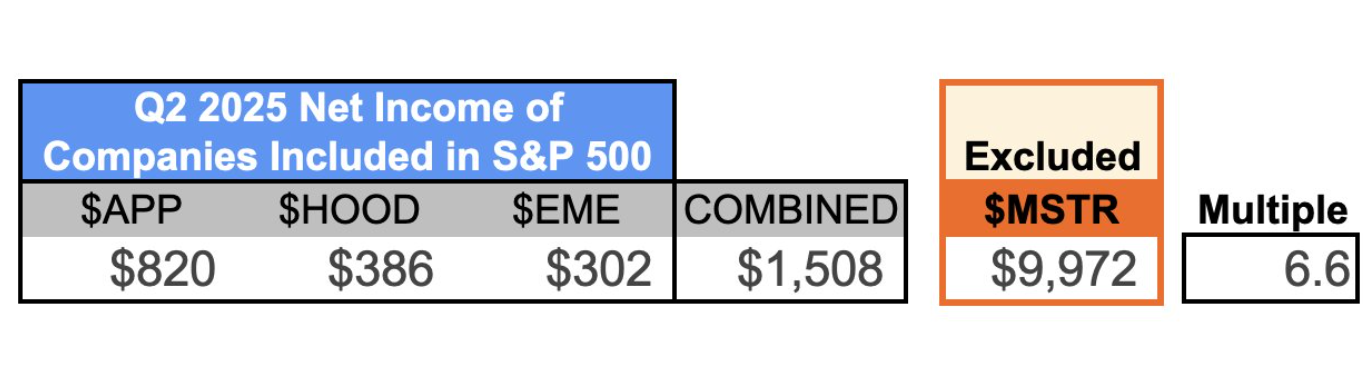
The debate was amplified by Jeff Walton, VP of Bitcoin Strategy at Strive Funds, who noted on X that “$MSTR had a Q2 2025 net income 6.6 times larger than the three companies added to the S&P 500 today — combined. The trailing 12-month net income is about 2.5 times greater than those three firms together, as if FASB rules were already in place.”
MSTR’s Q2 2025 earnings. | Source: @PunterJeff on X
Robinhood’s Surprise S&P 500 Inclusion: Fintech Enters the Big Leagues
In contrast, Robinhood Markets (NASDAQ: HOOD) earned an unexpected win. S&P Dow Jones Indices announced that Robinhood will replace Caesars Entertainment (CZR) in the index on September 22.
The news sent Robinhood’s stock up 6–7% after hours. The company has already more than doubled in value in 2025, and with a market cap north of $90 billion, it was one of the largest eligible names still outside the index.
Why Robinhood Got In
Founded in 2013 in Silicon Valley, Robinhood first made its mark by pioneering commission-free stock trades and drawing millions of new retail investors to its mobile app. Over the years, it added cryptocurrency trading, making coins like Bitcoin and Ether (ETH) as easy to buy as shares of Apple or Tesla.
In 2025, Robinhood doubled down on digital assets. It rolled out new crypto custody services, expanded its list of tradable tokens, and deepened integration with crypto wallets to give users more flexibility in moving their holdings. These moves helped Robinhood position itself not just as a stock brokerage but also as a gateway to crypto for mainstream investors.
Now, by being added to the S&P 500, Robinhood joins Coinbase (COIN) and Block (SQ) as the only crypto-linked names in the index, highlighting how digital asset firms are gradually entering Wall Street’s most elite club.
Robinhood made to the the S&P 500 because of many reasons, including:
Meets all the thresholds: Big enough, profitable, liquid, and U.S.-based.
Diversified business model: Known for commission-free stock trades and a large retail user base, Robinhood also offers crypto trading, but unlike Strategy, its revenues come from multiple sources.
Fintech validation: Robinhood’s inclusion underscores how far the fintech model has come since its pandemic-era surge. It joins Coinbase and Block as the only other crypto-linked names in the S&P 500.
Why Robinhood’s S&P 500 Debut Matters
For Robinhood, the S&P 500 debut is more than symbolic.
It means that index-tracking funds and ETFs will be required to buy its stock, automatically boosting demand and improving liquidity.
Beyond that, inclusion signals to the market that Robinhood has reached a new level of financial stability and credibility.
The company’s rise from a scrappy startup to a top-tier index member underscores how far fintech innovation has come. Its combination of commission-free trading and crypto offerings has reshaped how everyday Americans invest and now, with S&P 500 inclusion, Robinhood’s influence is being formally recognized by the financial establishment.
What Is the S&P 500 and How Do Companies Get In?
The Standard & Poor’s 500 Index (S&P 500) is one of the most widely followed benchmarks in global finance. It was introduced in March 1957 by Standard & Poor’s, a firm that later became part of S&P Global.
The index was created to provide a broad, market-capitalization-weighted measure of U.S. large-cap stocks, replacing earlier, narrower composites that covered fewer companies.
It tracks the performance of 500 of the largest publicly traded U.S. companies, covering about 80% of the U.S. stock market’s total value. Because trillions of dollars are tied to funds tracking it, inclusion or exclusion can move a stock dramatically.
Criteria for S&P 500 inclusion:
Market capitalization: An S&P 500 candidate must be a large-cap company. As of 2025, that generally means a market value well into the tens of billions of dollars. (For context, the smallest S&P 500 members at times hover around $6–8 billion, but new entrants typically far exceed that.) Morningstar reported that the index’s guidelines call for a market cap above roughly $22.7 billion for new additions, though the committee has some flexibility. Strategy Inc.’s $95B valuation and Robinhood’s $91B easily cleared this hurdle.
U.S. base: The firm must be headquartered in the United States and have the bulk of its assets and revenues in the U.S. market. Foreign issuers are excluded from the S&P 500 by design.
Liquidity and float: At least 50% of shares must be publicly available (not closely held by insiders or governments), and trading volume must be high. Additionally, the stock should have high liquidity, usually evidenced by trading at least 250,000 shares a day (often much more for large caps). These criteria prevent companies that, while large on paper, have thin trading and could be easily manipulated.
Financial viability: The company must be profitable in the most recent quarter and across the last four combined. In other words, the business should be currently profitable and not have an overall loss over the past year. This rule keeps out early-stage high-growth companies that are still losing money, as well as any large firms in temporary distress. For example, Tesla was only added after it finally achieved a string of profitable quarters. In this rebalance, Strategy Inc. clearing the profitability hurdle was notable; a year ago it wouldn’t have qualified on this metric due to bitcoin-related accounting losses.
Committee discretion: Even if a company meets all the criteria, inclusion is not automatic. The index committee has the final say to ensure the index remains balanced and representative.
This last point is crucial for understanding why Strategy, despite “qualifying on paper,” wasn’t selected.
Bloomberg analyst Eric Balchunas summed up the frustration on X, writing: “Why wasn’t $MSTR allowed into the S&P 500 Index despite meeting all the criteria? Because the ‘Committee’ said no. You have to realize SPX is essentially an active fund run by a secret committee.”
Why wasn't $MSTR allowed into the S&P 500 Index despite meeting all the criteria? Because the 'Committee' said no. You have to realize SPX is essentially an active fund run by a secret committee. We intv'd the dude who used to run this committee on Trillions. Check it out. pic.twitter.com/w334JrX9VO
It’s also worth noting that the timing of index changes can vary:
The S&P 500 is rebalanced on a regular schedule – typically quarterly, with announcements on the first Friday of the last month of each quarter (March, June, September, December) and changes taking effect about two weeks later. The Robinhood/AppLovin/Emcor news came right on schedule in early September.
However, most index changes actually happen off-schedule, triggered by corporate actions. S&P Dow Jones Indices frequently makes ad hoc adjustments when a current S&P 500 constituent is acquired, files bankruptcy, or splits into multiple companies.
By some analyses, roughly 90% of S&P 500 membership changes over the past few decades occurred outside the routine quarterly rebalances – for example, when big mergers close, the index may swap in a new firm to replace the acquired one promptly.
In other cases, if a company’s market cap plunges far below the cutoff or it ceases to meet criteria, the committee might do a special removal and addition. This flexibility helps keep the index reflective of the market’s reality in real time, not just at set intervals.
Other Additions in the S&P 500 September Rebalance
The committee also added two more companies:
AppLovin (APP): A leading app-monetization and marketing tech company, replacing MarketAxess (MKTX).
Emcor Group (EME): An industrial and construction services provider, replacing Enphase Energy (ENPH).
The reshuffle will take effect ahead of the opening bell on September 22, according to S&P Global. As part of the update, AppLovin will step in for MarketAxess, while Robinhood replaces Caesars Entertainment.
The index, already heavily weighted toward major technology names, has welcomed other growth companies this year, including Datadog and DoorDash.
This underscores the competitive nature of S&P 500 entry: plenty of companies meet the thresholds, but only a few slots open each quarter.
The Committee’s Discretion: Eligibility Doesn’t Guarantee Inclusion
The September reshuffle is a reminder that the S&P 500 is not a purely rules-based index. The committee explicitly states that meeting the requirements only makes a company eligible, not automatically included.
That discretion explains why Robinhood made it while Strategy didn’t and why the latter’s advocates may need to wait another quarter (or more) for inclusion.
Conclusion
The September reshuffle of the S&P 500 highlights just how much weight the index committee’s discretion carries. Strategy Inc. (MSTR) met every requirement on paper but was passed over, likely due to concerns about its heavy reliance on Bitcoin.
Meanwhile, Robinhood (HOOD) secured a spot, validating fintech’s rise and the growing but selective acceptance of crypto-linked firms.
With AppLovin and Emcor also joining the index, the latest changes show that eligibility is only the starting point, the real decision rests with the committee.
For Michael Saylor’s Bitcoin bet, the message is clear: the mainstream may not be ready for a pure Bitcoin-treasury play just yet.
Because it satisfied all inclusion criteria and represents a large, profitable, and diversified fintech. Its addition reflects fintech’s growing importance and compels index funds to buy the stock, boosting liquidity and visibility.
Why wasn’t Strategy (MSTR) included despite qualifying S&P 500 inclusion?
The committee gave no official reason, but its methodology stresses discretion. Analysts cite Strategy’s extreme Bitcoin exposure and newly achieved profitability as possible factors.
What other companies were added to or removed from S&P 500?
AppLovin and Emcor were added alongside Robinhood. Caesars Entertainment, MarketAxess, and Enphase Energy were removed.
Does meeting the S&P 500’s criteria guarantee inclusion?
No. Meeting the criteria makes a company eligible, but inclusion is decided by the index committee’s judgment on factors like sector balance and financial stability.
Disclaimer:
The information provided in this article is for informational purposes only. It is not intended to be, nor should it be construed as, financial advice. We do not make any warranties regarding the completeness, reliability, or accuracy of this information. All investments involve risk, and past performance does not guarantee future results. We recommend consulting a financial advisor before making any investment decisions.
Onkar Singh has three years of experience as a digital finance content creator. Throughout his career, he has collaborated with various DeFi projects and crypto media outlets. In his leisure time, he enjoys fitness activities at the gym and watching movies across different genres. Balancing his professional and personal interests, Onkar continues to contribute to the digital finance landscape while pursuing his hobbies.


 Easy
Easy