Futures, options, and leveraged positions can trigger cascading liquidations, causing sharp and rapid price movements of BTC beyond the influence of retail traders.
Experts note that structural drivers remain strong, making long-term BTC prospects compelling.
Bitcoin slipping under $100,000 has reignited a question that resurfaces every cycle: Who’s actually responsible for these wild price swings?
Spoiler: It’s not the average investor buying $50 a week on a crypto app. Nor is it the casual day trader hoping to time the bottom.
The reality is that a complex network of forces shapes Bitcoin’s price: some transparent, some hidden, and most operating on a scale much larger than anything retail investors can influence.
When BTC breaks a major psychological level, it’s rarely because you or I bought or sold a few hundred dollars’ worth. It’s because deep-pocketed players and macro-level mechanisms are shifting the market.
Let’s break down who really moves the BTC price when it takes a plunge or goes on a tear.
Crypto Whales and Large Holders: The Biggest Drivers Behind Bitcoin Price Swings
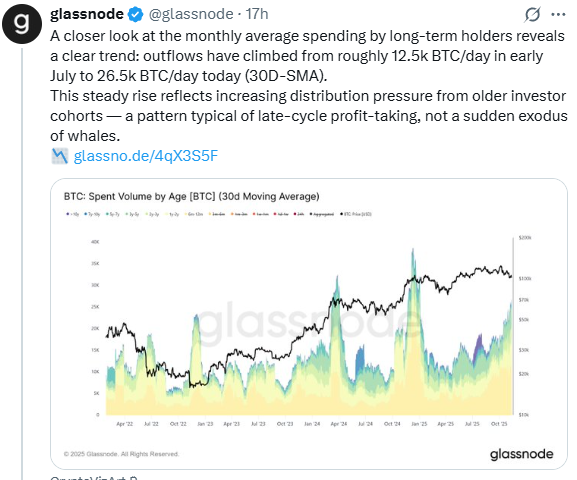
When Bitcoin was young, a handful of early adopters and miners controlled a significant portion of the supply. While ownership has broadened, whale wallets holding thousands to hundreds of thousands of BTC still command enormous influence.
Average spending by BTC long-term holders. | Credit: Glassnode X profile
Why Whales Matter
A single whale can hold more Bitcoin than an entire exchange’s daily spot volume.
When they transfer BTC to exchanges, traders interpret it as potential selling pressure.
Even the appearance of whale activity can shift liquidity and sentiment.
In a low-liquidity moment, such as a weekend or after a prolonged rally, one massive sell order can trigger a broader downturn.
Institutional Investors and ETFs: How Big Money Controls Bitcoin’s Direction
Institutions used to stay away from Bitcoin. Now they shape almost every major move, thanks to ETFs, hedge fund flows, and publicly traded companies with BTC-heavy strategies.
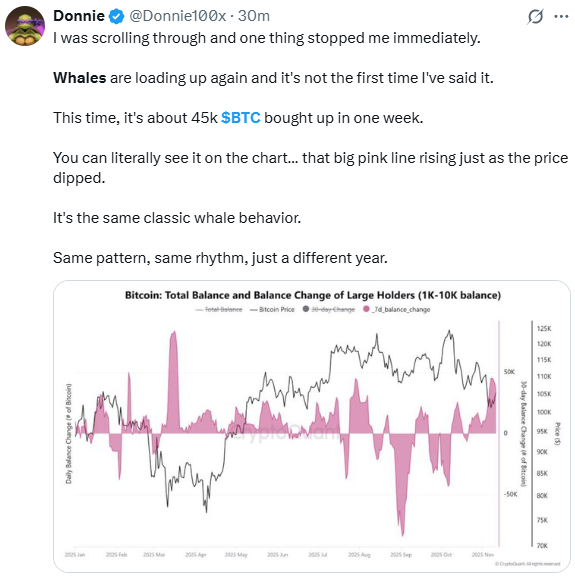
Whales are loading up again. | Credit: Donnei100x X profile
This inversion has sparked debate for two reasons:
It suggests investors doubt the sustainability of Michael Saylor’s long-standing “never sell” pledge. If markets believe Strategy might someday be forced to sell, that creates psychological pressure.
It highlights how Bitcoin-heavy corporate structures can become sentiment indicators. When a company built entirely on BTC leverage trades at a discount to its own BTC stash, markets read it as a stress signal.
Some analysts, including Bitget CEO Gracy Chen, argue that the next significant Bitcoin move may now hinge not on corporate buyers, but on macroeconomic shifts, specifically interest rate cuts. A more dovish environment could restore confidence; sustained high rates could deepen the inversion.
Corporate treasuries don’t just buy Bitcoin; they shape narratives. And narratives move prices.
Market Makers and Liquidity Providers: The Hidden Forces Behind Bitcoin Volatility
Market makers (MMs) don’t predict Bitcoin’s direction: they scaffold the market’s structure.
How market makers influence BTC price:
They tighten or widen spreads depending on volatility.
They hedge exposure across spot, futures, and options.
During fast crashes, they pull back, leading to thinner books and larger moves.
When liquidity dries up, even modest institutional orders can produce dramatic price swings.
Leveraged Trading, Futures and Liquidations: Why Bitcoin Crashes So Quickly
The derivatives market now has a greater influence on BTC than spot trading.
Why leverage drives extreme volatility:
Traders build up large leveraged positions.
A small dip triggers stop-losses and liquidations.
Exchanges automatically sell positions to protect collateral.
Selling begets more selling.
A cascade forms, pushing BTC far below its “natural” price.
This mechanical feedback loop is why Bitcoin often plunges sharply, then stabilizes just as quickly: the leverage resets.
Options markets add another layer, with hedging flows around expiration dates contributing to predictable volatility bands.
Retail cannot compete with a liquidation engine handling billions in leveraged contracts.
Bitcoin Miners: The Long-Term Supply Pressure That Influences BTC Price Trends
Miners steadily sell BTC to cover operational costs. Their influence is subtle but persistent.
Miners move the market when:
BTC price drops below miner breakeven levels.
Energy costs surge.
Halvings cut block rewards.
Major mining firms capitulate or liquidate assets.
Miner selling rarely causes sudden crashes, but it can amplify downward momentum, especially if miners transfer unusually large amounts to exchanges.
Global Economic Conditions: Why Macro Forces Push Bitcoin Up or Down
Bitcoin’s biggest moves are increasingly driven by global macroeconomic conditions, rather than crypto-specific news.
Major macro triggers:
Interest rate cuts or hikes.
Inflation data.
Bond yield shifts.
Liquidity cycles.
Currency devaluation.
Geopolitical tensions.
Bitget CEO Gracy Chen’s view reflects a growing consensus: the next major Bitcoin move hinges on whether interest rates begin to fall.
A lower-rate environment could reignite risk appetite and ETF inflows; higher-for-longer rates keep pressure on speculative assets, especially those with leverage-heavy ecosystems.
Retail sentiment cannot override the global cost of capital.
Media, Social Sentiment and Narratives: The Emotional Layer That Amplifies BTC Moves
Narratives don’t cause giant moves, but they accelerate them.
Narrative drivers include:
Fearful headlines amplify sell-offs.
Influencers and social media drive crowd behavior.
Coverage of events like the Strategy inversion shapes expectations.
AI-driven trading models scrape sentiment and react instantly.
Narratives are the emotional layer on top of structural market forces.
Bitcoin’s Dip Below $100K: Buying Opportunity or More Pain Ahead? Experts Weigh In
With Bitcoin back under $100,000, is it a good time to buy the dip? Or another downside move is on the horizon?
Nigel Green, CEO of the advisor deVere Group, told CCN that the renewed slide, which has taken Bitcoin to its weakest level since May, has triggered intense speculation about whether deeper losses are coming, but the underlying dynamics point to something very different.
“Every major correction in Bitcoin’s history has opened the door to substantial upside for patient investors. This cycle is likely to be no exception,” he notes.
“The structural drivers are strengthening even as short-term sentiment weakens.”
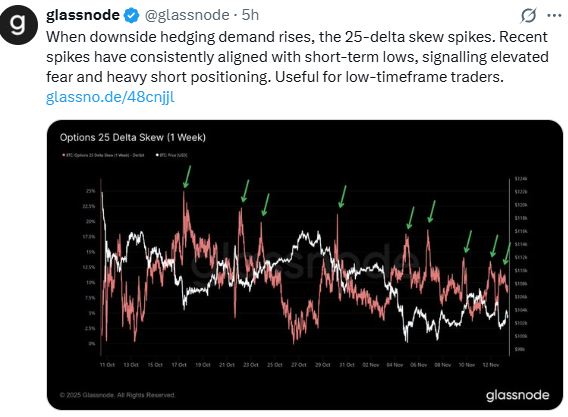
Recent BTC spikes have aligned with short-term lows. | Credit: Glassnode X profile
Green highlights the fixed-supply model, the expanding participation of institutions and sovereign entities, and the embedding of digital-asset infrastructure across global finance.
“Bitcoin remains the reference asset for the digital economy. Its role is increasing, not diminishing,” he says.
The recent selling by long-term holders is significant, yet the deVere chief executive views it as part of a typical reset phase following an extended run.
“Corrections clear excess leverage, concentrate ownership, and reset expectations. Those resets typically create fertile ground for the next expansion,” he says.
He believes many investors will bide their time before re-entering the market. “This period will likely attract capital that has been waiting on the sidelines for a decisive entry point,” he says.
“When the dust settles, the blend of lower prices, stronger hands and ongoing adoption becomes highly compelling.”
Bitcoin’s drop below $100K is driven by a combination of factors, including whale activity, institutional flows (like ETFs), leveraged trading liquidations, macroeconomic conditions, and market sentiment. Retail investors have minimal influence on major price swings.
Who are the whales in Bitcoin, and how do they affect the market?
Whales are large holders of Bitcoin, often owning thousands to hundreds of thousands of BTC. Their movements, such as transferring Bitcoin to exchanges, can create selling pressure and trigger broader price fluctuations, particularly during periods of low liquidity.
How do institutional investors and ETFs influence Bitcoin price?
Institutional investors, through ETFs, hedge funds, and corporate treasuries, now control billions in BTC flows. Large ETF inflows can spark rallies, while outflows create downward pressure. Corporate actions, such as Strategy trading below its BTC holdings, also affect market sentiment.
Should investors buy Bitcoin during corrections under $100K?
Experts suggest patience. Corrections often reset leverage, concentrate ownership, and create fertile ground for future gains. Lower prices combined with strong hands, institutional adoption, and ongoing infrastructure growth can provide compelling long-term opportunities.
Giuseppe Ciccomascolo began his career as an investigative journalist in Italy, where he contributed to both local and national newspapers, focusing on various financial sectors.
Upon relocating to London, he worked as an analyst for Fitch's CapitalStructure and later as a Senior Reporter for Alliance News. In 2017, Giuseppe transitioned to covering cryptocurrency-related news, producing documentaries and articles on Bitcoin and other emerging digital currencies. He also played a pivotal role in establishing the academy for a cryptocurrency exchange website. Crypto remained his primary area of interest throughout his tenure as a writer for ThirdFloor.


 Easy
Easy