A major Cloudflare outage knocked offline Coinbase, Kraken, Aave, Etherscan, and more. See the full list of impacted crypto platforms and what caused the disruption. | Credit: CCN.com
Share
Key Takeaways
IBM’s new Digital Asset Haven platform, built with Dfns, is offering a unified solution for managing the entire digital asset lifecycle.
The platform integrates tools to eliminate single points of failure and strengthen protection against hacks and thefts.
As corporate interest in digital assets grows, Digital Asset Haven is set to launch in late 2025.
International Business Machines Corp (IBM) on Monday announced the launch of Digital Asset Haven, a platform designed to help banks, governments, and corporations manage and secure digital assets as institutional adoption accelerates.
However, as holdings surge, advisory firms are warning that the complexity of managing digital assets is also intensifying, raising the question of whether corporate crypto security can improve.
Try Our Recommended Crypto Exchanges
Sponsored
Disclosure
We sometimes use affiliate links in our content, when clicking on those we might receive a commission at no extra cost to you. By using this website you agree to our terms and conditions and privacy policy.
Developed with digital wallet infrastructure firm Dfns, the new digital asset “haven” integrates IBM’s enterprise-grade infrastructure and security with Dfns’ custody and key management capabilities.
IBM said the system offers institutions a single solution for the full digital asset lifecycle, from custody and transactions to settlement.
The aim of the platform is to reduce the burden of meeting compliance and regulatory requirements.
The platform will connect with more than 40 public and private blockchains and includes pre-integrated tools for identity verification, anti-money laundering and yield generation, according to IBM.
Hacks on the Rise
The launch comes amid growing concerns over the surge in crypto-related hacks and thefts, which continue to worry institutional investors.
According to blockchain analytics firm Chainalysis, technical wallet infrastructure improvements “have proven essential for institutional security” over the past year.
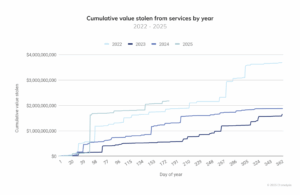
In the firm’s mid-year crime update in July, research found that over $2.17 billion had been stolen from crypto services so far in 2025.
“While the ecosystem has matured in terms of regulatory frameworks and institutional security practices, threat actors have correspondingly upgraded their capabilities and expanded their range of targets,” the firm wrote.
IBM’s Security Protocols
IBM says its Digital Asset Haven platform is designed to address these vulnerabilities on a large scale.
The platform will use IBM’s Hardware Security Modules (HSMs) and multi-party computation for cryptographic key management, aiming to reduce single points of failure, the company said.
IBM added that the system integrates the IBM Offline Signing Orchestrator, which enables cold storage operations—an approach where private keys are stored in offline environments to prevent unauthorized access.
These mechanisms are increasingly required in several regulated jurisdictions, IBM noted.
“With IBM Digital Asset Haven, our clients have the opportunity to enter and expand into the digital asset space backed by IBM’s level of security and reliability,” said Tom McPherson, general manager of IBM Z.
IBM said the platform will be available via SaaS and hybrid cloud models in the fourth quarter of 2025, with on-premises deployment expected in mid-2026.
The Need For Corporate Crypto Security
Over 6,000 businesses were using Bitcoin as a form of payment in 2024, according to financial advisory Deloitte.
In its 2025 perspective report, The Use of Cryptocurrency in Business, the firm sounded the alarm on the complex risks of corporate crypto security.
Security must remain a central focus even when companies use third-party custodians or payment processors, Deloitte said.
“Since the third party is an agent, ensuring that settlement actually occurs is still the responsibility of the company,” Deloitte wrote. “You cannot shift all regulatory and compliance responsibility to another provider.”
The report also highlighted that strong internal controls are essential for protecting corporate crypto operations from both fraud and cyber threats.
“Pay close attention to the vendor’s internal controls; financial well-being; security over their operations, such as cybersecurity in conformity with accepted standards; detection of fraud schemes; and the reliability and accuracy of all conversions to fiat currency,” Deloitte advises.
Beyond vendor oversight, companies are urged to reinforce operational safeguards within their own accounting processes.
“Make certain the company staff responsible for processing and confirming the receipt of the crypto transactions is segregated from the staff processing refunds,” the report recommends.
“The staff responsible for processing and confirming should not be authorized to make outward payments from those receiving crypto addresses.”
The advisory also flags emerging risks tied to Layer-two blockchain protocols, which can expose companies to potential manipulation if transactions are not immediately recorded on the blockchain.
“It is during that transition from execution to recording on the blockchain that there can be room for error or manipulation by a hostile party, should they gain access to the network,” Deloitte warns.
Corporate Bitcoin Holdings Surge 40%
Corporate ownership of Bitcoin surged nearly 40% in the third quarter, marking the strongest quarterly increase on record, according to data from Bitwise’s Corporate Bitcoin Adoption, Q3 2025 report.
The number of publicly listed firms holding Bitcoin rose to 172, up from 123 in the previous quarter.
Together, those companies now control about 1.02 million BTC, equivalent to roughly 4.8% of total supply and valued at $117 billion as of September 30.
There are almost 40% more public companies holding bitcoin today than there were 3 months ago.
Bitwise said the rise was driven by a series of large acquisitions and new entrants into the market.
The increase in corporate exposure comes despite limited price movement in Bitcoin, which has struggled to sustain gains following a volatile summer.
CCN analyst Victor Olanrewaju explained that Bitcoin’s price “hasn’t reacted strongly to corporate adoption because most institutional purchases happen over-the-counter.”
“These private transactions don’t hit public exchanges, so they have minimal immediate impact on the coin’s value,” he added. “In the short term, BTC might experiences consolidation. However, a notable correction is unlikely,” he said.
Kurt Robson is a London-based reporter at CCN, specialising in the fast-moving worlds of crypto and emerging technology. He began his career covering local news in Cornwall after graduating from Falmouth University with First Class Honours in Journalism. There, he cut his teeth on everything from council meetings to missing swans.
He quickly rose through the ranks to become a frontline journalist at several of the UK’s leading national newspapers. Over the years, he has interviewed musicians and celebrities, reported from courtrooms and crime scenes, and secured multiple front-page exclusives.
Following the upheaval of the COVID-19 pandemic, Kurt shifted his focus to technology journalism—just ahead of the AI boom. With a natural curiosity and a trained eye for emerging trends, he has found a new rhythm in reporting on innovation.
At CCN, Kurt's work focuses on the cutting edge of crypto, blockchain, AI, and the evolving digital world. Drawing on his background in people-first reporting and his deep interest in disruptive tech, Kurt delivers stories that are insightful, entertaining, and human-centric.














 ‘It’s Going Higher’ Arthur Hayes Doubles Down as Ethereum Finds Its Footing