Bitcoin’s sharp drop from $126K to under $98K has rattled investors. Could Dollar-Cost Averaging turn this crash into a long-term opportunity? | Credit: CCN.com
Share
Key Takeaways
BTC has fallen below $98,000 after peaking near $126,000, erasing over $450 billion in market value.
Fear dominates the market as leveraged positions unwind and investors retreat from risk.
Dollar-cost averaging (DCA), regularly investing a fixed sum regardless of price, has proven effective at turning volatility into opportunity.
Analysts advocate discipline, gradual buying, and risk management. A staged DCA approach allows investors to accumulate through downturns while avoiding the pitfalls of market timing.
Bitcoin has fallen sharply below the $100,000 mark, sending shockwaves through global crypto markets and officially pushing the digital asset into bear market territory. The flagship cryptocurrency dropped as much as 3.9% to around $97,956, deepening a sell-off that has erased more than $450 billion in market value since early October.
After reaching an all-time high of roughly $126,000 just weeks earlier, Bitcoin’s sudden collapse reflects how quickly sentiment can turn in the high-risk world of digital assets.
This latest downturn, driven by a series of macroeconomic shocks and record-breaking liquidation events, marks one of Bitcoin’s steepest reversals in recent years.
The cascade began when fears of a global trade war and rising economic uncertainty triggered panic selling and the largest one-day liquidation in crypto history, over $19 billion in leveraged positions wiped out within hours. In the days that followed, Bitcoin tumbled from its $122,000 weekly high to near $104,000, shaking confidence across the entire market.
Now officially in a crypto bear market (defined by a >20% drop from its peak), Bitcoin is struggling to find a floor. “High risk-off sentiment is canceling out optimism about a more clement environment for coins,” observed Susannah Streeter, head of money and markets at Hargreaves Lansdown, noting that investors are fleeing risky assets en masse.
Institutional buyers, once a cornerstone of Bitcoin’s 2025 rally, have largely stepped aside, amplifying price fragility and leaving retail investors to shoulder the volatility.
Crypto Bear Market 2025: Causes and Sentiment Shift
Bitcoin’s sharp correction stems from a convergence of global economic headwinds. The re-escalation of U.S.–China trade tensions, the announcement of steep tariffs, and ongoing worries about central bank tightening have fueled a broad retreat from risk assets. Adding to the pressure, a record-long U.S. government shutdown in late 2025 drained liquidity from financial markets, reducing institutional buying power and exacerbating Bitcoin’s decline.
This combination of macro uncertainty and thinning liquidity created the perfect storm for a sell-off. Within weeks, Bitcoin surrendered nearly all its gains for the year. The total crypto market, once up more than 40% in 2025, now clings to a meager 2.5% year-to-date increase.
Analysts also note that Bitcoin, despite its reputation as “digital gold,” has behaved much like a traditional risk asset, vulnerable to the same macro shocks affecting equities and commodities. Gold, for example, has surged roughly 66% year-to-date, vastly outperforming Bitcoin’s modest 10% gain.
Still, not all observers view the crash as entirely negative. Some analysts argue that the sell-off has purged excessive leverage and speculative froth from the system, potentially laying the groundwork for a more sustainable recovery. “The good news is that this crash has cleaned out the excessive leverage and reset the risk in the market,” said Nic Puckrin, crypto analyst and co-founder of The Coin Bureau, cautioning that Bitcoin still faces tough resistance levels before any lasting rebound.
For long-term believers in Bitcoin’s potential, the key question now is whether this volatility can be transformed into opportunity and whether strategies like dollar-cost averaging (DCA) offer a disciplined way to navigate the storm.
Dollar-Cost Averaging: Turning Bitcoin Volatility Into an Advantage?
DCA has emerged as one of the most discussed investment strategies in the wake of Bitcoin’s recent crash. The concept is simple yet powerful: invest a fixed amount of money into Bitcoin at regular intervals, weekly, monthly, or quarterly, regardless of the price. Over time, this approach smooths out the average purchase cost and removes the emotion and guesswork from market timing.
For instance, if an investor buys $50 of Bitcoin each week, that $50 buys less when prices are high and more when they drop. This automatic buying discipline can turn Bitcoin’s volatility from an enemy into an ally. When markets crash, DCA investors are effectively “buying the dip” by accumulating more Bitcoin at cheaper prices.
🧵The Power of DCA into Bitcoin
Dollar-cost averaging (DCA) = investing a fixed amount at regular intervals, no matter the price.
It smooths volatility. It captures long-term growth.
Historical data supports the effectiveness of this approach:
A study found that investing just $10 per week into Bitcoin over five years, about $2,620 in total, would have grown to around $7,913, a return of over 200%. The reason for this impressive performance lies in Bitcoin’s extreme cycles: sharp sell-offs allow disciplined investors to accumulate more at lower prices, while subsequent rallies amplify long-term gains.
Even more striking, according to Michael Saylor, an investor who had followed a $30-per-day DCA strategy from 2016 through early 2025 (investing roughly $98,000 total) would now hold a Bitcoin portfolio worth around $2.2 million. That outcome underscores how consistent accumulation, especially during downturns, can dramatically enhance long-term returns.
While not every period will deliver such outsized results, DCA has proven to be one of the most psychologically sustainable ways to invest in volatile assets like Bitcoin. It avoids the common pitfall of emotional buying and selling, and it keeps investors engaged even when sentiment turns bleak.
BTC Price Decline Below $98K — Experts Weigh In on Patience, Strategy and Risk Management
With Bitcoin trading under $100,000, experts remain divided on what comes next. Some see the current dip as a fleeting opportunity, while others warn that macro risks could keep prices depressed for longer.
How to make it: “Effectively protect and increase your economical energy”
DCA Bitcoin with % of the surplus from your monthly income
If there’s no surplus, you have a different and bigger problem
He advises allocating 25% now, 25% after confirmation of a trend reversal, and 50% later, arguing that “the dip below $100K may be the last one ever” for Bitcoin.
His team remains bullish long term, viewing sub-$100K prices as a potential “last chance” for accumulation before the next upswing.
Another practical method is to apply DCA into Bitcoin using a small, consistent percentage of your monthly surplus income.
“DCA Bitcoin with % of the surplus from your monthly income. If there’s no surplus, you have a different and bigger problem,” one analyst explained.
Historically, Bitcoin has often rebounded strongly in the fourth quarter, and some believe this pattern could repeat if macro conditions stabilize. On-chain data also indicates that long-term holders and large investors (“whales”) are quietly buying during the dip, shifting capital from weaker altcoins into Bitcoin as part of an accumulation strategy.
However, skeptics emphasize that volatility remains high and external risks, ranging from inflation to geopolitical instability, could keep Bitcoin under pressure. They caution investors not to underestimate how long “crypto winter” can last. The overarching message: stay disciplined, manage risk, and avoid overexposure.
ChatGPT’s Take: DCA Isn’t Magic — But It’s Smart in Volatile Times
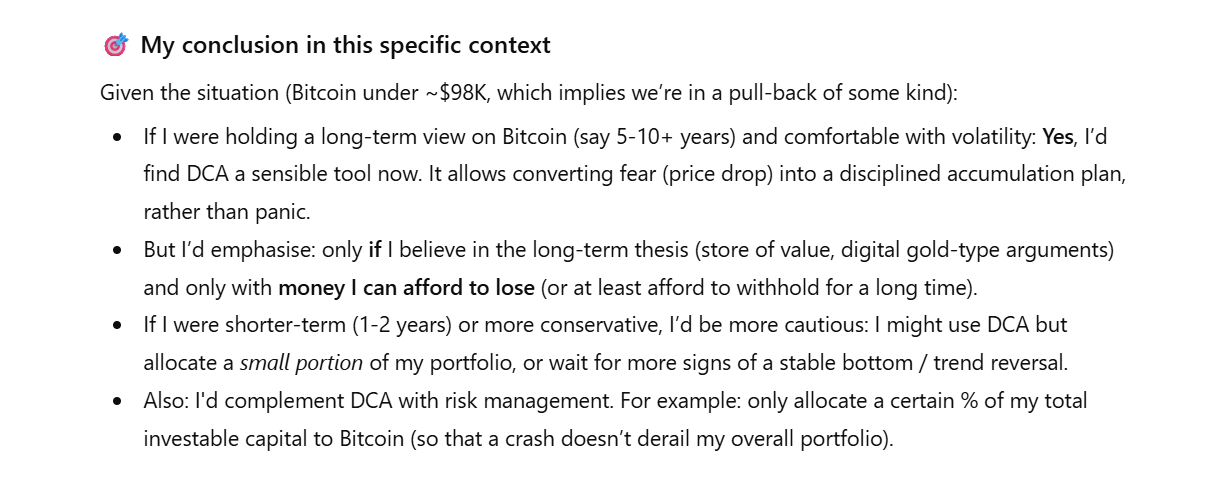
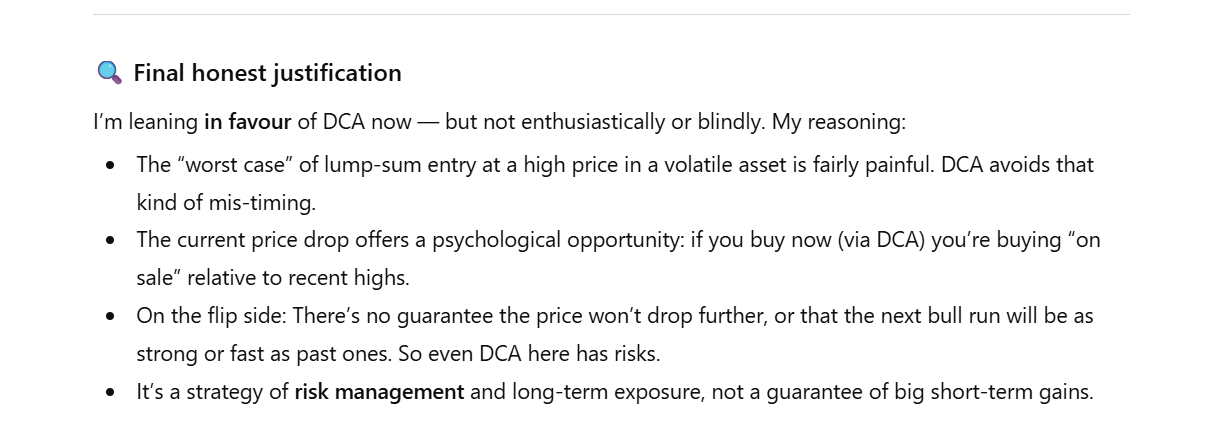
According to ChatGPT, with Bitcoin dipping below $ 98,000, the market is clearly in a pullback phase. In this context, DCA emerges as a rational approach, not because it guarantees profits, but because it enforces discipline over emotion.
Question to ChatGPT. | Credit: ChatGPT
If ChatGPT were approaching this as a long-term investor (5–10+ years) with a high tolerance for volatility, it would view DCA as a sensible strategy right now. The method helps convert fear into opportunity, gradually accumulating Bitcoin while prices are under pressure, rather than attempting to “time the bottom.”
However, this approach only makes sense for those who believe in Bitcoin’s long-term fundamentals, such as its potential role as a store of value or “digital gold.” ChatGPT emphasizes that investors should only commit capital they can afford to lose or lock up for the long term.
For individuals with shorter investment horizons (1–2 years) or lower risk tolerance, ChatGPT advises caution. A smaller DCA allocation, or waiting for clearer technical and market signals, could be a more prudent move.
ChatGPT’s conclusion. | Credit: ChatGPT
Additionally, ChatGPT underscores the importance of risk management. No single asset, even Bitcoin, should dominate a portfolio. Keeping position sizes reasonable helps shield investors from deep drawdowns or extended bear markets.
First response. | Credit: ChatGPT
Should You Buy the Dip?
Bitcoin’s sharp decline below $100,000 highlights the ongoing tension between risk and potential reward in volatile markets. Buying the dip offers the possibility of significant returns if prices recover, but it also exposes investors to further downside should the bear trend persist.
Bitcoin falls below $100k
“Crypto is a scam”
“Bitcoin is a bubble”
“You all will lose money”
All the blablabla right until US starts printing money again and Bitcoin pops to $150k+ (basic liquidity rule)
Idk why dont these ppl learn to buy during red. Works every time haha.
Historical data shows that Bitcoin’s recoveries can be rapid yet unpredictable, making timing a major challenge. Approaches such as DCA illustrate the trade-off between short-term volatility and long-term opportunity but do not remove risk.
Ultimately, Bitcoin’s price swings reflect its dual nature as both a high-risk asset and a vehicle for potential long-term growth, leaving the balance between return and uncertainty at the core of any investment decision.
The drop was driven by a combination of macroeconomic shocks and cascading liquidations. The reintensification of the U.S.–China trade war, new tariffs, and a prolonged U.S. government shutdown created liquidity stress that drained institutional participation. As leveraged bets unwound, the sell-off deepened, pushing Bitcoin into a bear market.
What is Dollar-Cost Averaging (DCA)?
DCA is a strategy where investors allocate a fixed amount of money into Bitcoin at regular intervals, regardless of its price. This method averages out the purchase cost over time and removes emotional decision-making. It’s particularly useful in volatile markets where prices fluctuate dramatically.
How can DCA help in a bear market?
During downturns, DCA allows investors to buy more Bitcoin for the same amount of money, effectively turning volatility into a long-term advantage. As prices recover, these accumulated lower-cost purchases can yield strong returns. While DCA doesn’t guarantee profits, it reduces the risk of investing all funds at a market peak.
What strategies do analysts recommend now?
Experts advocate patience and prudence. Many suggest staggered buying, splitting purchases into phases and sticking to a consistent DCA plan. Risk management remains vital: invest only what you can afford to hold long term, diversify your portfolio, and avoid chasing short-term price swings.
Disclaimer:
The information provided in this article is for informational purposes only. It is not intended to be, nor should it be construed as, financial advice. We do not make any warranties regarding the completeness, reliability, or accuracy of this information. All investments involve risk, and past performance does not guarantee future results. We recommend consulting a financial advisor before making any investment decisions.
Dr. Guneet Kaur is a senior editor at CCN.com and a Science Fellow at Exponential Science. She is a fintech and blockchain expert with extensive experience in digital finance education, blockchain ecosystems, and cryptocurrency markets. She has worked with global media such as Cointelegraph, as well as education and blockchain platforms, to design and lead strategic content and learning initiatives. As an educator and assessor for top-tier executive programs, she bridges real-world fintech trends with academic insight.
Dr. Kaur is also a published researcher and peer reviewer across fintech and data science journals, including Financial Innovation Journal and International Journal of Big Data Intelligence and Applications. Her work spans data-driven analysis, Web3 innovation, and technical content development. With a strong foundation in both industry and academia, she translates complex financial technologies into practical applications, empowering learners, professionals, and institutions across the rapidly evolving digital finance landscape.
Giuseppe Ciccomascolo began his career as an investigative journalist in Italy, where he contributed to both local and national newspapers, focusing on various financial sectors.
Upon relocating to London, he worked as an analyst for Fitch's CapitalStructure and later as a Senior Reporter for Alliance News. In 2017, Giuseppe transitioned to covering cryptocurrency-related news, producing documentaries and articles on Bitcoin and other emerging digital currencies. He also played a pivotal role in establishing the academy for a cryptocurrency exchange website. Crypto remained his primary area of interest throughout his tenure as a writer for ThirdFloor.


 Easy
Easy