Bitcoin Miners Are Going Dark as Hash Revenue Falls 35% — ROI Now Tops 1,000 Days
Share
Key Takeaways
In 2025, seven solo miners found blocks despite network difficulty exceeding 126 trillion.
Devices ranged from ultra-low power Bitaxe rigs to full ASIC setups.
These wins confirmed that even non-industrial miners can still compete.
Solo CKPool enabled small-scale miners to retain full rewards and stay independent.
In 2025, Bitcoin’s network difficulty climbed beyond 134.7 trillion, making solo mining feel like buying a lottery ticket with astronomical odds.
Industrial-scale Application-Specific Integrated Circuit (ASIC) farms with exahashes of power dominated the field, while hobbyist rigs had chances of one in a million or worse. Against all odds, seven small operators still managed to hit a block.
Their setups looked nothing like the warehouse rows of Antminers or Whatsminers, industrial-grade Bitcoin machines that drive most of the network’s hashrate. Instead, these were compact, low-power devices such as the Bitaxe and the FutureBit Apollo II, Bitcoin miners.
Built around single-chip ASICs, they lack the raw output of industrial hardware, yet their affordability, accessibility, and open-source roots set them apart as a different class of miner.
This article tells the story of those 7 solo miners, how they managed to strike Bitcoin blocks with modest rigs and why their wins highlight the ongoing role of small-scale mining in a network dominated by industrial power.
Try Our Recommended Crypto Exchanges
Sponsored
Disclosure
We sometimes use affiliate links in our content, when clicking on those we might receive a commission at no extra cost to you. By using this website you agree to our terms and conditions and privacy policy.
Inside the 2025 Solo Mining Wins: Hashrate, Transactions, Odds, and Rewards
Before going deeper, it is essential to note that the following list breaks down each of the 2025 solo wins with key details: how much power was used, how many transactions were included, how rare the event was, and what kind of reward the miner took home. These are essential technical stats that give context to the scale of each win.
What are GH/s, TH/s, and PH/s?
This refers to the power used, which shows whether the miner ran a single low-cost device or something closer to a small ASIC setup.
These units stand for how many hashes per second a miner can calculate. A hash is a complex mathematical puzzle that Bitcoin miners try to solve to earn a block reward.
GH/s (gigahashes per second) = 1 billion hashes per second. Example: Bitaxe Ultra (480 GH/s)
TH/s (terahashes per second) = 1 trillion hashes per second. Example: Antminer S19 (75–110 TH/s)
PH/s (petahashes per second) = 1 quadrillion hashes per second. Example: Large mining farms or setups with hundreds of ASICs
The higher the number, the more powerful the miner. More power means more chances to solve a block, but also more electricity used.
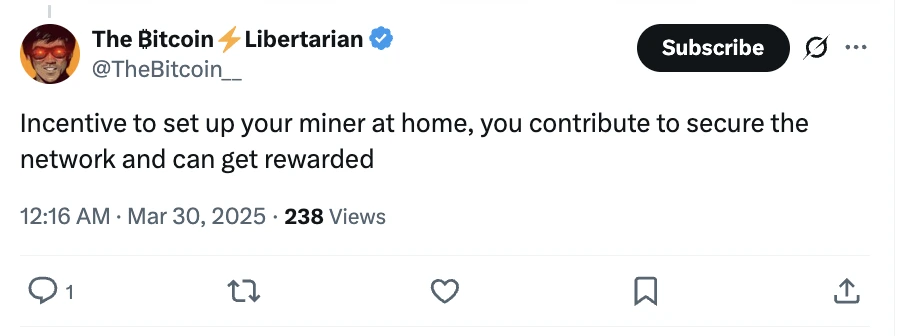
Additionally, a common misconception is that solo mining and mining at home are the same thing. They are not.
Solo mining means a miner works entirely on their own, without joining a pool. They run a full node, validate transactions, and try to find a block by themselves. If they succeed, they earn the full block reward. However, without massive hashrate, the odds of success are extremely low.
Mining at home refers to operating hardware such as small ASICs at a personal setup. Since GPUs are no longer effective for Bitcoin, home miners typically join mining pools. In a pool, they contribute hashpower and receive a share of the rewards in proportion to the work performed.
So, when a small device like a Bitaxe (480 GH/s) finds a block while competing with industrial farms doing 60+ PH/s, it’s like winning the lottery with a single ticket against millions.
The number of transactions reveals how active the Bitcoin network was then and how much in fees may have been earned.
What Transaction Count and Probability Really Show
A block with over 4,000 transactions signals a busy mempool, while one under 2,000 reflects lighter activity.
Probability captures how unlikely each solo win really was based on the miner’s hashrate compared to the global Bitcoin network hashrate, which in 2025 averaged more than 900 exahashes per second (EH/s). One miner beat odds of one in 1.5 million per day. Another had a one-in-800 chance.
Comparing them shows that not all solo wins are the same. Rarity comes in degrees, making it worth examining how each miner beat the odds.
Here it is, 7 solo wins, each with the numbers that tell the whole story.
Block #
Date
Power Used
Reward (BTC / USD)
Transactions
883,181
Feb 10, 2025
75 TH/s (3 kW, Antminer S19-class)
3.15 BTC ($300,000)
3,071
887,212
Mar 10, 2025
480 GH/s (Bitaxe Ultra, 20W)
3.15 BTC ($263,000)
3,433
889,975
Mar 29, 2025
1.2 TH/s, 18W (Bitaxe Gamma, stock, 15 J/TH)
3.149 BTC ($259,637)
1,610
903,883
Jul 4, 2025
2.3 PH/s (small farm)
3.173 BTC ($349,028)
3,949
907,283
Jul 26, 2025
Small ASIC (30W, CKPool)
3.15 BTC ($372,773)
4,038
910,440
Aug 17, 2025
10 TH/s (300W, CKPool)
3.137 BTC ($373,000)
4,913
913,632
Sep 8, 2025
500 GH/s (Bitaxe Ultra-class)
3.14 BTC ($348,111)
1,956
Block 883,181
Date: February 10, 2025
Power used: 75 TH/s (estimated; likely a single Antminer S19-class ASIC drawing 3 kW)
Reward: 3.15 BTC ($300,000)
Transactions: 3,071 (a large number showing strong on-chain activity and fee opportunities at the time)
Probability: 1 in 1.5 million per day (once every 10,000 years at that hash rate; network 600 EH/s)
This early-year solo block surprised the community due to its astronomically low probability.
Although details about the setup remain unknown, its timestamp began a series of unlikely solo wins throughout 2025. The block was the first major solo strike after the halving and helped spark interest in solo mining possibilities again.
Block 887,212
Date: March 10, 2025
Power used: 480 GH/s
Reward: 3.15 BTC ($263,000)
Transactions: 3,433 (a typical mid-sized block indicating steady network demand)
Probability: 1 in 1,000,000 per day (about once every 3,500 years at that hashrate)
This block, mined using a Bitaxe Ultra, a $299 home mining device consuming just 15 to 20 watts, gained traction online as a symbol of true decentralization. The solo miner, working with a hashrate far below that of industrial farms, overcame nearly impossible odds.
It proved that even the smallest home setups still have a real chance.
Block 889,975
Date: March 29, 2025
Power used: 18 W (confirmed for stock Bitaxe Gamma, 1.2 TH/s, 15 J/TH efficiency; no overclock)
Transactions: 1,610 (a lighter block with fewer fee-paying transactions compared to other March wins)
Probability: 1 in 6,875,000 per day (about once every 18,836 years at that hashrate; network 970 EH/s)
This was the fourth solo-mined block of March 2025, following wins on March 10, March 21, and March 23. Despite modest fees and a smaller transaction count, it capped off a remarkable streak that stunned the Bitcoin community. March 2025 became a rare month when four solo miners defied the odds, reminding everyone that decentralization in mining is still alive.
Block 903,883
Date: July 4, 2025
Power used: 2.3 PH/s
Reward: 3.173 BTC ($349,028)
Transactions: 3,949
Probability: 1 in 2,800 per day (once every 8 years at that hash rate)
While the March solo win made waves for its underdog narrative, Block 903,883 stood out for sheer scale.
During the post-halving surge, when Bitcoin traded above $110,000, this solo block showed that larger home setups or small farms still have a stake in the game.
With 2.3 PH/s, this miner ran a considerably more powerful operation than the Bitaxe soloist, but the find still ranked as lucky, given today’s near-total pool dominance. Transaction fees bolstered its reward slightly, reflecting growing congestion and fee market activity around July 4.
Block 907,283
Date: July 26, 2025
Power used:(estimated; Solo CKPool, likely small ASIC or high-end home rig, 30W)
Transactions: 4,038 (one of the highest transaction counts of 2025 solo wins, reflecting heavy network use)
Probability: 1 in 180,000 per day (once every 3,500 years at that hash rate; network 900 EH/s)
This block featured one of the highest transaction counts among 2025 solo wins and a solid reward thanks to fee inclusion. It further confirmed the role of Solo CKPool in offering decentralized miners a shot, especially as post-halving rewards made each block more valuable.
Block 910,440
Date: August 17, 2025
Power used: 10 TH/s (estimated; Solo CKPool, mid-tier ASIC setup, 300W)
Despite the modest fee boost, this block was remarkable for its relatively high solo probability. At just 1 in 800 odds, it reflected a more powerful miner behind the setup, possibly testing a strategy of sustained high-volume solo attempts through CKPool.
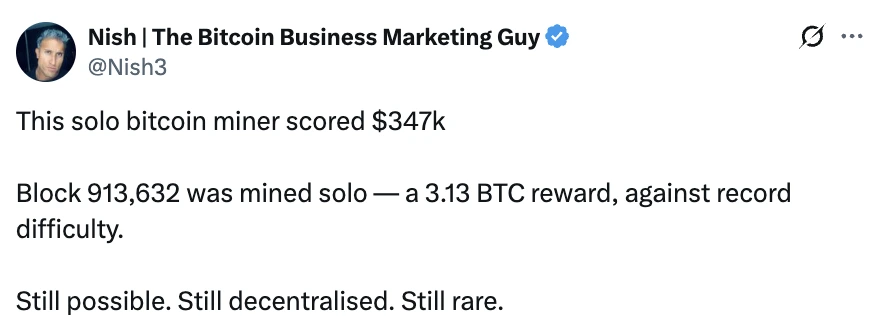
Block 913,632
Date: September 7, 2025
Power used: 500 GH/s (estimated; likely Bitaxe Ultra or similar, 15-20W)
Transactions: 1,956 (a low count suggesting fewer high-fee transactions in that block)
Probability: 1 in 50,000 per day (once every 140 years at that hash rate; network 987 EH/s)
With a smaller transaction count and no information on power used, this block remains mysterious. It stood out for its middle-ground probability and decent fee inclusion, possibly reflecting a mid-tier miner without industrial backing.
Behind every solo win is more than luck. These miners beat the odds not just for themselves, but for the entire Bitcoin network. Their rare success stories prove something bigger: even in a system dominated by industrial-scale operations, the door is still open for anyone to participate and win.
Solo mining is risky. Unlike mining pools that offer regular payouts by splitting rewards among thousands of contributors, solo miners work alone. They either find a block and take the full reward or get nothing.
With today’s difficulty and massive network hashrate, most solo miners operate for years without results.
Devices like the Bitaxe push these limits even further, making a successful block find feel more like a lottery win than a business model.
But that’s exactly why these wins matter. Each one reminds the network that mining is still permissionless. They show that decentralization can be real.
Solo CKPool blocks mined in 2025 | Source: Memepool Space
These blocks were mined through Solo CKPool in 2025. Some may have come from low-power home devices, while others likely used full ASIC setups. Each solo win proves that miners outside of major pools, whether hobbyist or semi-pro, can beat the odds and claim an entire Bitcoin block.
When small miners succeed using open-source or low-cost tools, they help keep Bitcoin’s power structure in check. These wins may be rare, but they keep the nature of the network going.
Solo Bitcoin miners proved their place in 2025. From single-chip Bitaxe devices to moderate ASIC setups, these operators secured entire blocks when no one expected them to. Their wins broke through a wall of industrial dominance, reminding the network that anyone with a rig and some power still has a shot.
Mining pools continue to dominate the hashrate, but that does not make solo mining irrelevant. Even if rare, these wins keep Bitcoin’s core principle of permissionless access alive. They prove that decentralization is not theoretical. It exists on-chain, in the blocks, and in the numbers.
As mining difficulty rises and hardware advances, these solo wins become even more valuable. They are not just technical achievements. They are proof that Bitcoin’s system still makes space for the smallest players.
FAQs
Can solo Bitcoin miners really succeed in 2025?
Yes, several solo miners hit full blocks in 2025 despite extreme odds.
What tools do solo miners typically use?
Many use Bitaxe, FutureBit Apollo, or single-unit ASICs.
How often do solo miners find blocks?
Very rarely. Most odds range from one in 1,000 to one in 1.5 million per day.
Is Solo CKPool open to anyone?
Yes, it is a permissionless mining pool for solo miners worldwide.
Disclaimer:
The information provided in this article is for informational purposes only. It is not intended to be, nor should it be construed as, financial advice. We do not make any warranties regarding the completeness, reliability, or accuracy of this information. All investments involve risk, and past performance does not guarantee future results. We recommend consulting a financial advisor before making any investment decisions.
Dr. Lorena Nessi is an award-winning journalist and media technology expert with 15 years of experience in digital culture and communication. Based in Oxfordshire, UK, she combines academic insight with hands-on media practice.
She holds a PhD in Communication, Sociology, and Digital Cultures, and an MA in Globalization, Identity, and Technology.
Lorena has taught at Fairleigh Dickinson University, Nottingham Trent University, and the University of Oxford. She is a former producer for the BBC in London, with additional experience creating television content in Mexico and Japan.
Her research focuses on digital cultures, social media, technology, capitalism, and the societal impact of blockchain innovation.
She has written extensively on digital media and emerging technologies, with her work featured in both academic and media platforms. Her Web3 expertise explores how blockchain technologies shape culture, economics, and decentralized systems.
Outside of work, Lorena enjoys reading science fiction, playing strategic board games, traveling, and chasing adventures that get her heart racing. A perfect day ends with a relaxing spa and a good family meal.


 Easy
Easy