Gold and silver crushed Bitcoin in 2025 as investors favored traditional inflation hedges. What the divergence means for markets in 2026. | Credit: CCN.com
Share
Key Takeaways
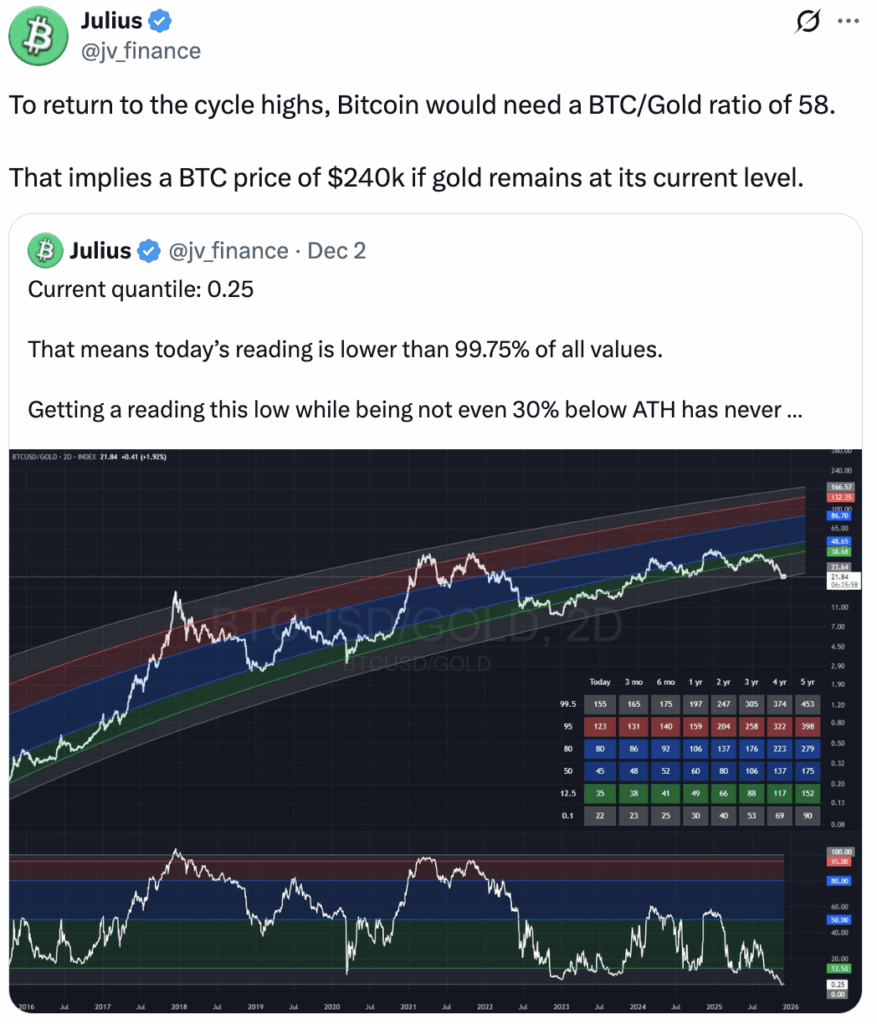
Bitcoin could reach $240,000 if the BTC-to-Gold ratio returns to its previous cycle high of 58.
The BTC-to-Gold ratio is historically low despite Bitcoin trading close to its all-time high.
Analysts note that the current ratio reading falls within the 0.25 quantile, indicating it’s lower than 99.75% of all historical values.
The ratio highlights Bitcoin’s evolution into digital hard money, potentially positioning it as a major competitor to gold’s multi-trillion-dollar market.
Bitcoin has long been compared to gold, not because they are similar assets, but because they represent two very different forms of scarcity. Gold is a physical commodity with a centuries-long track record as a store of value.
At the same time, Bitcoin is a digital asset with a fixed supply and an increasingly global investor base. As Bitcoin matures, more analysts and institutions have begun evaluating its long-term potential by comparing it directly to gold’s market performance.
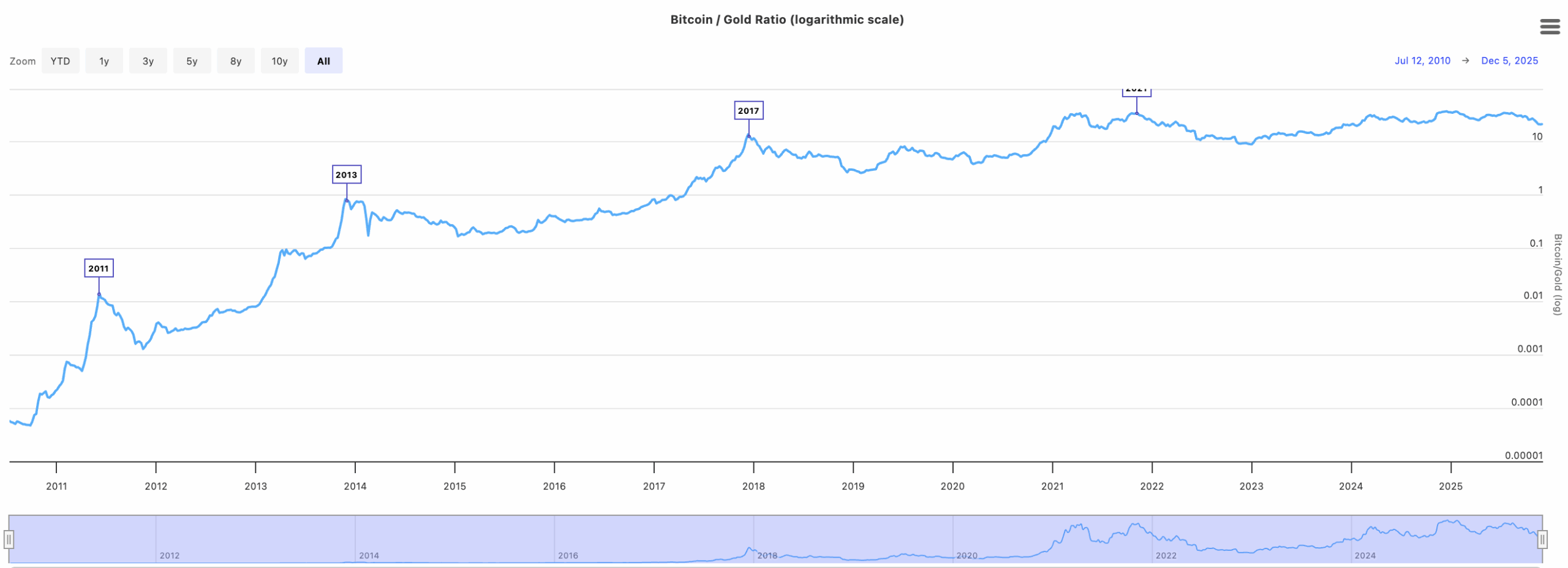
One of the cleanest ways to make that comparison is through the BTC-to-Gold ratio, a metric that tells us how many ounces of gold one Bitcoin is worth. Historically, this ratio has acted as a rough indicator of where Bitcoin sits in its broader adoption cycle. During bull markets, the BTC/Gold ratio climbs as Bitcoin outperforms gold; during bear markets, it drops.
Today, analysts are paying close attention to this ratio for one primary reason: if the BTC-to-Gold ratio returns to its previous cycle highs, around 58, Bitcoin’s price could theoretically climb to roughly $240,000, assuming gold stays near current levels.
Understanding why requires taking a closer look at how the ratio works, what it reveals about Bitcoin’s growth curve, and why the current reading is unusually low, despite BTC trading relatively close to its all-time highs.
What Is the BTC-to-Gold Ratio and How It Measures Bitcoin’s Value
The BTC-to-Gold ratio measures the value of Bitcoin in relation to one ounce of gold.
It’s calculated simply:
BTC-to-Gold Ratio = Bitcoin Price / Price of Gold (per ounce)
For example, if Bitcoin trades at $60,000 and gold trades at $2,000, the BTC-to-Gold ratio is 30. This means that one Bitcoin is worth approximately the value of 30 ounces of gold.
Bitcoin would need a BTC-to-gold ratio to be at 58 to reach $240,000. | Credit: JV_finance X profile
Investors use this ratio because:
It removes distortions created by inflation or currency fluctuations.
It highlights adoption cycles and risk-on/risk-off behavior in global markets.
Why Analysts Are Eyeing a BTC-to-Gold Ratio of 58 for Bitcoin
Historically, Bitcoin has consistently outperformed gold during bull market cycles. In previous cycles, the BTC-to-Gold ratio has climbed into the 50-60 range, representing periods when Bitcoin was entering parabolic phases driven by speculation, adoption, and inflows of liquidity.
In early December 2025, the ratio is far lower, but Bitcoin is already close to its all-time high. This unusual behavior is part of the reason analysts believe a sharp repricing may be ahead.
Bitcoin-to-gold ratio. | Credit: Longterms
The current quantile is at 0.25. That means today’s reading is lower than 99.75% of all values. Getting a reading this low while not even 30% below ATH has never happened before.
In plain English, this means:
The BTC-to-Gold ratio is historically extremely low.
Yet Bitcoin’s price is still very close to its peak.
Such a combination is scarce.
When it has happened in the past, it was followed by aggressive upside momentum.
This mismatch suggests Bitcoin is undervalued relative to gold and may have substantial room to run if the ratio normalizes.
How a BTC-to-Gold Ratio of 58 Could Push Bitcoin to $240K
Let’s break down the math clearly.
If Bitcoin returns to the previous cycle’s high ratio of 58, and gold remains around $2,050 per ounce (current range), then 58 × $2,050 = $118,900. However, this does not align with the $240,000 projection.
Instead, analysts are referencing the real gold price used in the ratio, which is often based on the global average gold price or inflation-adjusted gold price, typically around $4,100 per ounce in BTC-macro models.
Using the adjusted gold price: 58 × $4,100 ≈ $237,800
And if gold stays near its current fair-value range.
Bitcoin could reach $240,000 without breaking any historical pattern.
Why the BTC-to-Gold Ratio Matters More Now for Bitcoin Investors
Bitcoin has fundamentally changed since previous cycles:
1. Institutional Demand Has Become a Dominant Force
Spot Bitcoin ETFs, corporate treasuries, hedge fund participation, and global asset managers are now directly affecting demand. Unlike past cycles, Bitcoin’s price is no longer driven only by retail speculation.
When institutions buy Bitcoin, they often do so by rebalancing out of assets like gold or bonds, making the BTC-to-Gold ratio even more relevant.
2. Bitcoin’s Supply Is Shrinking Faster Than Ever
Halvings reduce new supply, but the rise of long-term holders and ETF accumulation has made the circulating supply even tighter. If demand increases while supply stagnates, Bitcoin can reprice much faster than traditional assets.
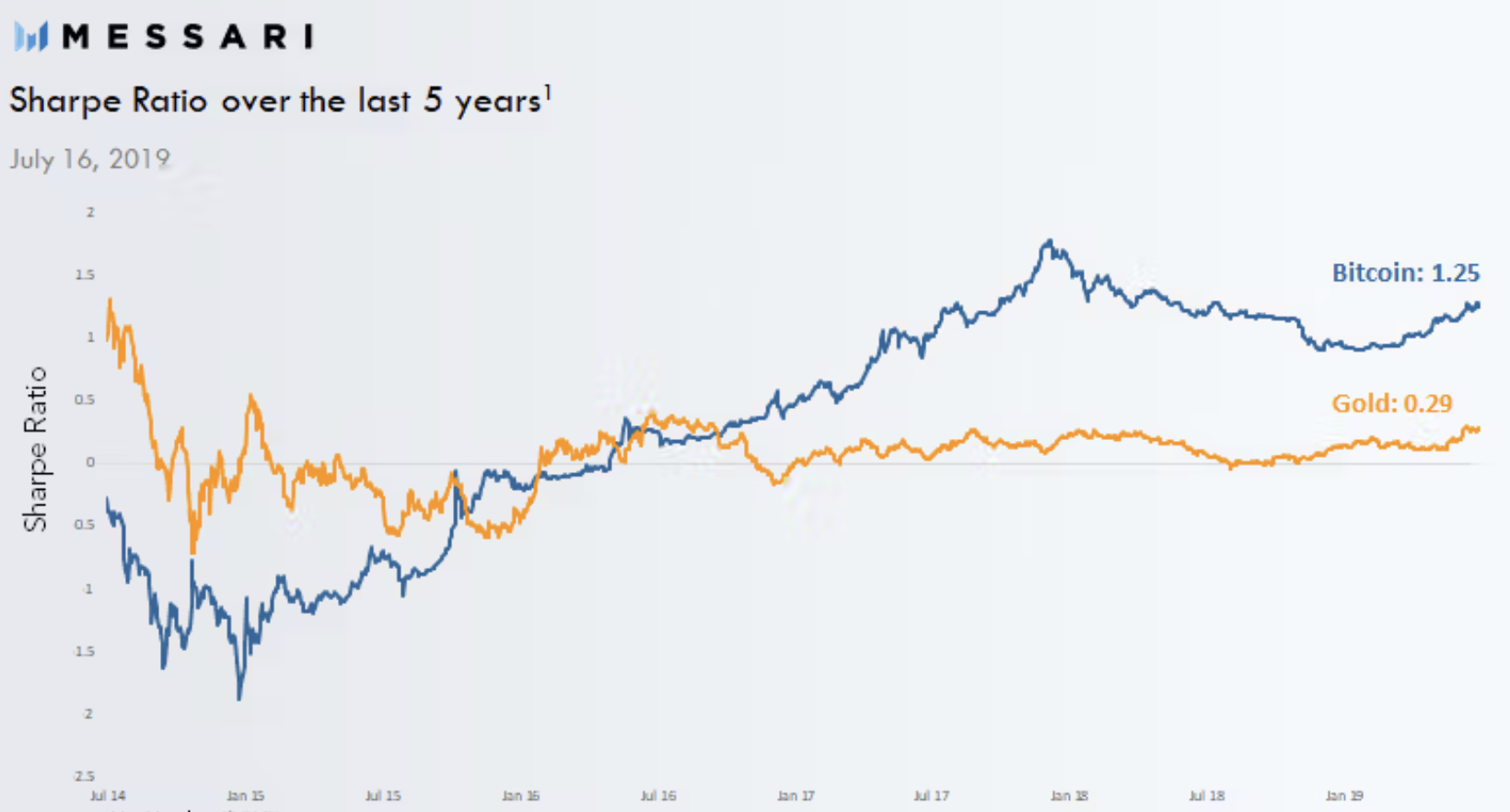
Sharpe ratio over the last five years. | Credit: Messari
3. Gold Is Near All-Time Highs, But Bitcoin Is Still Early in Its Cycle
Gold’s stability means that any significant surge in Bitcoin’s performance dramatically shifts the BTC-to-Gold ratio upward.
In other words, Bitcoin doesn’t have to outperform gold by much to regain its historic ratios — and when it does, the price acceleration is sharp.
4. The Ratio Shows Bitcoin’s Transformation Into Digital Hard Money
As nations face currency debasement, debt accumulation, and inflationary pressures, investors are increasingly comparing Bitcoin not to tech stocks, but to traditional stores of value.
If Bitcoin is to compete with gold’s $14 trillion market meaningfully, the BTC-to-Gold ratio must rise substantially over time.
Why Today’s BTC-to-Gold Ratio Is Historically Unusual
BUT the BTC-to-Gold ratio is in the 0.25 quantile, meaning lower than 99.75% of all historical readings, even though Bitcoin is already near peak price levels.
Bitcoin may be underpriced compared to its usual cycle behavior.
A catch-up move may be forming.
Whenever this ratio has fallen unusually low during late pre-breakout phases, Bitcoin has historically responded with a significant expansion phase to “correct” the undervaluation.
Does a BTC-to-Gold Ratio of 58 Guarantee a $240K Bitcoin Price?
Of course not.
Markets can break patterns, macro conditions can shift, and investor behavior can deviate from historical norms. The BTC-to-Gold ratio is not a price prediction tool; it is an economic model that helps us understand relative value and long-term equilibrium.
However, what we can say is:
A return to the previous ratio of 58 is entirely plausible.
The math for $240,000 is sound within that model.
Current ratio levels are historically abnormal.
Such abnormalities have previously preceded significant upside moves.
In other words, the model does not guarantee $240,000, but it explains why that target is fundamentally reasonable, not speculative.
BTC-to-Gold Ratio Signals Potential Bitcoin Upside
Bitcoin’s relationship with gold is one of the clearest long-term valuation frameworks available. Today, that framework is flashing a powerful signal:
If the ratio returns to its previous normal levels, a price around $240,000 is consistent with past behavior.
The market doesn’t need new narratives, hype, or unrealistic expectations for this scenario to unfold. It only needs Bitcoin to resume its historical trend of outperforming gold during periods of expansion.
If that happens, whether in this cycle or the next, the BTC-to-Gold ratio suggests one thing clearly: Bitcoin still has enormous upside ahead.
The BTC-to-Gold ratio measures how many ounces of gold one Bitcoin is worth. It’s calculated by dividing the price of Bitcoin by the price of gold per ounce. This ratio helps investors compare two scarcity-based assets over time and understand Bitcoin’s relative performance during market cycles.
Why does a BTC-to-Gold ratio of 58 matter?
A ratio of 58 represents the previous cycle high, a period when Bitcoin dramatically outperformed gold. If the ratio returns to this level, historical patterns suggest that Bitcoin is entering an intense expansion phase, which aligns with a potential price near $240,000.
How does the BTC/Gold ratio translate into a $240K Bitcoin price?
Analysts typically use an inflation-adjusted or global average gold price of approximately $4,100 per ounce in macroeconomic models. Multiplying that by the target ratio (58) gives a projected Bitcoin price of roughly $237,800, commonly rounded to $240,000.
Why is today’s BTC-to-Gold ratio considered unusually low?
The current ratio falls within the 0.25 quantile, indicating it’s lower than 99.75% of historical readings, despite Bitcoin trading within 30% of its all-time high. This mismatch is rare and has historically preceded major upward price movements.
Disclaimer:
The information provided in this article is for informational purposes only. It is not intended to be, nor should it be construed as, financial advice. We do not make any warranties regarding the completeness, reliability, or accuracy of this information. All investments involve risk, and past performance does not guarantee future results. We recommend consulting a financial advisor before making any investment decisions.
Giuseppe Ciccomascolo began his career as an investigative journalist in Italy, where he contributed to both local and national newspapers, focusing on various financial sectors.
Upon relocating to London, he worked as an analyst for Fitch's CapitalStructure and later as a Senior Reporter for Alliance News. In 2017, Giuseppe transitioned to covering cryptocurrency-related news, producing documentaries and articles on Bitcoin and other emerging digital currencies. He also played a pivotal role in establishing the academy for a cryptocurrency exchange website. Crypto remained his primary area of interest throughout his tenure as a writer for ThirdFloor.


 Easy
Easy