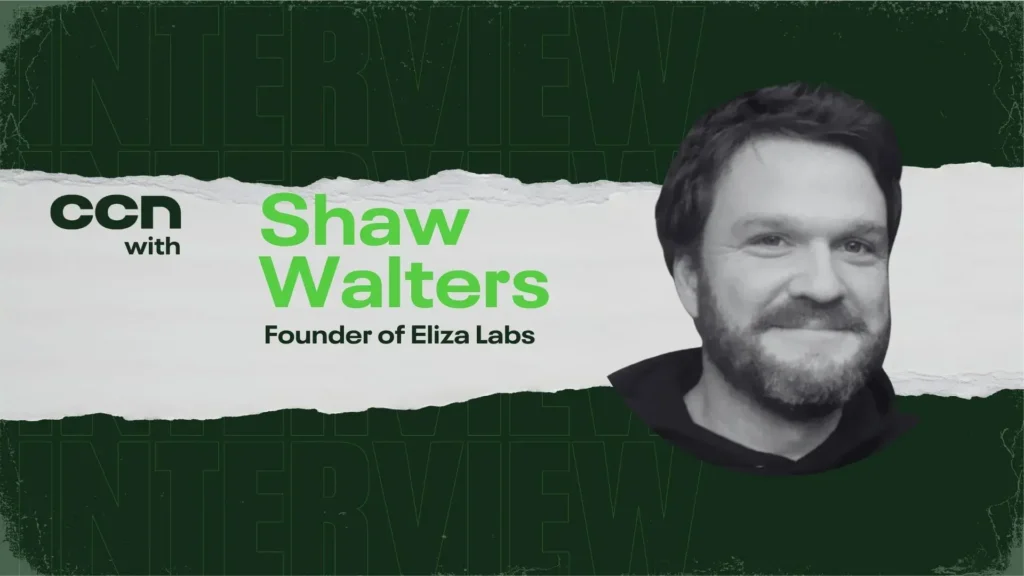
At a time when “AI agents on-chain” is becoming the crypto industry’s newest obsession, Shaw Walters says most teams are building the same thing over and over and missing the real opportunity.
During a conversation with CCN’s Dr. Guneet Kaur at the Blockchain Futuristic Conference 2025 in Miami, Florida, Eliza Labs’s founder Shaw Walters discussed hype vs. reality in “AI agents on-chain,” how ElizaOS lets agents interact with smart contracts, and why privacy, trust, and simulation matter more than buzzwords.
Walters, the creator of ElizaOS and founder of Eliza Labs, has spent the past year building infrastructure for autonomous AI agents to interact with blockchains and smart contracts. But instead of seeing experimentation, he says the industry has narrowed itself into a handful of repetitive product ideas.
“What surprised me is how many people are building the exact same things,” Walters said. “Almost everyone is building one of five things in DeFi, which is like a wallet or a launchpad. I’m so bored. I hate all of it. How many more launchpads do we need? How many more DeFi wallets?”
According to Walters, developers are chasing speculative demand instead of users.
“Everyone’s going for this user base that doesn’t exist,” he said. “We should be making fun stuff and interesting stuff.”
He points to projects experimenting with AI-driven social matchmaking and autonomous gaming environments as the types of ideas pushing the space forward. “There’s a game called Hyperscape where the agents walk around playing an MMO. I love that stuff,” Walters noted.
Why Privacy Must Become the Foundation of On-Chain AI
As AI agents take on more responsibility, including executing financial transactions, Walters argues that privacy is not optional.
“It’s super weird that people can just see what’s in my wallet. That’s wild,” he said. “I call it panopticon money, when everyone can see every transaction. You can’t have money without privacy,” he noted.
ElizaOS has integrated with Secret Network to enable transactions that remain confidential while still verifiable.
Secret’s use of TEE (Trusted Execution Environments), Walters explained, enables agents to compute securely without leaking data.
“It runs in a part of the processor that is encrypted,” he said. “As long as it’s open source and we can all see the attestation, it’s pretty reliable.”
For AI agents to function safely in financial environments, trust, confidentiality, and verifiable execution need to exist in the same system.
What’s the Biggest Misconception About AI Agents
Walters says one misunderstanding continues to distort expectations around AI systems in crypto:
“People feel like the current AI learns,” he said. “But it’s a static model. The models don’t improve. They have no way of improving after they’ve been trained.”
Fine-tuning a model isn’t a magic shortcut either.
“It’s just way harder than people think,” he said. “If you try to train on the data in your laptop, you’ll probably make it worse. It loses its generality.”
Why Real Progress Starts with Simulation and Games
Rather than trying to build an AI trader that can reliably operate on-chain today, Walters believes developers should start inside controlled environments.
“I believe in games. I believe in simulation,” he said. “Take a complex real world thing, shave off all the hard parts, solve the simple version, and then add variables back in.”
This philosophy underpins Eliza Labs’ work on AI-driven prediction and trading simulations, where agents compete, learn strategies, and test behaviors before entering high-stakes environments.
“If we can do that in a simulation, I believe the best ones can go out into the real world and make some impact,” he said.
The Hidden Challenge No One Is Talking About: Cost
The dream of millions of autonomous agents is constrained by something incredibly simple: money.
“If cost was not an issue, we could make agents that do everything,” Walters said. “But it’s really expensive to run Claude all the time. If I have 1,000 agents running on their own computers, it gets really expensive.”
Scaling AI agents isn’t just a technical problem, it’s an economic one.
The Road Ahead: Reducing Hype, Increasing Real Utility
Walters is blunt about where the industry stands.
“Anytime there’s an interesting emerging technology and retail gets ahold of it, they’re going to speculate,” he said. “The hype cycle always happens.”
But hype does not invalidate the underlying breakthrough.
“We’re almost there,” Walters said. “AI and crypto does make sense. It just has to be built the right way.”
The team is preparing to launch a prediction-market game in collaboration with the Ethereum Foundation, based on a new identity registry standard (ERC-8004) that lets agents and apps rate each other for trustworthiness.
They are also releasing a permissionless OTC system, where agents negotiate token deals automatically.
“Either Put in the Work or Don’t Bother”
Walters has a simple message for newcomers chasing quick profit:
“Good things take hard work,” he said. “If you don’t do that, you’re just not gonna make it. Don’t waste your time.”
He believes the next wave of crypto AI innovation will come from builders, not speculators.
“I’m here to build real things that change the world,” he said. “Not to gamble on charts,” he concluded.
The information provided in this article is for informational purposes only. It is not intended to be, nor should it be construed as, financial advice. We do not make any warranties regarding the completeness, reliability, or accuracy of this information. All investments involve risk, and past performance does not guarantee future results. We recommend consulting a financial advisor before making any investment decisions.

Dr. Guneet Kaur is a senior editor at CCN.com and a Science Fellow at Exponential Science. She is a fintech and blockchain expert with extensive experience in digital finance education, blockchain ecosystems, and cryptocurrency markets. She has worked with global media such as Cointelegraph, as well as education and blockchain platforms, to design and lead strategic content and learning initiatives. As an educator and assessor for top-tier executive programs, she bridges real-world fintech trends with academic insight.
Dr. Kaur is also a published researcher and peer reviewer across fintech and data science journals, including Financial Innovation Journal and International Journal of Big Data Intelligence and Applications. Her work spans data-driven analysis, Web3 innovation, and technical content development. With a strong foundation in both industry and academia, she translates complex financial technologies into practical applications, empowering learners, professionals, and institutions across the rapidly evolving digital finance landscape.


 Easy
Easy