Ark Invest said quantum computing threats are a long way off for Bitcoin — others believe Satoshi Nakamoto's holdings could be at risk. | Source: CCN
Share
Key Takeaways
Quantum threat to Bitcoin is distant, not immediate, says Ark Invest.
Some argue that older Bitcoin could be exposed in the future, including Satoshi Nakamoto’s holdings.
Industry remains divided on urgency.
Advances in quantum computing are unlikely to pose an immediate threat to Bitcoin. However, investors and developers should begin preparing for the long-term implications, according to a new research paper by ARK Invest.
The report comes as industry figures debate whether breakthroughs in quantum computing could one day threaten Bitcoin’s cryptographic security, with some warning that older coins, including those of Satoshi Nakamoto’s, may be more exposed than others.
Try Our Recommended Crypto Exchanges
Sponsored
Disclosure
We sometimes use affiliate links in our content, when clicking on those we might receive a commission at no extra cost to you. By using this website you agree to our terms and conditions and privacy policy.
Ark’s report, created with Unchained, argues that while quantum computing could eventually challenge Bitcoin’s cryptography, the technology remains far from the capabilities required to compromise the network.
Instead, ARK researchers say any risk would unfold gradually over years or decades, giving the Bitcoin ecosystem time to adapt through upgrades and governance decisions.
In collaboration with @unchained, ARK Invest's new paper on Bitcoin and Quantum computing is live!
—-
Bitcoin and Quantum Computing
This paper assesses whether and how advances in quantum computing (QC) pose a risk to Bitcoin. Our two central arguments are as follows:
ARK’s analysis concludes that current quantum computers lack the scale and reliability necessary to break Bitcoin’s elliptic curve cryptography (ECC).
Today’s systems operate in what researchers call the “Noisy Intermediate-Scale Quantum” (NISQ) era, typically involving around 100 logical qubits and limited circuit depth.
Breaking Bitcoin’s encryption would require a dramatic leap to at least 2,330 logical qubits and the ability to execute tens of millions to billions of quantum gates.
Risks Remain
However, the report noted that a portion of Bitcoin’s supply could be theoretically exposed if quantum computers ever reached that capability.
Around 1.7 million BTC held in older pay-to-public-key (P2PK) addresses are considered permanently lost but technically vulnerable.
Meanwhile, roughly 5.2 million BTC in reused or migratable address formats could potentially move to safer cryptographic standards.
Together, those categories account for about 35% of Bitcoin’s total outstanding supply, though ARK emphasizes that the network would have time to migrate funds.
No Risk At All?
Not all observers frame quantum computing as a long-term risk for Bitcoin.
Michael Saylor, executive chairman of Strategy and one of Bitcoin’s most prominent corporate advocates, has dismissed concerns that quantum computers could undermine the crypto.
“Quantum computing won’t break Bitcoin — it will harden it,” Saylor wrote in a post on X in December.
The Bitcoin Quantum Leap: Quantum computing won’t break Bitcoin—it will harden it. The network upgrades, active coins migrate, lost coins stay frozen. Security goes up. Supply comes down. Bitcoin grows stronger.
According to Saylor, the network would adapt through software upgrades that allow active coins to migrate to more secure cryptographic standards while lost or inactive coins remain locked permanently.
“The network upgrades, active coins migrate, lost coins stay frozen,” he wrote, adding that the process could reduce effective supply.
Analysts Say Some Older Coins Could Face Exposure
Others broadly agree that Bitcoin itself would likely survive a quantum breakthrough but warn that older coins could face risks.
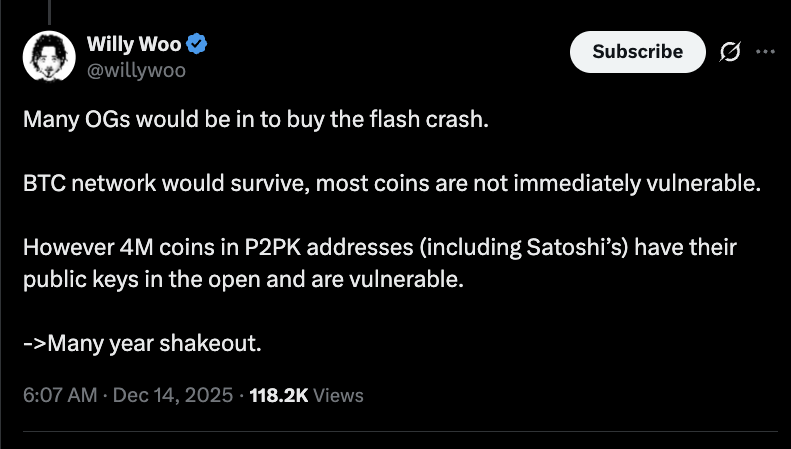
On-chain analyst Willy Woo said in December that while the network’s cryptographic standards can be upgraded, a subset of early wallets may be vulnerable because their public keys are already exposed on the blockchain.
Source: X (@willywoo)
He estimated that sufficiently powerful quantum computers could theoretically target roughly 4 million Bitcoins stored in early pay-to-public-key addresses—including tokens believed to belong to Bitcoin’s creator, Satoshi Nakamoto.
Woo said any disruption would likely unfold gradually rather than trigger a sudden market collapse.
“Many OGs would be in to buy the flash crash,” he added, describing what he called a potential “many-year shakeout” if quantum capabilities eventually reach cryptographic attack thresholds.
Vitalik Buterin Urges Early Preparation
Ethereum co-founder Vitalik Buterin has also warned that the industry should begin preparing sooner rather than later for potential quantum breakthroughs.
In public remarks in August 2025, Buterin said there is roughly a 20% chance that quantum computers capable of breaking current cryptographic systems could emerge before 2030, citing forecasts from the prediction platform Metaculus.
The median estimates from those forecasts place such capabilities closer to 2040.
Buterin stressed that the risk is not immediate but is significant enough to warrant early planning across the cryptocurrency ecosystem.
“The quantum threat is no longer just distant science fiction,” he said, arguing that developers should begin preparing migration paths toward quantum-resistant cryptography.
He reiterated the warning later that year at Devconnect in Buenos Aires, where he urged developers to move Ethereum toward quantum-resistant security standards within the next few years.
How Quantum Computing Could Affect Bitcoin
Bitcoin’s security relies heavily on cryptography that is extremely difficult for classical computers to break.
Most Bitcoin transactions rely on the Elliptic Curve Digital Signature Algorithm (ECDSA).
This system relies on a mathematical challenge called the elliptic curve discrete logarithm, which conventional computers cannot practically solve.
In simple terms, as explained by the CCN education team, the process works as follows:
Private key: A secret number proving ownership of Bitcoin.
Public key: A visible cryptographic key used to verify transactions.
ECDSA signatures: Mathematical proofs confirming a transaction was authorized by the private key.
Quantum computers, however, operate differently from classical machines.
Using algorithms such as Shor’s algorithm, sufficiently powerful quantum systems could theoretically solve the mathematical problems underlying ECDSA much faster.
If attackers achieved that capability, they could derive a private key from a public key and forge digital signatures, enabling them to spend coins they do not own.
Kurt Robson is a London-based reporter at CCN, specialising in the fast-moving worlds of crypto and emerging technology. He began his career covering local news in Cornwall after graduating from Falmouth University with First Class Honours in Journalism. There, he cut his teeth on everything from council meetings to missing swans.
He quickly rose through the ranks to become a frontline journalist at several of the UK’s leading national newspapers. Over the years, he has interviewed musicians and celebrities, reported from courtrooms and crime scenes, and secured multiple front-page exclusives.
Following the upheaval of the COVID-19 pandemic, Kurt shifted his focus to technology journalism—just ahead of the AI boom. With a natural curiosity and a trained eye for emerging trends, he has found a new rhythm in reporting on innovation.
At CCN, Kurt's work focuses on the cutting edge of crypto, blockchain, AI, and the evolving digital world. Drawing on his background in people-first reporting and his deep interest in disruptive tech, Kurt delivers stories that are insightful, entertaining, and human-centric.