Bitcoin remains absent from clear treatment in U.S. Basel III proposals, leaving banks uncertain on capital rules and risk weighting. | Credit: CCN.com
Share
Key Takeaways
2140 matters because miners will rely only on transaction fees, not new Bitcoin block rewards.
Layer-2 can move small payments off-chain, but Layer 1 can still earn fees from big “final settlement” transactions.
Bitcoin’s value after 2140 will depend more on demand and trust than on new coin issuance.
Watch block fullness, the fee share of miner revenue, and whether mining spreads out or becomes more concentrated.
Bitcoin’s creator programmed its blockchain to stop providing block rewards once all 21 million Bitcoin are released in circulation, meaning miners will earn only through transaction fees.
Experts project block rewards to end in 2140, which seems like a far-off sci-fi problem meant for the movies. But the problem shows up today when mining fees get quiet.
Those low-fee weeks are a practice run for a future where miners live on fees alone, and they help explain what will really drive Bitcoin’s value: use, trust, and security.
One must wonder what determines Bitcoin’s value when scarcity becomes a fundamentally different factor, and how miners will operate with lower profits.
Earn Crypto with These Top Mining Apps
Sponsored
Disclosure
We sometimes use affiliate links in our content, when clicking on those we might receive a commission at no extra cost to you. By using this website you agree to our terms and conditions and privacy policy.
Even when block validation rewards cease, Bitcoin’s core mission will always remain the same: people hold it because they see the asset as scarce, untamperable money, and they use it when they want strong, intermediary-free settlement.
Decentralized miners prop up Bitcoin’s security, but when miners earn less, fewer of them can afford the expensive process of keeping their rigs up and running. Fewer miners means a more centralized network, and one that’s easier to attack.
Speaking to CCN, Jeremy Dreier, Managing Director of GoMining Institutional, noted that during current periods of lower fees, “the winners are the operators with cheap power, flexible loads, high uptime, and disciplined fleet spending.”
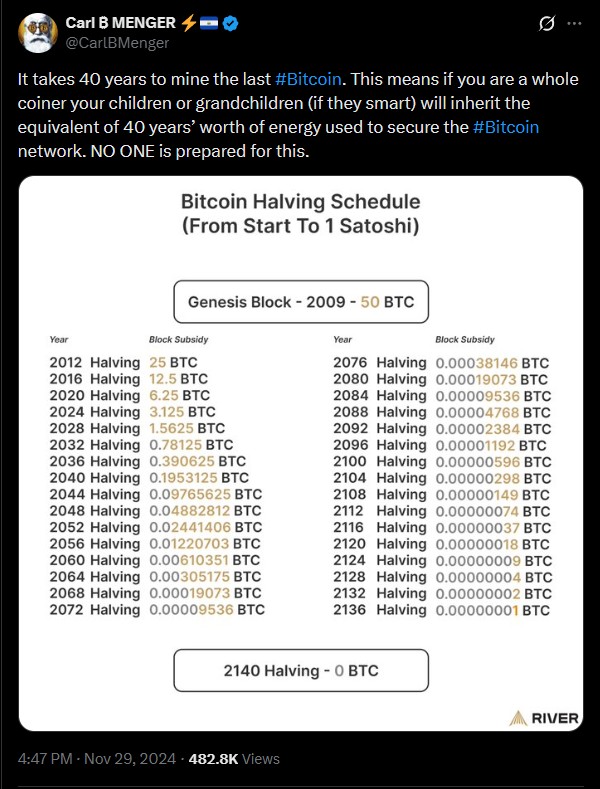
This is also why halvings matter long before 2140. Bitcoin’s block rewards are cut in half about every four years, which slowly moves mining income away from new coins and toward transaction fees.
Source: @CarlBMenger on X
“Margin compression punishes any operator without structurally competitive power and execution,” concludes Dreier.
In plain terms: halvings tighten mining profits, so miners need cheaper power and more efficient operations to stay alive.
Layer-1 vs. Layer-2 Bitcoin: How Network Design Impacts Fees and Miners
To understand how fees will work in the future, it helps to understand the difference between layer-1 and layer-2 Bitcoin networks.
Layer-1 is the base Bitcoin chain, the main public record where settlement occurs.
layer-2 systems act off-chain, then settle back on layer-1 for permanence. The tradeoff is: on-chain transactions are slower but more secure, while off-chain ones are cheaper and faster, they can add new risks if the tools are poorly built.
The best-known layer-2 Bitcoin project is the Lightning Network. Lightning reduces costs for small transfers, enabling everyday purchases like coffee. It bundles a bunch of small transactions that settle on Layer-1 for finality.
How does this help miners? It can keep fees flowing to miners even if most small payments move off-chain. When layer-2 systems open, close, or settle in big batches, they do so on layer-1, and that can pay meaningful fees.
“Layer-2 growth can help or hurt, depending on how it evolves,” says Dreier. “If L2 meaningfully reduces the need to touch L1, it can dampen fee pressure; if it scales by batching more value into fewer L1 transactions, it can support a sustainable fee market even with lower “everyday” on-chain traffic.”
What Will Drive Bitcoin’s Price After 2140?
When the last Bitcoin is released into the wild, scarcity becomes a constant. New supply from block rewards will no longer exist, so Bitcoin’s value will depend more on demand and trust than on new coin issuance.
It also helps to remember that even today, Bitcoin’s price doesn’t just rise based on a supply cap. It fluctuates based on what people are willing to pay, how long-term holders act, and how markets react to fear or hype.
After 2140, if users continue to see Bitcoin as scarce, censorship-resistant money, long-term holding demand could remain strong. Transaction fees must be high enough to incentivize miners to secure the network, as security underpins trust.
Layer-2 systems may support this by batching high-value settlements on the base chain. Adoption as collateral, reserve asset use, and institutional participation will also shape Bitcoin’s post-2140 price dynamics.
Here are the main drivers that might matter most after 2140:
People Still Want To Hold Bitcoin
If Bitcoin keeps its reputation as scarce money that’s hard to manipulate, people might keep holding it as a form of digital gold.
Bitcoin Can Still Provide Settlement
Bitcoin does not need to handle every small payment on its main chain. Over time, the base chain may be used mostly for final moves, like large transfers between exchanges, big investors, companies, or Layer-2 systems closing out many smaller payments at once. These are high-value settlements.
If the base chain is mostly used for large, important transfers, those users can afford to pay higher fees to get fast, reliable final settlement. A $20 or even $100 fee looks very different when someone is moving $1 million than when someone is buying a $5 coffee.
Dreier emphasizes layer-2 settlement, stating, “A credible path is that L1 becomes more settlement-oriented, with L2 systems batching demand into fewer, higher-fee transactions. This can support aggregate fees without demanding constant congestion for everyday users.”
The Network Stays Secure and Credible
The loop that keeps Bitcoin secure and credible:
Miners earn fees.
Fees fund mining.
Mining funds security.
Security supports network trust.
Trust supports demand and value.
So if miners are Bitcoin’s security team, yet it’s harder for them to receive pay, it’s important to note that Bitcoin won’t simply lose all of its value. Instead, the network adjusts its mining difficulty every 2,016 blocks to keep block validation time around ten minutes.
If fewer miners participate in the network, its hashrate, or the rate at which new blocks are validated, adjusts accordingly. Fewer miners do not equal fewer block validations. The network rebalances itself. Dreier calls out that rebalancing “doesn’t magically guarantee enough security, but it means the chain doesn’t just stop functioning because profitability changes.”
Bitcoin-Backed Products and Bitcoin as Collateral
Bitcoin’s value can also be supported by what people can do with it.
If Bitcoin is widely used as collateral, it becomes part of real financial activity, not just a thing people hold. This use can increase demand and liquidity. Bitcoin-backed loans, for instance, might become more popular as the world continues to accept digital currency, and this isn’t to mention Bitcoin ETFs or other investment avenues.
The biggest open question is whether transaction fees can keep miners paid enough to protect the network as rewards shrink. In the years ahead, watch for how often the base chain gets used for large settlements, whether layer-2 growth creates regular Layer-1 activity, and whether mining continues to decentralize or regress and become more concentrated.
If Bitcoin can keep a healthy fee market and strong security through each halving cycle, 2140 becomes less of a drop-off point and more of a milestone that the network has prepared itself for.
In theory, yes, but it would require broad agreement across the network. That is why many people treat the cap as very hard to change.
Will fees be too high to use Bitcoin after 2140?
Fees could spike during busy periods, but Layer 2 tools are designed to handle small payments without needing every transaction on-chain.
Could miners just increase block space to make more fees?
Not easily. Bigger blocks can lower fees per transaction, and changing block rules would require broad consensus.
What happens if mining becomes too concentrated in a few hands?
It can raise trust and security concerns because attacks could become cheaper than they should be. This is why people track hashrate share and mining pool concentration over time.
Disclaimer:
The information provided in this article is for informational purposes only. It is not intended to be, nor should it be construed as, financial advice. We do not make any warranties regarding the completeness, reliability, or accuracy of this information. All investments involve risk, and past performance does not guarantee future results. We recommend consulting a financial advisor before making any investment decisions.
Max Moeller is a Chicago‑based writer and video editor passionate about games, tech, and crypto. Whether it’s crafting clear, insightful articles or piecing together engaging video retrospectives, he’s driven by curiosity and takes pride in keeping things human. Since 2017, Max has been published in a variety of notable crypto magazines.


 Easy
Easy