Discover the 2026 surge of USOR ($USOR) on Solana. Is there actual on-chain evidence of BlackRock and Trump-linked wallets accumulating? | Credit: CCN.com
Share
Key Takeaways
BlackRock is innovating beyond spot Bitcoin ETFs with the proposed Bitcoin Premium Income ETF, designed to generate income rather than just track Bitcoin’s price.
Income comes from option premiums, the fund “rents out” its Bitcoin exposure by selling options and distributes the collected fees to investors.
The trade-off is capped upside: investors get regular cash flow but give up part of Bitcoin’s explosive growth potential.
This product targets a different audience than pure spot ETFs, such as income seekers, conservative investors, and institutions that prefer steady payouts.
The world’s largest asset manager, BlackRock, has already made waves in crypto with the success of its iShares Bitcoin Trust (IBIT), a spot Bitcoin ETF. Now, it’s preparing to go one step further with a new concept: the Bitcoin Premium Income ETF.
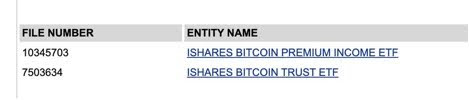
Bloomberg ETF analyst Eric Balchunaswrote on X that “BlackRock registered the name iShares Bitcoin Premium Income ETF, with a filing coming soon. This is a covered call Bitcoin strategy designed to give BTC some yield. It will be a ’33 Act spot product, a sequel to the $87 billion IBIT.”
BlackRock registered the name iShares Bitcoin Premium ETF. | Source: @EricBalchunas on X
So this product isn’t just another way to hold Bitcoin, it’s designed to generate income from Bitcoin exposure, targeting investors who want both crypto exposure and steady cash flows.
Let’s break it down.
What Is BlackRock’s Bitcoin Premium Income ETF?
A Bitcoin Premium Income ETF is a proposed exchange-traded fund (ETF) that would:
Distribute the “premiums” earned from these strategies as income to investors.
So instead of just tracking Bitcoin’s price, this ETF tries to make money from Bitcoin’s volatility by collecting option premiums, then paying them out as income.
Try Our Recommended Crypto Exchanges
Sponsored
Disclosure
We sometimes use affiliate links in our content, when clicking on those we might receive a commission at no extra cost to you. By using this website you agree to our terms and conditions and privacy policy.
These are tools that professional investors use to manage risk or generate cash flow.
Distributing Premiums as Income
The ETF doesn’t just keep those fees (premiums) for itself.
It pays them out to investors who hold shares of the ETF, like receiving dividends from a stock.
How Is Bitcoin Premium Income ETF Different From a Spot Bitcoin ETF?
Most people are familiar with spot Bitcoin ETFs (like BlackRock’s IBIT). These simply hold Bitcoin and mirror its price. If Bitcoin goes up, the ETF goes up; if Bitcoin falls, the ETF falls.
The Premium Income ETF would be different: it seeks to generate yield. Think of it like renting out your Bitcoin exposure, you may not capture 100% of the price gains, but you collect steady “rent” (income).
Investors who want cash flow while holding BTC exposure
Upside potential
Full upside if BTC price rises
Upside capped (option writing limits gains)
Downside risk
Fully exposed to BTC price drops
Still exposed, but income may offset some losses
Volatility impact
High volatility (mirrors BTC)
Slightly less volatile (income cushions swings)
Payouts
None (unless you sell your shares)
Regular distributions from earned premiums
You might be wondering: “Isn’t BlackRock’s Bitcoin Premium Income ETF basically the same as Grayscale’s BPI or BTCC?”
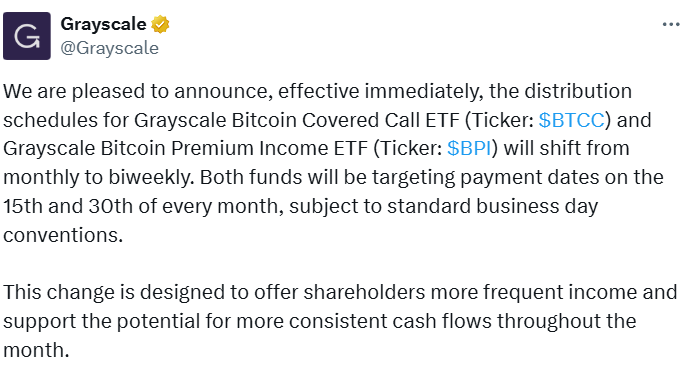
Grayscale, best known for GBTC (converted to a spot Bitcoin ETF in early 2024), now offers two income-oriented funds: the Grayscale Bitcoin Covered Call ETF (BTCC) and the Grayscale Bitcoin Premium Income ETF (BPI).
Grayscale’s $BTCC and $BPI. | Source: @Grayscale on X.
Both aim to generate biweekly distributions by writing covered-call options on Bitcoin ETPs (they do not hold spot Bitcoin directly). BTCC’s primary objective is current income; BPI seeks current income while maintaining prospects for capital appreciation.
By contrast, BlackRock’s proposed iShares Bitcoin Premium Income ETF has been described by Bloomberg’s Eric Balchunas as a ’33 Act spot product—i.e., potentially holding spot BTC while layering on covered calls; so if approved, it would be structurally different from Grayscale’s approach.
How the Bitcoin Premium Income ETF Might Work (Example)
Suppose the ETF holds exposure to 1 Bitcoin priced at $112,000. Instead of just passively tracking the price, the fund sells a covered call option to generate income:
Strike price: $118,000
Option premium collected: $3,000
Now two scenarios can play out:
If Bitcoin stays below $118,000 by the option’s expiration:
The ETF keeps the $3,000 premium.
That premium is distributed to investors as income.
The ETF still holds Bitcoin exposure at $112,000.
If Bitcoin rises above $118,000:
The ETF’s upside is capped at $118,000.
Investors still receive the $3,000 premium, but they miss out on gains above $118,000.
This is a simple example to show the trade-off. In practice, the ETF would manage a portfolio of Bitcoin and options contracts, and outcomes would depend on volatility, option pricing, and market conditions, not always as neat as this illustration.
Why Investors Might Choose a Bitcoin Premium Income ETF
Unlike a traditional spot Bitcoin ETF that simply tracks the price of Bitcoin, BlackRock’s proposed Bitcoin Premium Income ETF is designed to offer something extra: regular payouts. By combining Bitcoin exposure with strategies that generate income, it aims to appeal to investors who want more than just price speculation.
Below are the key reasons why this kind of fund could attract a wide range of investors.
1. Regular Cash Flow From a Volatile Asset
Most Bitcoin ETFs are like roller coasters, they move up and down with the price of Bitcoin. You only make money when you sell at a higher price than you bought.
With the Premium Income ETF, the fund would use strategies like covered call writing: selling options to traders who want the “right” to buy Bitcoin at a certain price.
The fund collects a premium (like rent) for granting that right.
That premium is then distributed to investors as cash flow.
For an investor who wants monthly or quarterly income, this is far more appealing than simply holding Bitcoin and waiting for price gains.
2. Potential Cushion Against Down Markets
If Bitcoin falls by, say, 10% in a month, a spot Bitcoin ETF investor sees the full loss.
With a Premium Income ETF, the investor might lose less because they received income from sold options, which cushions the decline.
This doesn’t remove risk, if Bitcoin crashes hard, you still take a hit. But the income stream softens the blow compared to a pure spot ETF.
3. A Middle Ground for Skeptical Investors
Some investors believe in blockchain’s future but are hesitant to take full exposure to Bitcoin’s wild price swings.
For them, this ETF is a compromise: they get exposure, but also a steady yield, making it psychologically easier to hold through volatility.
A yield-based Bitcoin ETF provides a “softer entry point.”
4. Attractive in a Low-Yield World
Traditional bonds and savings accounts often yield very little.
An ETF that can pay out option premiums linked to Bitcoin’s volatility might produce higher income than many fixed-income products.
This could appeal to income-hungry investors searching for alternatives outside of bonds or dividend stocks.
Example:
If U.S. Treasuries are yielding 3–4% but a Bitcoin Premium Income ETF can potentially yield 6–10% through option premiums, investors may find it compelling despite higher risks.
5. Diversification of Strategy
Spot Bitcoin ETFs give price-only exposure, but a Premium Income ETF offers strategy exposure (derivatives, options, income streams).
Holding both could create a balanced approach:
Spot ETF for upside potential.
Premium Income ETF for income + downside cushion.
6. Institutional Use Case
Institutions like pension funds or insurance companies often need steady distributions to match liabilities (like paying pensions or insurance claims).
These players may avoid a pure Bitcoin ETF because it has no cash flow.
But a Premium Income ETF could make Bitcoin exposure institutionally palatable, since it generates predictable payouts.
Risks of a Bitcoin Premium Income ETF
While the idea of earning income from Bitcoin sounds appealing, investors should understand the trade-offs and risks before diving in.
Capped upside: Selling options limits how much profit investors can make if Bitcoin’s price surges. Big rallies may be only partially captured.
Market risk still exists: If Bitcoin crashes, the income from option premiums won’t prevent large losses.
Derivative and counterparty risk: Using options adds complexity and reliance on trading partners, which could create new points of failure.
Uncertain yields: Premium income depends on Bitcoin’s volatility; payouts may fluctuate and are not guaranteed.
Regulatory uncertainty: The ETF is only proposed. Approval from regulators like the SEC is not assured, and rules could change.
Complexity for beginners: Understanding strategies like covered calls may be difficult for new investors compared to a simple spot Bitcoin ETF.
How Will BlackRock’s Bitcoin Premium Income ETF Compete With Strategy (MSTR)
Many investors today use Strategy (MSTR) as a “proxy” for Bitcoin exposure because the company has accumulated over 200,000 BTC on its balance sheet. But there are big differences between owning MSTR and owning a Bitcoin Premium Income ETF:
Features
Bitcoin Premium Income ETF
Strategy (MSTR)
Exposure type
Direct Bitcoin exposure + option income strategies
Indirect Bitcoin exposure through corporate holdings
Income
Designed to generate regular distributions from premiums
No income — investors rely on stock appreciation
Upside potential
Capped upside due to options
Unlimited upside (moves with BTC + company performance)
Growth-focused investors comfortable with corporate leverage
Why BlackRock’s Bitcoin Premium Income ETF Matters
BlackRock’s move shows how crypto is becoming part of mainstream financial engineering. First came the ability to hold Bitcoin in a simple ETF wrapper. Now, we’re seeing products that layer traditional Wall Street income strategies onto Bitcoin.
If approved, this ETF could open the door to a new wave of “crypto income products”, such as Ethereum income ETFs, tokenized bond yields, or more sophisticated structured funds.
The Bitcoin Premium Income ETF is not just about Bitcoin, it’s about giving investors choice. Some want to bet purely on Bitcoin’s price; others want steady income. BlackRock is trying to serve the second group.
But beginners should remember:
It’s still crypto, so risk is high.
Income doesn’t mean safety — Bitcoin can still fall sharply.
If approved, this ETF may be a useful tool for investors looking for yield, but it won’t replace a straightforward Bitcoin investment.
As filings progress and details become public, we’ll learn more about exactly how BlackRock plans to structure the fund, what the payouts might look like, and how accessible it will be to everyday investors.
How is the Bitcoin Premium Income ETF different from BlackRock’s iShares Bitcoin Trust (IBIT)?
IBIT tracks Bitcoin’s price directly, with no payouts. The Premium Income ETF aims to generate income by selling options on Bitcoin and distributing those premiums to investors.
How does the Bitcoin Premium Income ETF generate income?
The ETF may use options writing strategies. It rents out its Bitcoin exposure by selling call options, collects premiums (fees), and distributes them to shareholders. This turns Bitcoin’s volatility into a source of income for investors.
How is BlackRock’s Bitcoin Premium Income ETF different from Strategy (MSTR)?
MSTR is a stock that gives indirect Bitcoin exposure through a company that holds BTC and uses debt. The Premium Income ETF, if approved, would offer direct Bitcoin exposure plus income, without corporate risk.
Is the Bitcoin Premium Income ETF approved yet?
No. It has been filed but not approved by regulators like the SEC. Until approval is granted, it remains a proposal, and details (fees, yield, structure) could change.
Disclaimer:
The information provided in this article is for informational purposes only. It is not intended to be, nor should it be construed as, financial advice. We do not make any warranties regarding the completeness, reliability, or accuracy of this information. All investments involve risk, and past performance does not guarantee future results. We recommend consulting a financial advisor before making any investment decisions.
Giuseppe Ciccomascolo began his career as an investigative journalist in Italy, where he contributed to both local and national newspapers, focusing on various financial sectors.
Upon relocating to London, he worked as an analyst for Fitch's CapitalStructure and later as a Senior Reporter for Alliance News. In 2017, Giuseppe transitioned to covering cryptocurrency-related news, producing documentaries and articles on Bitcoin and other emerging digital currencies. He also played a pivotal role in establishing the academy for a cryptocurrency exchange website. Crypto remained his primary area of interest throughout his tenure as a writer for ThirdFloor.


 Easy
Easy