Home / Analysis / Crypto / Technical Analysis / Strategic Oil Supply (SOS) Spikes 90% as Israel Strikes South Pars, Iran Hits Qatar, and Trump Threatens Total Destruction
USOR has jumped 47% in 30 days as the US Strategic Petroleum Reserve falls to its lowest level since 1982. But there’s a major catch. | Credit: CCN.com
Share
Key Takeaways
Israel launched a strike on South Pars, the world’s largest natural gas field, while Iran retaliated.
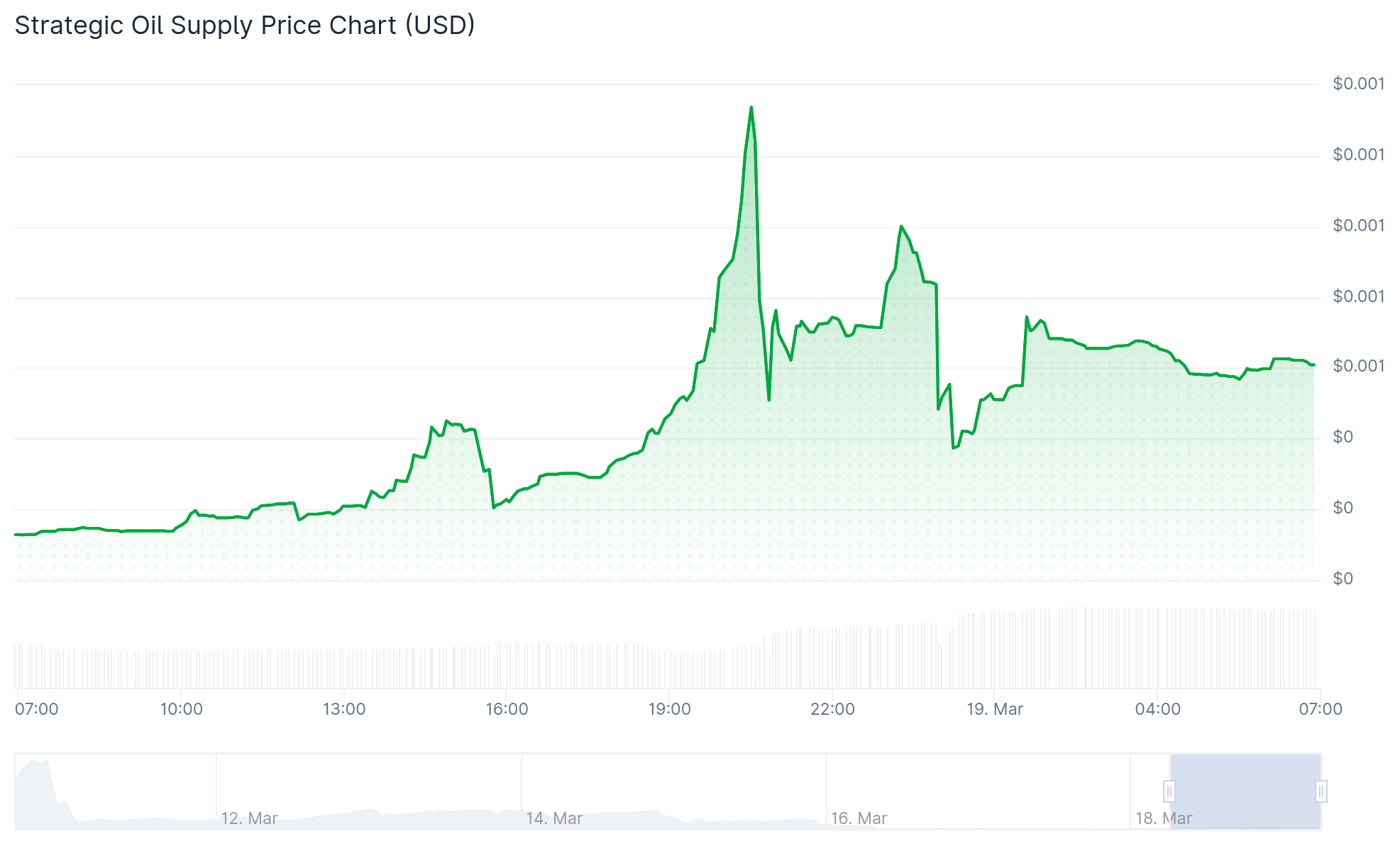
Amid the tension, the SOS crypto price rallied from its earlier collapse, rising 90% within 24 hours.
Despite that, SOS remains 97% below its ATH, with indicators uncertain of its next move.
Within the last 24 hours, the world has witnessed Israel strike South Pars (Iran’s largest and most strategically vital gas field).
In the same period, Iran retaliated by hitting Qatar’s Ras Laffan Industrial City with ballistic missiles.
Not long after,
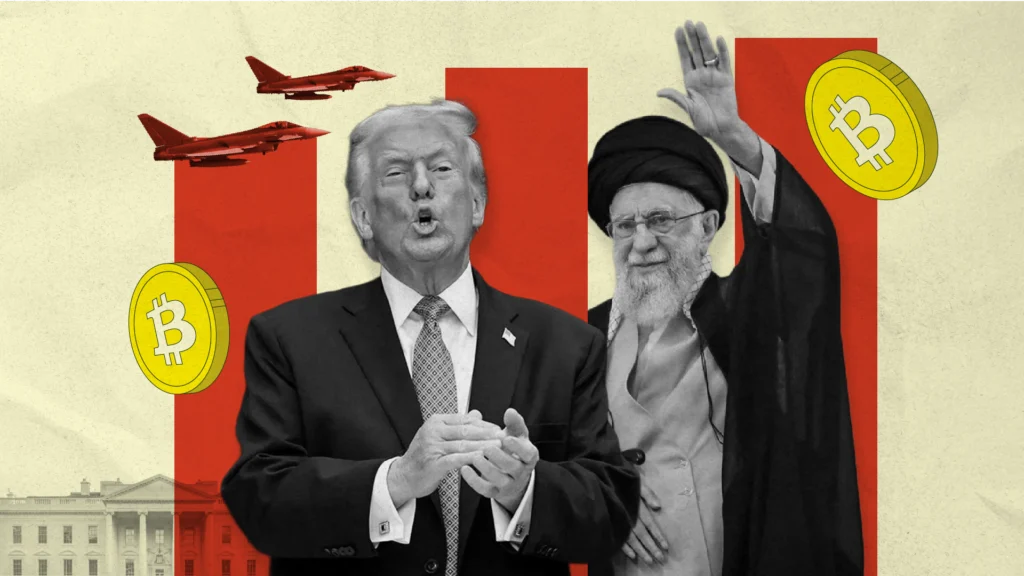
President Donald Trump posted one of the most explosive geopolitical ultimatums in modern history on Truth Social.
Amid all of these, the broader crypto market remained muted. However, Strategic Oil Supply (SOS) is one token that has responded positively to the development, surging 90% in the last 24 hours.
Here is a full breakdown of what went down and what lies ahead for the SOS crypto.
What Actually Happened
On Wednesday, March 18, Israel struck South Pars, the world’s largest natural gas field, located off Iran’s southern coast near Bushehr.
The strike seemed like a deliberate targeting of Iran’s most critical energy infrastructure rather than purely military assets.
The Soufan Center, a New York-based think tank, noted immediately that unlike oil storage depots, which can be replenished and rebuilt on a shorter timeline, Liquefied Natural Gas (LNG) production facilities cannot be repaired as easily.
Iran did not wait to respond.
Hours later, Qatar’s main energy hub, the Ras Laffan Industrial City, sustained extensive damage after Iranian missiles attacked it twice within twelve hours.
For context, the Ras Laffan complex is the world’s largest LNG plant as fire broke out across the facility.
Then Trump posted.
Trump threatened that the U.S., with or without the help or consent of Israel, would massively blow up the entirety of the South Pars Gas Field at an amount of strength and power that Iran has never seen or witnessed before if Iran attacked Qatar again.
“I do not want to authorize this level of violence and destruction because of the long term implications that it will have on the future of Iran, but if Qatar’s LNG is again attacked, I will not hesitate to do so,” Trump posted.
He simultaneously claimed the US had no advance knowledge of the Israeli South Pars strike.
However, some US and Israeli officials subsequently described the reports as inaccurate, stating that Trump and Netanyahu had coordinated the operation.
Why SOS Token Is the Direct Market Beneficiary
Following the development, the Strategic Oil Supply token surged 75%. But why did that happen?
As CCN explained earlier, the SOS crypto is not a random memecoin riding geopolitical noise.
It is a token architecturally designed to capture the financial dynamics of global energy supply disruptions.
Get These Top Crypto Casino Offers Now!
Sponsored
Disclosure
We sometimes use affiliate links in our content, when clicking on those we might receive a commission at no extra cost to you. By using this website you agree to our terms and conditions and privacy policy.
But at the time of writing, that has changed as the token’s price has reclaimed $0.00050. However, the cryptocurrency is still down 97% from its all-time high on March 10.
SOS Price Prediction
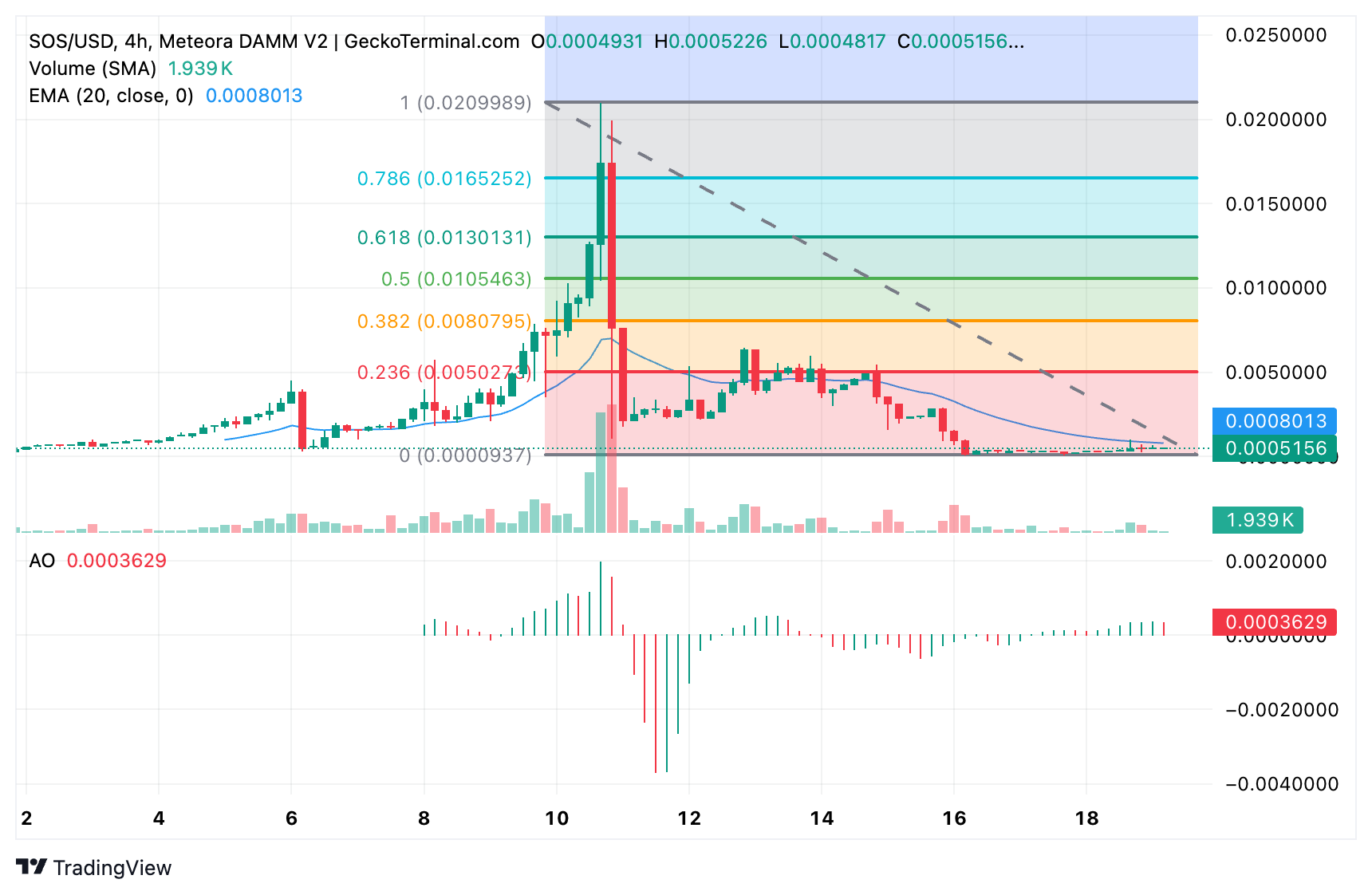
From a technical perspective, the SOS crypto reached a high of $0.017 on March 10before collapsing.
Price has since ground lower through every Fibonacci level, surrendering the 0.786, 0.618, 0.5, and 0.382 Fibs in succession. It now trades at $0.00052.
The 20-EMA at $0.00080 is well overhead the token’s price while acting as resistance.
The Awesome Oscillator (AO) at 0.00036 is fractionally positive. However, it has been oscillating tightly around zero since the spike’s collapse, producing alternating green and red bars without a clear direction.
In addition, the descending dashed trendline from the March 10 peak is the structural ceiling.
Notably, it has capped every attempted recovery since the reversal. Until the SOS price breaks above that trendline with volume, each green candle is a selling opportunity for those trapped from the spike.
The volume profile tells the story concisely. The March 10 spike candle dwarfs every session before or after.
Hold $0.0000937 (0 Fib) or the token loses its entire measurable structure. Meanwhile, the first recovery signal would be a 4-hour close above the descending trendline.
Until then, SOS might keep trading amid high volatility.
The Scale of What Is at Stake
The numbers behind this conflict are staggering. Since the Iran war started, some 20 vessels in the region have come under attack as Iranian fire effectively halts traffic through the Strait of Hormuz.
Furthermore, Trump suggested that other countries should be responsible for the Strait of Hormuz, after some nations rejected his demands for help in reopening the waterway.
Meanwhile, Saudi Arabia said it reserved the right to take military action against Tehran, while Qatar expelled Iran’s military and security attachés.
Saudi Arabia’s Foreign Minister stated that the little trust that had existed before had been completely shattered.
The foreign ministers of 12 Arab and Islamic states issued a joint statement demanding that Iran immediately halt its attacks.
The diplomatic architecture of the Gulf region is fracturing in real time. So, every fracture point is a new variable in an energy supply equation that is already under maximum stress.
Iran’s Counter-Threat and Why It Matters for SOS Price
Iran has not backed down. The Revolutionary Guards issued a direct statement warning that further attacks on its energy sector would result in escalating strikes on Gulf energy infrastructure until it is completely destroyed.
That mutual assured destruction posture between Iran and the Gulf states creates a sustained uncertainty premium in energy markets that persists regardless of short-term tactical developments.
That sustained uncertainty is the fuel that keeps the SOS crypto rally thesis intact beyond the initial 90% surge.
Disclaimer:
The information provided in this article is for informational purposes only. It is not intended to be, nor should it be construed as, financial advice. We do not make any warranties regarding the completeness, reliability, or accuracy of this information. All investments involve risk, and past performance does not guarantee future results. We recommend consulting a financial advisor before making any investment decisions.
Victor Olanrewaju is a crypto analyst and reporter at CCN with deep roots in on-chain research and technical analysis. His crypto journey began in 2017, but it was the 2020 Uniswap airdrop that sparked a full-time pivot into the space.
With a foundation in copywriting, Victor honed his craft creating high-converting content for leading crypto brokers — most notably an XRP price prediction that ranked #1 on Google during the 2021 bull run.
He later joined AMBCrypto in 2022, where he combined storytelling with technical and on-chain analysis to cover key market narratives.
In 2024, he expanded his expertise at BeInCrypto, collaborating with analysts and using tools like Glassnode, Santiment, and IntoTheBlock to break down Bitcoin and altcoin trends.
At CCN, Victor covers the top cryptocurrencies, memecoins, macro shifts, blending real-time insights with deep-dive metrics.
He holds a Bachelor’s degree in Physics from the University of Ibadan, equipping him to simplify complex data for a wide audience. Follow his work or connect on LinkedIn or X.