Strategic Oil Supply ($SOS) is a Solana-based crypto token themed around global oil markets and geopolitics; but it isn’t backed by real oil. | Credit: CCN.com
Share
Key Takeaways
The SOS token is built on the Solana blockchain and uses global oil reserves and energy market data as part of its branding.
However, the token does not represent ownership of physical oil or energy assets.
Rising oil prices amid tensions involving Iran and Middle East instability have increased attention on energy-themed tokens like SOS.
SOS belongs to a growing class of geopolitics-themed tokens that gain momentum during major news cycles such as wars, sanctions, and energy supply disruptions.
In recent years, the cryptocurrency market has seen a surge in theme-driven tokens that capitalize on major global narratives, from artificial intelligence to geopolitics. One of the latest examples is Strategic Oil Supply ($SOS), a Solana-based token designed around the symbolism of global oil reserves, energy markets, and geopolitical tensions.
At first glance, the concept can sound compelling: a cryptocurrency linked to oil supply dynamics during a time when global energy markets are highly volatile. However, many investors are asking a crucial question:
Is Strategic Oil Supply ($SOS) actually backed by real oil?
The short answer may surprise you.
While the token draws heavily on energy market data and oil reserve statistics for its branding, it does not represent ownership of physical oil or energy assets. Instead, SOS belongs to a growing category of narrative-driven crypto tokens that derive attention primarily from global events and market sentiment rather than commodity backing.
Understanding how the project works and what it does not represent is essential for anyone considering exposure to this emerging asset.
What Is Strategic Oil Supply ($SOS) Coin?
Strategic Oil Supply ($SOS) is a cryptocurrency token built on the Solana blockchain that centers its identity around global oil markets and geopolitical tensions.
The token trades under the ticker $SOS and is deployed under the contract address: 33dhma9QA7xefhVpA7c5vMrN826xcHanSHruUEKF2LmW
The project positions itself as a macro-themed digital asset inspired by the world’s strategic oil reserves and energy price movements.
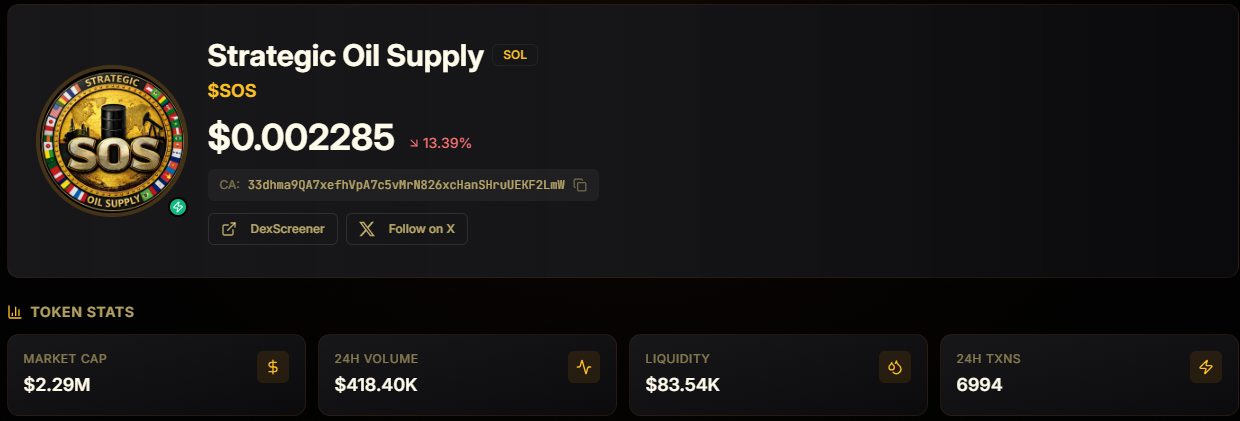
What is Strategic Oil Supply ($SOS)? | Credit: SOS website
However, despite the name and branding, the project does not represent tokenized oil barrels or physical commodity reserves. Instead, SOS is best understood as a thematic cryptocurrency whose narrative revolves around energy geopolitics.
Projects in this category are sometimes compared to tokens like:
In other words, buying SOS does not mean owning oil exposure.
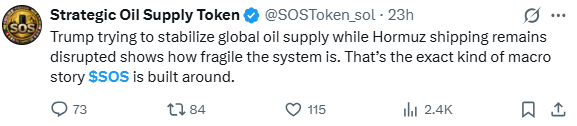
SOS tweets about investing in $SOS during this rising oil prices time. | Credit: SOS X profile
Some crypto projects attempt to tokenize commodities like gold or oil through custodial reserves. These systems involve verified storage and regulated frameworks.
The SOS project does not operate under such a model.
Instead, the token uses oil market statistics, energy price dashboards, and reserve data as contextual information rather than as inputs that influence token mechanics.
This means that WTI or Brent oil price movements do not automatically affect the supply or value of the SOS token.
The oil data displayed on the project’s website appears to be informational rather than functional.
How the Strategic Oil Supply Token Works on the Solana Blockchain
The SOS token is built on Solana, one of the fastest and most widely used blockchains for decentralized trading and token launches.
Solana provides several advantages for tokens like SOS:
Oil markets have been extremely volatile due to escalating geopolitical tensions, particularly involving Iran and broader instability in the Middle East.
Several factors are currently driving global oil prices higher.
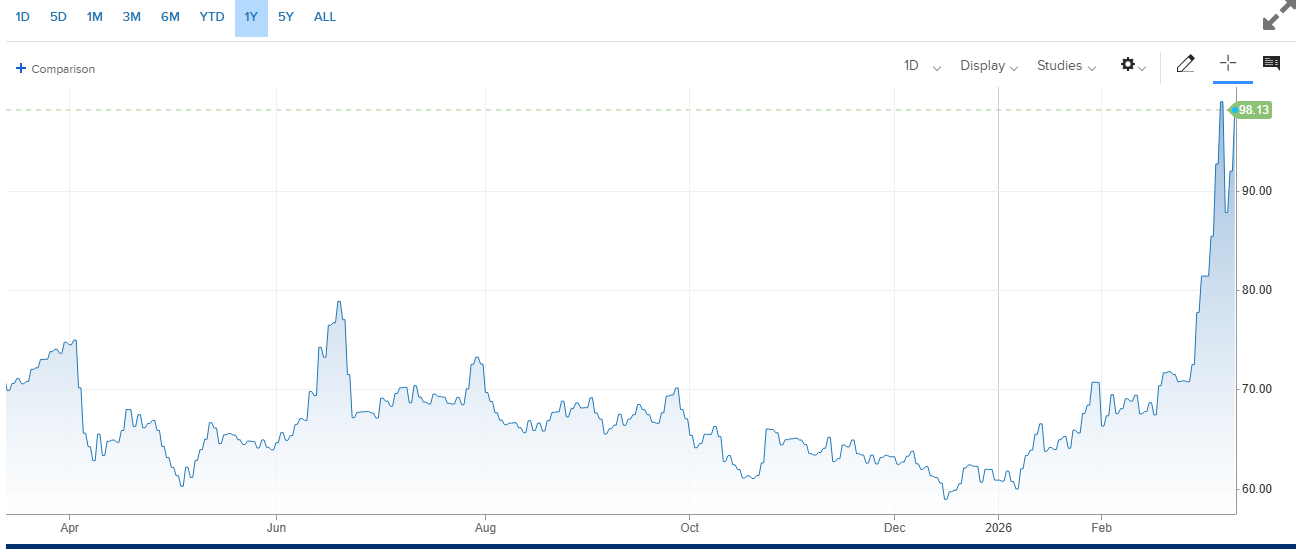
Brent price jumped after U.S.-Israel attack to Iran. | Credit: CNBC
Military tensions involving Iran and regional actors have raised concerns about potential disruptions to global energy supplies. The Middle East remains one of the most critical oil-producing regions in the world, and instability can quickly affect supply expectations.
Risk to the Strait of Hormuz
One of the most strategically important oil chokepoints is the Strait of Hormuz, through which roughly 20% of global oil shipments pass. Any threat to shipping in this corridor can cause immediate price spikes.
As tensions intensified, Brent crude oil surged past the $100 per barrel mark, triggering renewed attention across global financial markets.
Historically, oil prices often surge during:
Wars
Sanctions
Shipping disruptions
OPEC production shifts
These conditions create fertile ground for energy-related narratives in financial markets, including crypto markets.
Why Narrative Crypto Tokens Like $SOS Gain Popularity During Geopolitical Crises
The rise of tokens like Strategic Oil Supply reflects a broader trend within cryptocurrency markets: narrative trading.
Narrative tokens derive value primarily from social attention and macroeconomic storytelling, rather than from underlying assets or revenue models.
This distinction is critical for anyone evaluating the token as part of an investment strategy. While oil price spikes may increase attention around the token, there is no mechanism linking oil supply or demand to SOS token value.
Risks of Investing in Strategic Oil Supply ($SOS) Crypto
Several risks are important to consider when analyzing tokens like SOS.
Lack of commodity backing: Because SOS is not backed by oil reserves, it does not provide real exposure to energy markets.
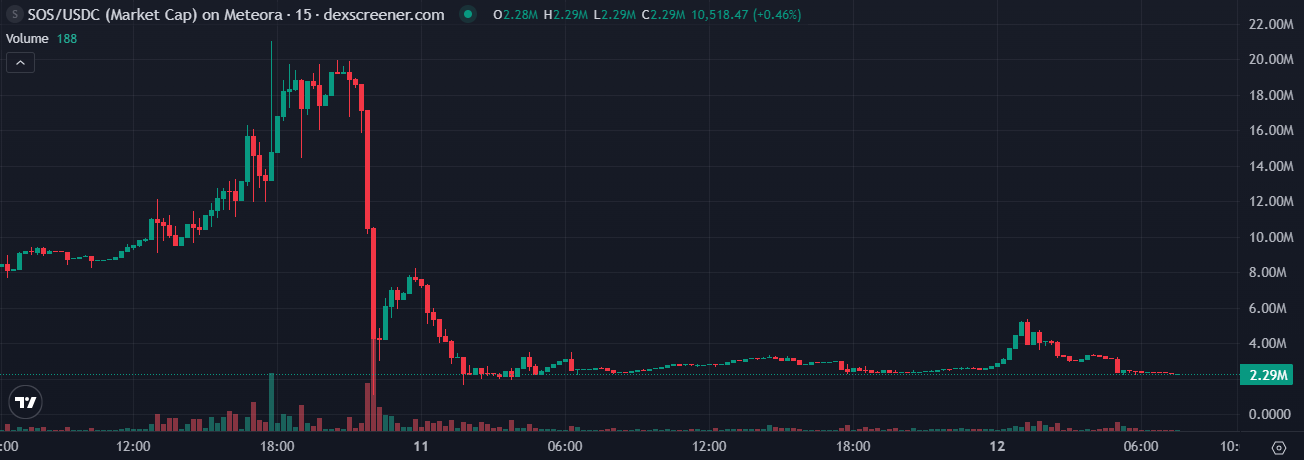
High volatility: Narrative-driven tokens often experience extreme price swings based on headlines or social media trends.
Limited liquidity: Lower liquidity pools can cause price movements to accelerate quickly in both directions.
Dependency on market sentiment: Interest in SOS may rise and fall depending on whether geopolitical tensions remain prominent in the news cycle.
Rise of Geopolitics-Themed Cryptocurrencies in Crypto Markets
Strategic Oil Supply is part of a broader category of geopolitics-themed cryptocurrencies. These tokens attempt to translate global tensions into market narratives that traders can speculate on.
Examples include tokens linked to:
War themes
Government reserves
Energy supply disruptions
Global political events
While these projects can generate short-term trading opportunities, they rarely represent direct ownership of real-world assets.
Instead, they reflect how crypto markets rapidly tokenize narratives and global events.
Strategic Oil Supply ($SOS) Coin Explained: Final Thoughts for Investors
Strategic Oil Supply ($SOS) coin may appear at first glance to represent tokenized oil reserves or an on-chain energy asset.
In reality, it is something quite different.
SOS is a narrative-driven cryptocurrency built on Solana that uses global oil markets and geopolitical tension as its branding framework.
It is not backed by physical oil, regulated commodity reserves, or real-world energy assets. As oil prices surge amid geopolitical tensions, especially with Brent crude surpassing $100 per barrel and instability in the Middle East, tokens tied to energy narratives are gaining attention across crypto markets.
But investors should approach them with a clear understanding of what they represent.
In simple terms: Strategic Oil Supply is not oil on-chain. It is geopolitics and energy sentiment tokenized into speculative crypto trading.
Understanding that distinction is the key to evaluating the token responsibly.
Is Strategic Oil Supply ($SOS) backed by real oil?
No. The Strategic Oil Supply ($SOS) token is not backed by physical oil reserves or energy assets. Despite using oil market data and global reserve statistics in its branding, the token does not represent ownership of oil or provide commodity-backed exposure.
What is Strategic Oil Supply ($SOS) crypto?
Strategic Oil Supply ($SOS) is a Solana-based cryptocurrency token themed around global oil reserves and energy geopolitics. It functions as a narrative-driven crypto asset rather than a commodity-backed investment.
Does the price of oil affect the SOS token price?
Not directly. Oil prices such as Brent crude or WTI crude do not automatically influence the SOS token’s supply, mechanics, or valuation. However, rising oil prices and geopolitical tensions may increase attention and speculative trading around the token.
Why is Strategic Oil Supply ($SOS) trending?
The token has gained attention during periods of geopolitical instability and rising oil prices, particularly amid tensions in the Middle East and disruptions to global energy supply chains. Narrative-driven tokens often trend when macroeconomic events dominate headlines.
Disclaimer:
The information provided in this article is for informational purposes only. It is not intended to be, nor should it be construed as, financial advice. We do not make any warranties regarding the completeness, reliability, or accuracy of this information. All investments involve risk, and past performance does not guarantee future results. We recommend consulting a financial advisor before making any investment decisions.
Giuseppe Ciccomascolo began his career as an investigative journalist in Italy, where he contributed to both local and national newspapers, focusing on various financial sectors.
Upon relocating to London, he worked as an analyst for Fitch's CapitalStructure and later as a Senior Reporter for Alliance News. In 2017, Giuseppe transitioned to covering cryptocurrency-related news, producing documentaries and articles on Bitcoin and other emerging digital currencies. He also played a pivotal role in establishing the academy for a cryptocurrency exchange website. Crypto remained his primary area of interest throughout his tenure as a writer for ThirdFloor.


 Easy
Easy