Coinbase Stock Tests $180 After Q1 Net Loss and Workforce Cuts? | Credit: Hameem Sarwar
Share
Key Takeaways
Coinbase withdrew its support for the CLARITY Act, delaying progress in U.S. crypto regulation.
Bitcoin’s price remains resilient, while XRP suffers most from the regulatory developments.
Ethereum’s price is stabilizing, but regulatory uncertainty could cap upside momentum.
On Jan. 14, the U.S. crypto regulatory landscape suffered a double blow as Coinbase officially withdrew its support for the CLARITY Act.
This triggered an immediate postponement of the Senate Banking Committee’s markup session.
This “regulatory stall” has injected fresh volatility into the market, as the hope for a clear federal framework for digital assets in early 2026 begins to fade.
But how will it affect some of the top cryptos, including Bitcoin (BTC), Ethereum (ETH), and XRP? Let’s find out.
CoinBase’s Brian Armstrong Says “No”
In a dramatic late-night post on Jan. 14, Coinbase CEO Brian Armstrong announced the exchange could no longer support the Senate’s latest draft of the Digital Asset Market CLARITY Act. Here are his reasons:
The “Bad Bill” Argument: Armstrong stated, “We’d rather have no bill than a bad bill,” citing provisions that he claims would be more restrictive than the current “regulation by enforcement” status quo.
Stablecoin Rewards: A major sticking point is a proposed ban on stablecoin yield/rewards (like the 3.5% offered on USDC), which banks argue drains liquidity from traditional savings accounts.
DeFi & Privacy: Armstrong also flagged amendments that would grant the government broad access to DeFi user data and effectively ban tokenized equities on-chain.
The CLARITY Act Stall: Senate Postponement
Following Coinbase’s withdrawal and lobbying from the American Bankers Association, Senate Banking Chair Tim Scott officially postponed the January 15 markup.
The New Timeline: The session has been moved to the last week of January 2026 to allow for “further bipartisan negotiations.”
The Risk: Analysts warn that if the bill does not advance by early February, it risks being “shelved” as the 2026 midterm election cycle begins to dominate the legislative calendar.
“Everyone involved in the CLARITY Act is a parasite,” crypto analyst Aaron Day said.
However, Chris Dixon, Managing Partner at a16z, noted that this is the ideal time to pass the bill.
“It’s not perfect, and changes are needed before it becomes law. But now is the time to move the CLARITY Act forward if we want the U.S. to remain the best place in the world to build the future of crypto,” Dixon noted.
Furthermore, unlike Armstrong, Ripple’s CEO, Brad Garlinghouse, appears to support the act. He, however, mentioned that the issues raised can be resolved during the process.
“While long-overdue, this move by SenatorTimScott and BankingGOP on market structure is a massive step forward in providing workable frameworks for crypto, while continuing to protect consumers. Ripple (and I) know firsthand that clarity beats chaos, and this bill’s success is crypto’s success,” Garlinghouse posted on X.
Market Impact: BTC, XRP, and ETH
While the CLARITY Act’s development is significant, it has not had a substantial impact on top cryptocurrencies. However, in the future, it could be due to the reasons highlighted in the table below.
Asset
24-Hour Reaction
Technical Setup Status
Outlook
Bitcoin (BTC)
+1.81% ($96,744)
Tested the $97,000 psychological support before dropping
Neutral: BTC remains a “global” asset less tied to US-specific bills.
XRP (XRP)
-0.42% ($2.11)
Dropped from $2.25 resistance
Bearish: XRP was the biggest beneficiary of CLARITY; the stall is a major blow.
Ethereum (ETH)
+2.00% ($3,358)
Barely holding the $3,000 floor
Cautious: The DeFi restrictions in the bill are a direct threat to ETH utility.
Experts Support the Delay
Regarding the delay around the CLARITY Act, CCN spoke with several experts, including Elisenda Fabrega, General Counsel at Brickken, an enterprise-grade tokenization infrastructure for real-world assets.
Fabrega said Armstrong’s concerns are valid. In her view, the proposed framework still contains gaps that lawmakers need to address.
She noted that while the bill moves regulation in the right direction, unresolved issues could create ambiguity for market participants if left unchanged.
“The current draft contains several significant legal shortcomings. For instance, the lack of precision in certain definitions, which are overly broad, risks encompassing assets that do not exhibit the economic or structural features typically associated with securities. This could lead to regulatory overreach and uncertainty for projects operating in good faith,” She told CCN.
Despite backing the broader push, Fabrega warned that prolonged stalling could complicate the legislative process.
She stressed that disengagement would be counterproductive and urged Coinbase to remain actively involved, arguing that continued participation is essential to refining the framework and addressing its shortcomings.
“Stepping away at a critical moment limits the ability of informed stakeholders to influence the final outcome and increases the risk that the resulting framework reflects less nuanced or overly restrictive approaches. In this sense, while the objections raised by Coinbase highlight genuine weaknesses in the current proposal, the decision to disengage from the process itself is unlikely to produce constructive results,” Fabrega added.
Interestingly, another expert CCN spoke with was Konstantins Vasilenko, co-founder and CBDO of crypto–fiat infrastructure firm Paybis.
Like Fabrega, Vasilenko said he supports the delay. In an exclusive conversation with CCN, he argued the current draft needs fixes. In his view, it effectively shuts down stablecoin yield programs and shifts too much authority to the SEC at the CFTC’s expense.
“Any regulation that favors incumbent players over innovation will slow down crypto adoption. Over 125 crypto companies have pushed back against these changes. Coinbase isn’t alone here. The whole industry sees a bill that would set things back,” He highlighted.
Bitcoin (BTC) Price Steady
From the looks of things, the CLARITY Act may not be a major driver for Bitcoin in the near term. BTC tends to respond more to liquidity, rates, and risk appetite than to token-specific regulation.
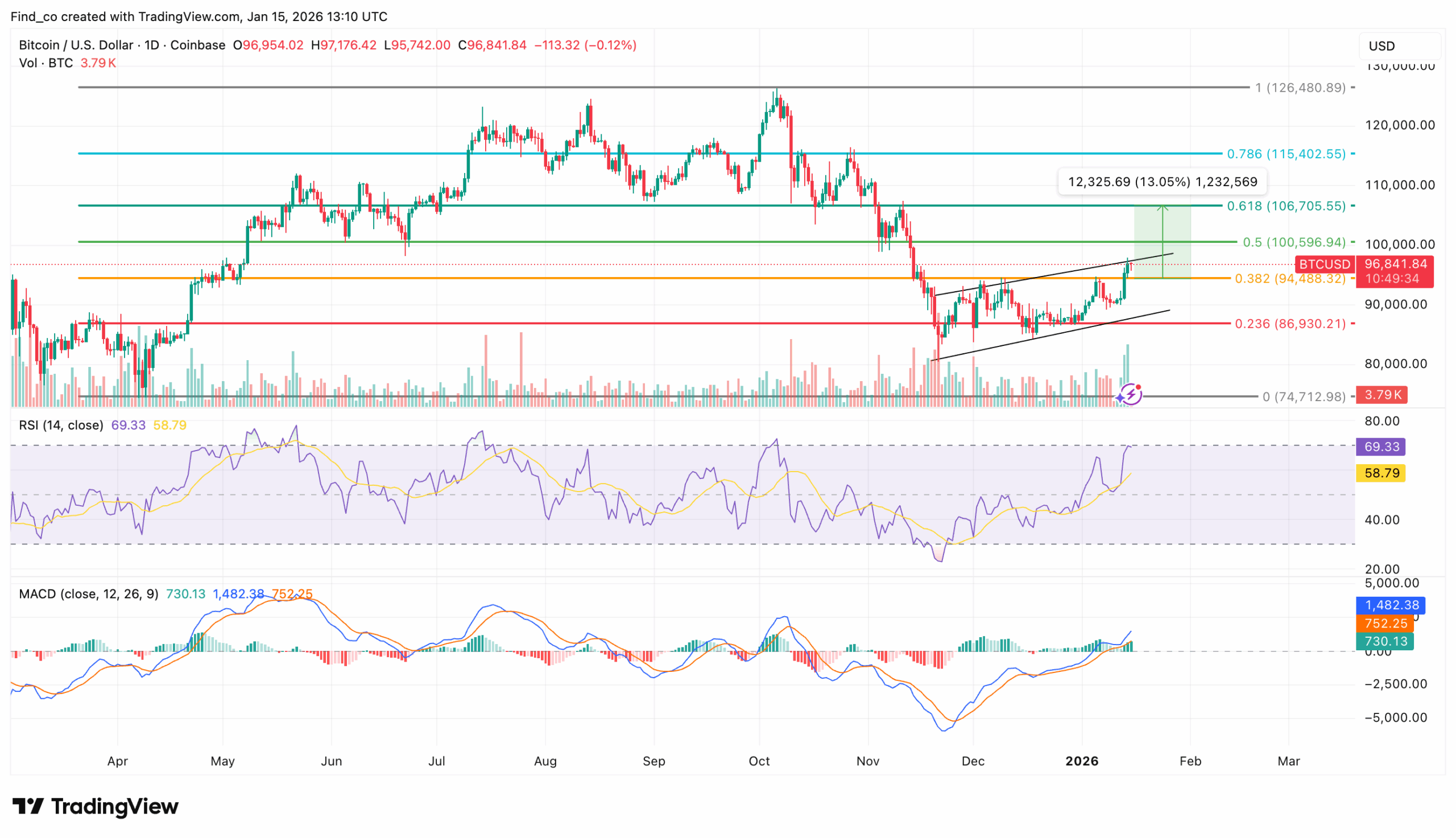
Technically, the chart still leans constructive. Bitcoin’s price is consolidatingwithin an ascending triangle, which often signals a continuation if buyers keep printing higher lows.
The Relative Strength Index (RSI) has climbed, indicating strengthening demand, while the Moving Average Convergence Divergence (MACD) has flashed a bullish crossover, suggesting that upside momentum is rebuilding.
If this setup holds, BTC could break above the $100,596 resistance. If buyers follow through, the next target sits near $106,705.
However, the risk remains a downside break. If selling pressure increases and BTC loses its support base, the breakout thesis weakens. In that scenario, Bitcoin’s price could drop to around $86,930.
Meanwhile, on price action, Vasilenko said the current phase of the process is unlikely to affect Bitcoin. He noted that BTC tends to react more to liquidity and macro forces than to legislative delays.
However, he added that once the bill eventually passes, the broader market could see a brief correction.
In his view, that pullback would likely reflect a “sell-the-news” reaction rather than a shift in Bitcoin’s long-term trend.
“When the bill passes, we’ll probably see the “sell the news” side play out, with a short-term pullback. What really moves prices long-term is institutional confidence,” Vasilenko said.
Notably, it is moving within a well-defined descending channel that has guided the market lower since the October breakdown.
Although buyers managed a short-term push higher, the rally stalled quickly, which confirms that sellers remain active on strength.
The Fibonacci framework reinforces this view. At the time of writing, XRP’s price failed to reclaim the 0.382 retracement level near $2.50 and remains capped below the 0.236 level around $2.22.
As long as XRP trades beneath these levels, upside moves look like relief rallies rather than the start of a trend reversal. The lower boundary of the channel and the prior base near $1.70 remain the key downside reference.
Additionally, the Awesome Oscillator (AO) has turned positive, indicating that bearish pressure is easing. Yet, the histogram remains modest and far from prior bullish setups.
Holder sentiment remains negative, suggesting that broader market confidence has not yet fully recovered. If this remains the case, XRP’s price risks declining below $2.
Overall, the chart suggests stabilization rather than strength. XRP needs a daily close above the descending trendline and a clean reclaim of the $2.22 to $2.25 area to shift the structure toward bullish recovery.
Amid all of this, Fabrega stressed that the market impact ultimately depends on the final form of the CLARITY Act.
In her view, a well-drafted bill could support prices across significant assets like Bitcoin, XRP, and Ethereum by improving regulatory clarity and reducing headline risk.
However, she warned that a poorly drafted framework could have the opposite effect. If it creates new ambiguity or expands enforcement risk, she believes top cryptocurrencies could face fresh downward pressure.
“In that scenario Bitcoin would remain resilient due to its simplicity and decentralized monetary profile, while Ethereum, XRP, and other utility assets may be exposed to downward repricing due to impaired legal operability or limitations on functional deployment,” She emphasized.
ETH Price Action Cautious
Meanwhile, Ethereum’s price trades near 3,367 on the daily chart and is showing early signs of recovery after a deep corrective phase.
At the time of writing, the price has been forming higher lows since mid-December, while the upper boundary remains capped by a descending trendline. This tightening structure reflects a market that is coiling and preparing for a directional move.
The Fibonacci levels highlight the key pressure zones. ETH is now pushing above the 0.236 retracement level near $3,170, marking an essential shift in short-term control.
However, price still sits below the 0.382 level around $3,509, and that area continues to act as the main upside barrier. As long as ETH remains below $3,500, the broader structure stays corrective rather than fully bullish.
Trend and flow indicators support cautious optimism.
The Supertrend has flipped supportive below price, suggesting reduced downside risk, while the rising lower trendline confirms improving structure.
At the same time, the descending upper trendline limits follow-through and keeps rallies contained. CMF has turned positive and is rising, signaling renewed capital inflows and improved participation.
Overall, Ethereum is stabilizing and gradually rebuilding strength, but confirmation is still missing.
A daily close above the descending trendline and the $3,500 to $3,550 zone would signal a stronger recovery and open the path toward the $4,050 and $4,450 retracement levels.
Disclaimer:
The information provided in this article is for informational purposes only. It is not intended to be, nor should it be construed as, financial advice. We do not make any warranties regarding the completeness, reliability, or accuracy of this information. All investments involve risk, and past performance does not guarantee future results. We recommend consulting a financial advisor before making any investment decisions.
Victor Olanrewaju is a crypto analyst and reporter at CCN with deep roots in on-chain research and technical analysis. His crypto journey began in 2017, but it was the 2020 Uniswap airdrop that sparked a full-time pivot into the space.
With a foundation in copywriting, Victor honed his craft creating high-converting content for leading crypto brokers — most notably an XRP price prediction that ranked #1 on Google during the 2021 bull run.
He later joined AMBCrypto in 2022, where he combined storytelling with technical and on-chain analysis to cover key market narratives.
In 2024, he expanded his expertise at BeInCrypto, collaborating with analysts and using tools like Glassnode, Santiment, and IntoTheBlock to break down Bitcoin and altcoin trends.
At CCN, Victor covers the top cryptocurrencies, memecoins, macro shifts, blending real-time insights with deep-dive metrics.
He holds a Bachelor’s degree in Physics from the University of Ibadan, equipping him to simplify complex data for a wide audience. Follow his work or connect on LinkedIn or X.