No Fed rate shock, but no BTC breakout either | Credit: Hameem Sarwar
Share
Key Takeaways
BTC is holding around $75,000 after the Fed paused rates, but market demand remains weak.
The $80,000 level is key resistance, as a breakout could accelerate toward higher targets.
Thin liquidity makes price moves more volatile and reactive, with direction unclear.
Bitcoin (BTC) price has held the $75,000 level after the Federal Reserve held interest rates unchanged at 3.50%–3.75%, with Jerome Powell expected to deliver what is expected to be his final FOMC speech before stepping down on May 15.
As expected, the shift in monetary policy did not bolster appetite for risk assets. However, markets remain cautious.’
Here is why that happened and what could be next for Bitcoin’s price.
The Fed Holds Rates, BTC Wobbles
At exactly 2:00 PM ET, the Federal Reserve confirmed what markets had already priced in — no rate change.
For weeks, investors had assigned a near 100% probability to a pause. But that headline hid a deeper issue.
Get These Top Crypto Casino Offers Now!
Sponsored
Disclosure
We sometimes use affiliate links in our content, when clicking on those we might receive a commission at no extra cost to you. By using this website you agree to our terms and conditions and privacy policy.
The Fed didn’t hold because it wanted to. It held because it had no choice. The numbers are clear.
“In support of its goals, the Committee decided to maintain the target range for the federal funds rate at 3‑1/2 to 3‑3/4 percent. In considering the extent and timing of additional adjustments to the target range for the federal funds rate, the Committee will carefully assess incoming data, the evolving outlook, and the balance of risks,” It stated.
March CPI came in at 3.3% year-over-year — the highest level since May 2024.
That’s more than a full percentage point above the Fed’s 2% target.
Following the development, Bitcoin’s price slid below $76,000, and is currently holding the $75,000 support.
Powell’s Final Speech to Carry the Real Weight?
Meanwhile, at 2:30 PM ET, Powell will step up, and markets will listen differently.
This is not just another press conference. It is likely his last.
As expected, Powell will likely strike a neutral tone, echoing TD Securities’ view that the Fed would remain “patient” and noncommittal given the current environment.
But even neutrality carried meaning. Powell made one thing clear.
The path forward is uncertain. The Fed is balancing:
Persistent inflation driven by energy prices.
Geopolitical risks that cannot be modeled easily.
and an economy that hasn’t clearly slowed.
This explains why the FOMC has now held rates steady across January, March, and April meetings.
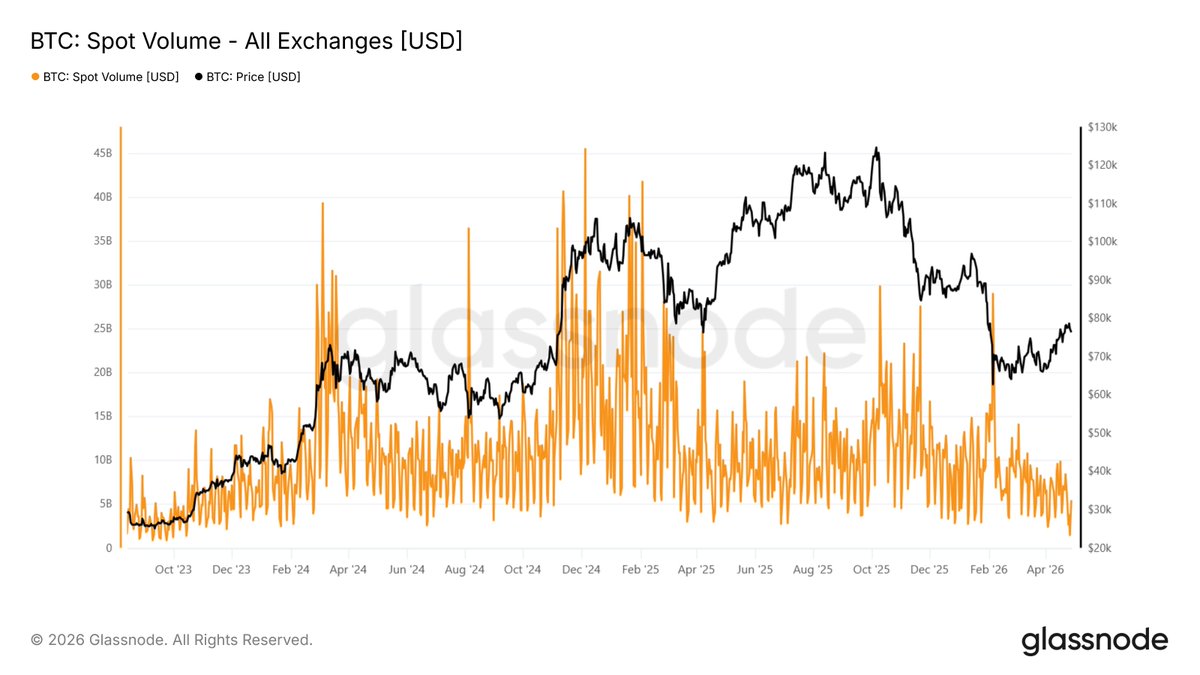
In the meantime, what stands out is that Bitcoin spot volume across major exchanges has dried up completely.
Rate Cuts Unlikely for the Remainder of 2026
Besides that, according to Wall Street Journal reporter Nick Timiraos, the Federal Reserve’s latest decision to pause rates drew four dissents.
Three regional bank presidents opposed retaining an easing bias, while one governor dissented in favor of a rate cut. Notably, this marks the first meeting with four dissents since 1992.
As a result, expectations have shifted. The Fed is no longer widely anticipated to cut interest rates in 2026 following today’s decision.
Moreover, market sentiment reflects this change. On Polymarket, the probability of zero rate cuts in 2026 has risen to 59%, reinforcing a more hawkish outlook for the remainder of the year.
Fed Rate Cuts in 2026 Chances | Credit: Polymarket
According to the Glassnode chart below, this is the lowest level we’ve seen since October 2023.
On the flip side, this thin liquidity can work both ways. If buyers step in and push through resistance, the lack of sell-side depth could accelerate the price quickly toward $100,000.
But if sellers defend this zone, the same lack of demand underneath could lead to a fast move back toward $65k.
No Liquidity for Bitcoin Price
Additionally, the Bitcoin liquidation heatmap shows where real liquidity is, and it aligns well with the low-volume environment we discussed earlier.
Right now, Bitcoin’s price is hovering around $76,000. But the important part is the imbalance around it.
There’s a dense cluster of liquidity below, especially in the $70,000-$72,000 range.
Above the price, liquidity is stacked around $$80,000. However, it is thinner and more fragmented compared to what’s sitting below.
This reinforces the idea that the $80,000 zone remains a strong resistance. At the same time, it is not necessarily a breakout zone unless new demand comes in.
In a normal high-volume market condition, the price could grind through these levels more evenly.
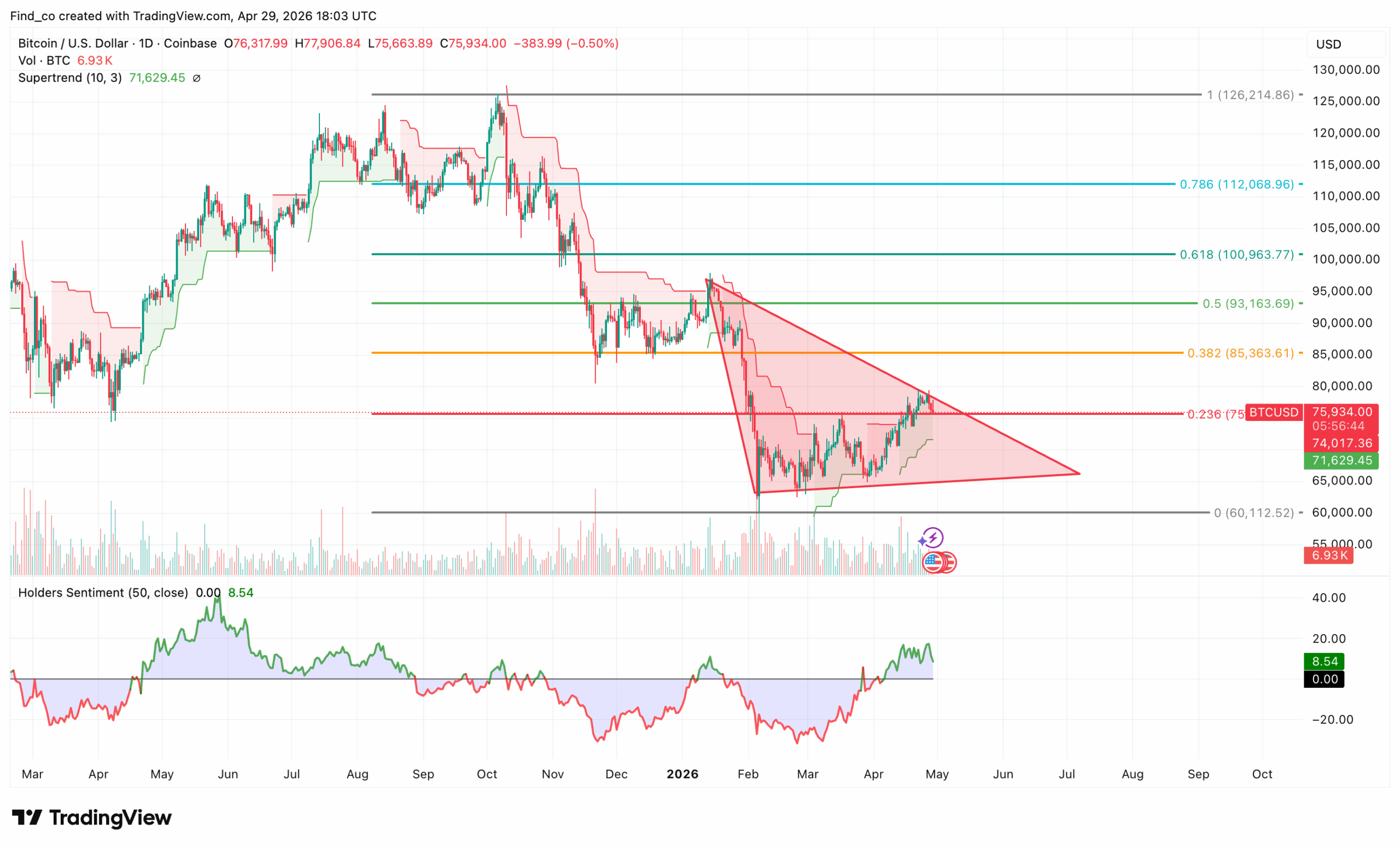
The broader structure is still a pullback from the highs, but price has already reclaimed from the $60,000 region and is now pushing into that first major resistance band.
The triangle you drew shows volatility tightening, and that usually leads to expansion. So, this is more about when it breaks than if.
The key thing here is positioning relative to the fibs. If BTC can break and hold above $76,000, that opens the path toward $85,000 (0.382) pretty quickly.
From there, you’re looking at a continuation move back into the $93k–$100k range. That would basically confirm this was just a corrective structure resolving higher.
If it rejects here, though, it’s still technically a lower high inside a broader pullback. In that case, I’d expect a move back toward $70k, with $65,000 being the stronger support below.
Holders’ sentiment is turning positive again, which supports the idea that this is accumulation rather than distribution, but it still needs price confirmation at this resistance level.
Disclaimer:
The information provided in this article is for informational purposes only. It is not intended to be, nor should it be construed as, financial advice. We do not make any warranties regarding the completeness, reliability, or accuracy of this information. All investments involve risk, and past performance does not guarantee future results. We recommend consulting a financial advisor before making any investment decisions.
Victor Olanrewaju is a crypto analyst and reporter at CCN with deep roots in on-chain research and technical analysis. His crypto journey began in 2017, but it was the 2020 Uniswap airdrop that sparked a full-time pivot into the space.
With a foundation in copywriting, Victor honed his craft creating high-converting content for leading crypto brokers — most notably an XRP price prediction that ranked #1 on Google during the 2021 bull run.
He later joined AMBCrypto in 2022, where he combined storytelling with technical and on-chain analysis to cover key market narratives.
In 2024, he expanded his expertise at BeInCrypto, collaborating with analysts and using tools like Glassnode, Santiment, and IntoTheBlock to break down Bitcoin and altcoin trends.
At CCN, Victor covers the top cryptocurrencies, memecoins, macro shifts, blending real-time insights with deep-dive metrics.
He holds a Bachelor’s degree in Physics from the University of Ibadan, equipping him to simplify complex data for a wide audience. Follow his work or connect on LinkedIn or X.