Bitcoin options are flashing a rare warning as upside demand falls to an all-time low. Discover what it means for BTC price, volatility, and market sentiment. | Credit: CCN.com
Share
Key Takeaways
Bitcoin slipped below $81,000 after heavy volatility triggered liquidations amid Fed uncertainty and geopolitical tensions.
Markets are reacting cautiously to Kevin Warsh’s expected appointment as Fed Chair, as traders fear higher interest rates.
Despite short-term weakness, Bitcoin’s price still holds a bullish structure above crucial support near $79,000.
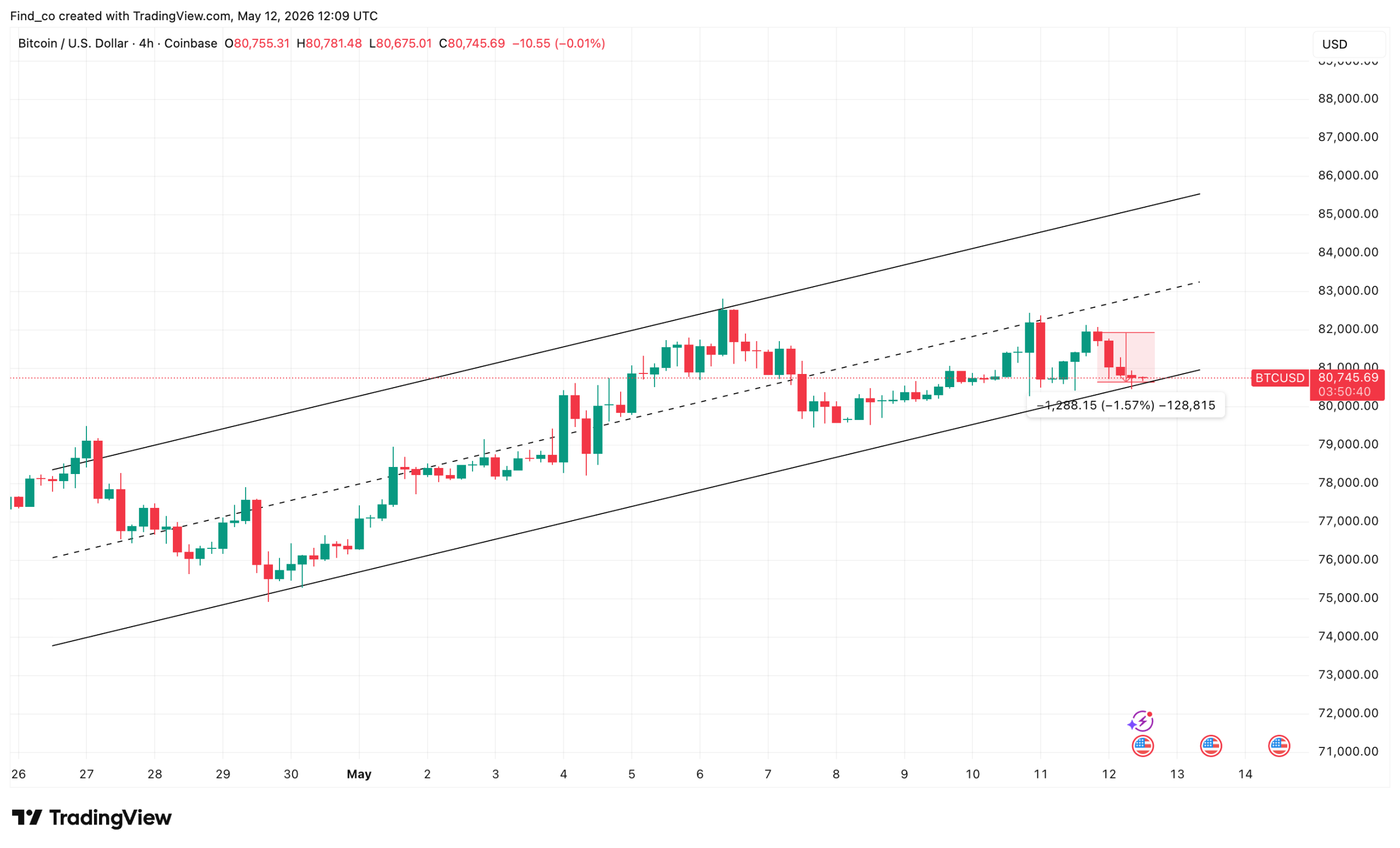
Bitcoin (BTC) is trading under mild downward pressure, falling roughly 1.5% over the past 24 hours to hover near the $80,500.
While the decline is relatively modest, it follows an extremely volatile 48-hour period where Bitcoin swung nearly $4,000 in both directions.
During that window, more than $370 million in leveraged long and short positions were liquidated across the crypto market.
But why else is Bitcoin down today? Also, what could be next amid a combination of geopolitical tensions, Federal Reserve uncertainty, and sovereign outflows?
Try Our Recommended Crypto Exchanges
Sponsored
Disclosure
We sometimes use affiliate links in our content, when clicking on those we might receive a commission at no extra cost to you. By using this website you agree to our terms and conditions and privacy policy.
The biggest macro factor currently weighing on Bitcoin’s price is the impending leadership transition at the US Federal Reserve.
On Monday, May 11, the US Senate advanced a procedural cloture vote that cleared the path for Kevin Warsh, President Donald Trump’s nominee, to become the next Federal Reserve Chair.
A final confirmation vote is expected later this week ahead of Jerome Powell’s official term expiration on May 15.
Get These Top Crypto Casino Offers Now!
Sponsored
Disclosure
We sometimes use affiliate links in our content, when clicking on those we might receive a commission at no extra cost to you. By using this website you agree to our terms and conditions and privacy policy.
Warsh has historically been viewed as an “inflation hawk,” favoring tighter monetary policy, higher interest rates, and balance sheet reduction.
For markets, that creates fears that interest rates could remain “higher for longer,” which generally reduces liquidity for speculative assets like cryptocurrencies.
Higher Treasury yields and a stronger US Dollar have already started capping Bitcoin’s upside momentum below its previous $126,198 cycle peak.
Besides that, US inflation rose to 3.8%, above expectations.
For context, the US April seasonally adjusted Core CPI rose 0.4% MoM, exceeding market expectations of 0.3% and recording its strongest monthly increase since January 2025.
At the time of writing, Bitcoin’s price is down 36% from that high.
He has reportedly invested in more than 20 crypto-linked companies and previously described Bitcoin as “new gold for the under-40s.”
Furthermore, some analysts believe his leadership could eventually support clearer crypto regulation and accelerate legislation such as the CLARITY Act later in 2026.
Trump’s Middle East Comments Triggered Immediate Liquidations
Apart from that, the catalyst for Bitcoin’s latest volatility spike came from geopolitical tensions surrounding Middle East peace negotiations.
Earlier on, Iran reportedly responded to a US 14-point peace proposal through Pakistani mediators while pushing back against certain nuclear restrictions.
President Trump responded publicly on social media with four blunt words:
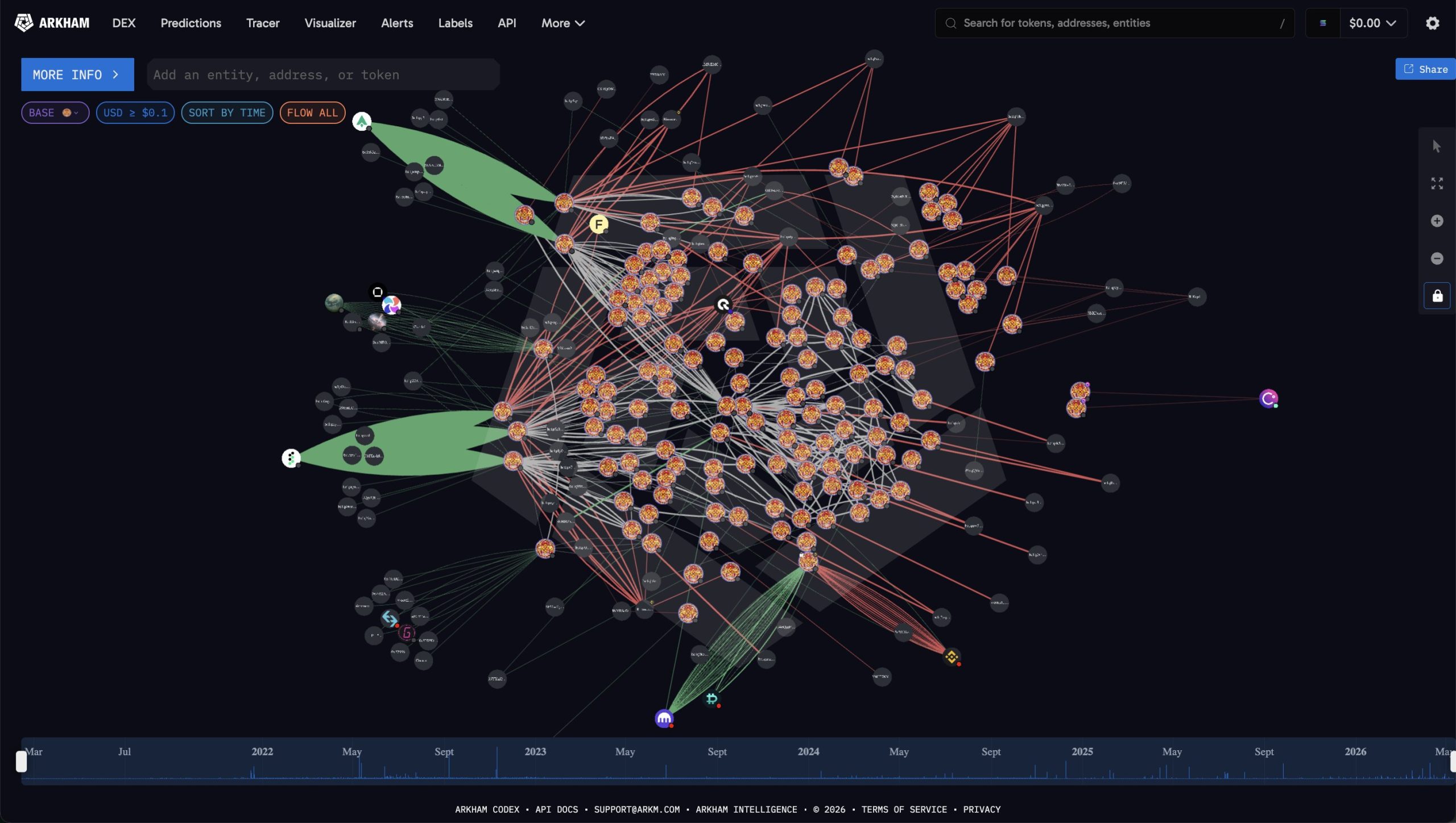
While some of these transactions appear to be related to internal wallet restructuring and migrations to native SegWit infrastructure, previous transfers have frequently been routed to Binance and Galaxy Digital deposit addresses.
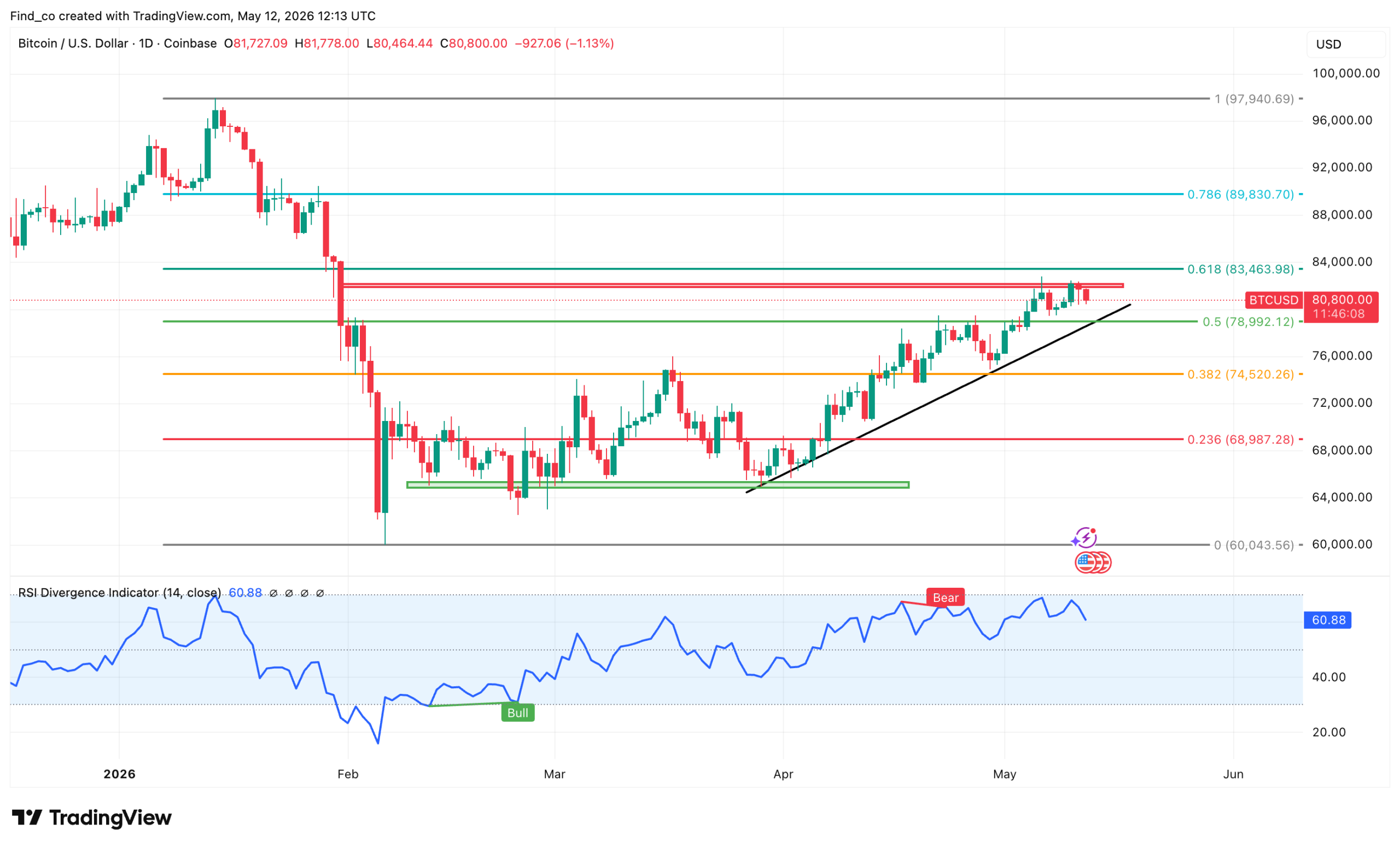
At the time of writing, BTC is consolidating just below a major resistance zone around $82,000.
However, the overall structure remains bullish, with price continuing to print higher lows along the ascending trendline.
Yet, the repeated rejections near resistance show sellers are still defending this area. But at the same time, bulls have not lost momentum yet.
RSI remains above 60, which supports overall continuation strength.
If Bitcoin’s price breaks and closes above the $82,000 resistance zone, the next major target lies near the 0.618 Fib at $83,463, followed by the 0.786 Fib at $89,830.
As long as price holds above the rising trendline and the $79,000 support region, the bullish structure stays intact.
On the contrary, a bullish invalidation would occur if the trendline is broken.
In that case, Bitcoin could go down as the price might break below the $74,520, triggering a deeper retracement toward the $69,000 support.
Despite the current volatility, many long-term investors still view the current consolidation as a healthy market structure following the 2024 halving cycle.
With daily Bitcoin issuance remaining constrained at roughly 450 BTC, broader long-term supply dynamics remain fundamentally bullish.
As a result, many institutional analysts continue to maintain aggressive year-end Bitcoin targets of $150,000 to $200,000 if ETF inflows stabilize and macro conditions improve later in 2026.
Disclaimer:
The information provided in this article is for informational purposes only. It is not intended to be, nor should it be construed as, financial advice. We do not make any warranties regarding the completeness, reliability, or accuracy of this information. All investments involve risk, and past performance does not guarantee future results. We recommend consulting a financial advisor before making any investment decisions.
Victor Olanrewaju is a crypto analyst and reporter at CCN with deep roots in on-chain research and technical analysis. His crypto journey began in 2017, but it was the 2020 Uniswap airdrop that sparked a full-time pivot into the space.
With a foundation in copywriting, Victor honed his craft creating high-converting content for leading crypto brokers — most notably an XRP price prediction that ranked #1 on Google during the 2021 bull run.
He later joined AMBCrypto in 2022, where he combined storytelling with technical and on-chain analysis to cover key market narratives.
In 2024, he expanded his expertise at BeInCrypto, collaborating with analysts and using tools like Glassnode, Santiment, and IntoTheBlock to break down Bitcoin and altcoin trends.
At CCN, Victor covers the top cryptocurrencies, memecoins, macro shifts, blending real-time insights with deep-dive metrics.
He holds a Bachelor’s degree in Physics from the University of Ibadan, equipping him to simplify complex data for a wide audience. Follow his work or connect on LinkedIn or X.