Key Takeaways
- Senate Majority Leader John Thune filed cloture on the motion to proceed to the CLARITY Act, setting up the bill’s next Senate test.
- XRP whales accumulated more than 380 million tokens over the past week, according to data shared by analyst Ali Martinez.
- Martinez identifies $1.06 as the critical resistance, with $1.35 and $1.64 as potential technical targets if XRP breaks higher.
XRP is approaching a potentially important September as a fresh Senate move on the CLARITY Act coincides with heavy whale accumulation and a new long-term technical buy signal.
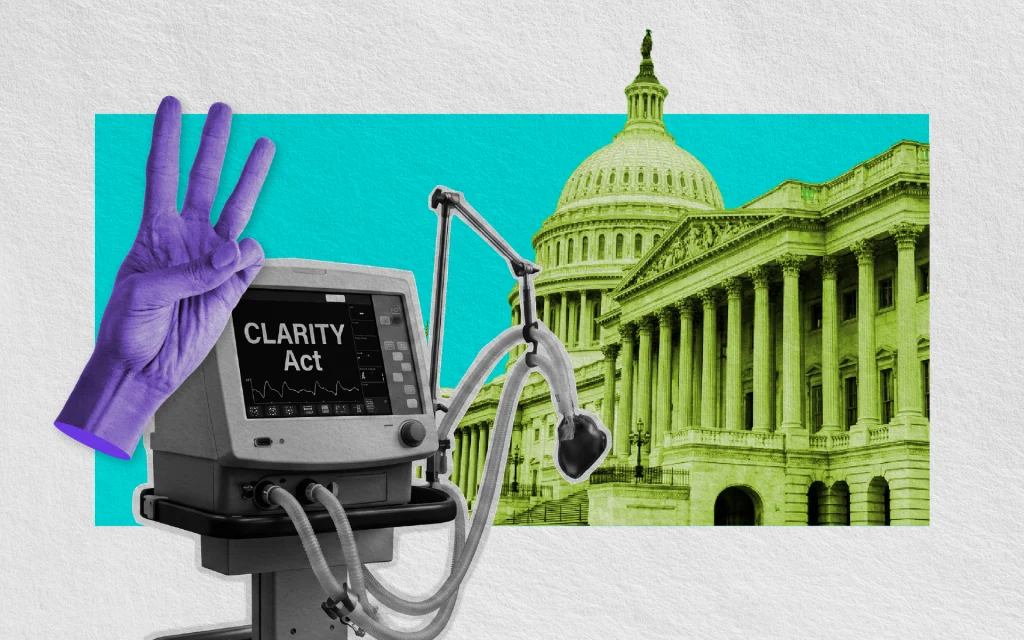
Senate Majority Leader John Thune filed cloture on the motion to proceed to Calendar No. 423, H.R. 3633, the CLARITY Act, according to the Senate Cloakroom.
The procedural move sets up a vote after senators return in September.
However, the development does not mean the CLARITY Act has passed. Cloture on the motion to proceed is a procedural step toward bringing legislation before the Senate, rather than a final vote on the bill itself.
For XRP, however, the renewed legislative movement arrives alongside a notable change in positioning among large holders.
XRP Whales Accumulate 380M Tokens
Crypto analyst Ali Martinez, citing Santiment data, said whales accumulated more than 380 million XRP over the past week.
The accumulation comes as Martinez says the Tom DeMark Sequential has generated a buy signal on XRP’s monthly chart.
He pointed to previous instances where the indicator appeared near major XRP reversals. An April 2020 buy signal preceded a reported 1,074% rally, while an August 2022 signal preceded a 973% increase. Conversely, an April 2025 sell signal was followed by a 57% decline.
Those historical moves do not mean the latest signal will produce a comparable rally. But combined with the reported whale accumulation, they provide two indicators traders are watching for a possible change in XRP’s longer-term momentum.
Academic research published this year has also found that characteristics of XRP’s transaction network can contain information relevant to unusually large price movements, although predicting crypto prices remains inherently uncertain.
Could CLARITY Act Passage Still Matter for XRP?
The Senate development comes one day after Grayscale Head of Research Zach Pandl argued that crypto could continue expanding even if Congress ultimately fails to enact the CLARITY act.
Pandl said existing regulatory developments around custody, banking access, staking and crypto investment products mean major blockchain networks would continue functioning without the legislation.
The bigger cost, in Grayscale’s view, would emerge over the longer term. Without comprehensive market structure legislation, crypto development and capital formation could increasingly shift overseas, leaving the SEC and other agencies to fill regulatory gaps through rulemaking.
For XRP, that distinction is important. A successful procedural vote would move the legislation forward, but several steps would still remain in the Senate before a final market structure framework could become law.
XRP Price: $1.06 Is the Level to Watch
Martinez identifies $1.06 as XRP’s immediate technical hurdle. Onchain data cited by the analyst shows nearly 3 billion XRP changed hands around that price, creating a significant concentration of supply.
A monthly close above $1.06, according to his analysis, could open a technical path toward $1.35, followed by $1.64.
That makes the current setup unusually concentrated around two separate catalysts: a political one in Washington and a market one around $1.06.
The 380 million XRP accumulation suggests some large holders are positioning ahead of that test, but neither whale buying nor the CLARITY Act’s procedural progress guarantees a breakout. Until $1.06 is decisively reclaimed, the higher targets remain scenarios rather than confirmed price objectives.
Top Trending Crypto Articles
The information provided in this article is for informational purposes only. It is not intended to be, nor should it be construed as, financial advice. We do not make any warranties regarding the completeness, reliability, or accuracy of this information. All investments involve risk, and past performance does not guarantee future results. We recommend consulting a financial advisor before making any investment decisions.

Dr. Guneet Kaur is a senior editor at CCN.com and a Science Fellow at Exponential Science. She is a fintech and blockchain expert with extensive experience in digital finance education, blockchain ecosystems, and cryptocurrency markets. She has worked with global media such as Cointelegraph, as well as education and blockchain platforms, to design and lead strategic content and learning initiatives. As an educator and assessor for top-tier executive programs, she bridges real-world fintech trends with academic insight.
Dr. Kaur is also a published researcher and peer reviewer across fintech and data science journals, including Financial Innovation Journal and International Journal of Big Data Intelligence and Applications. Her work spans data-driven analysis, Web3 innovation, and technical content development. With a strong foundation in both industry and academia, she translates complex financial technologies into practical applications, empowering learners, professionals, and institutions across the rapidly evolving digital finance landscape.