Key Takeaways
- Senate leaders delayed the vote on the CLARITY Act until September due to disagreements over ethics and regulatory oversight.
- Polymarket’s odds of the bill becoming law in 2026 briefly fell to a record low of 13%.
- XRP recorded an unprecedented 627 consecutive daily closes above $1.
US Senate Republican leaders have postponed an initial vote on a landmark crypto bill until September, narrowing the path for the measure to become law this year as lawmakers remain divided over ethics and regulatory oversight.
The setback came as XRP marked a record 627 consecutive daily closes above $1, a sign of unusual price resilience for the token even as hopes for near-term action on the Digital Asset Market Clarity Act faded.
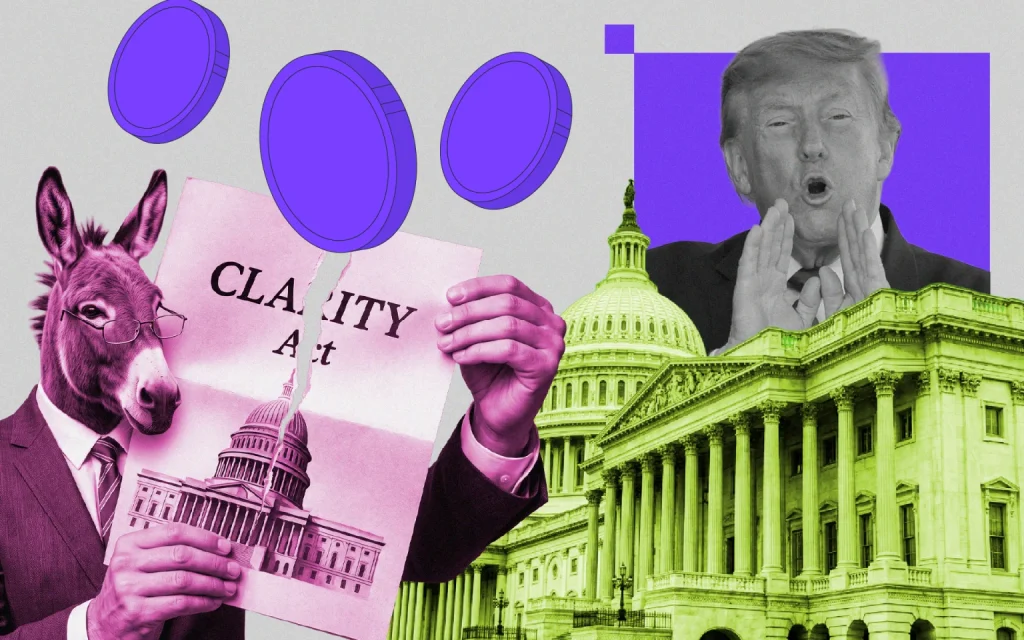
CLARITY Act Vote Pushed Beyond August Recess
POLITICO reported that Senate leaders would put off consideration of the CLARITY Act until after the chamber’s August recess.
Senate Majority Leader John Thune confirmed the delay late on Thursday, saying Democrats had insisted that no vote be held before lawmakers left Washington.
“We’re getting that queued up first thing [when] we come back in September,” Thune told reporters.
Thune could still file a cloture motion, the procedural step used to limit debate and prepare legislation for floor action.
The bill is not expected to receive a vote, however, until senators return on Sept. 14.
The Senate’s official calendar lists Aug. 10 through Sept. 11 as a state work period.
Democrats declined to approve a time agreement that would have accelerated the Senate’s remaining pre-recess business, according to POLITICO.
They argued that negotiations over the crypto measure should continue. Such an agreement would have required the consent of all 100 senators.
The delay drew anger from some retail investors.
One XRP holder labeled it a “disgrace” in a post on X and urged scrutiny of lawmakers’ finances.
Crypto Rover Says CLARITY Act Passage Now ‘Almost Impossible’
Crypto commentator Crypto Rover said before Thune’s confirmation that passage of the CLARITY Act had become “almost impossible” after a Wednesday cloture filing did not include the bill.
That omission effectively shut the usual procedural route to a Friday vote, Rover said.
The remaining options would have required either unanimous consent to speed up the process or an extension of the Senate session into the weekend.
Senator Cynthia Lummis had said she believed the chamber could stay open beyond Friday to vote, but Thune’s announcement ruled out that scenario.
The delay quickly filtered into prediction-market pricing.
The “Yes” contract on Polymarket for the CLARITY Act to be signed into law by the end of 2026 fell as low as 13% before edging back to about 14% on Friday, its weakest level since the market opened in January.
More than $5.19 million had been traded on the contract.
XRP Holds Above $1 For Record 627 Days
XRP, meanwhile, has recorded 627 consecutive daily closes above $1, the longest such run in its history, according to X trader InvestWithD.
The token traded around $1.06 on Friday.
In earlier market cycles, moves above $1 were followed by steep reversals.
The latest streak may suggest the level has shifted from short-lived resistance into more durable support.
The CLARITY Act could still indirectly affect XRP.
Clearer classifications and venue rules could reduce legal uncertainty for exchanges and institutional investors dealing in tokens such as XRP.
A September breakthrough could support crypto-market sentiment by reducing regulatory uncertainty.
Another failure could weigh on risk appetite, particularly for assets whose adoption depends on access to US exchanges and institutional participation.
Neither passage nor delay would guarantee a particular XRP price response.
What the September Timetable Means
The September return gives negotiators several weeks to seek a bipartisan compromise, but it also compresses an already crowded legislative calendar.
The immediate test will be whether Thune files cloture and can assemble the 60 votes generally needed to end debate on legislation.
Even a successful Senate vote would not send the measure directly to the White House.
If the Senate passes language that differs from the House-approved bill, the two chambers would have to reconcile their versions and approve identical text before it could go to the president.
The delay does not make enactment in 2026 impossible.
It does, however, remove the Senate’s preferred pre-recess window and leave less room for further setbacks.
The information provided in this article is for informational purposes only. It is not intended to be, nor should it be construed as, financial advice. We do not make any warranties regarding the completeness, reliability, or accuracy of this information. All investments involve risk, and past performance does not guarantee future results. We recommend consulting a financial advisor before making any investment decisions.

Kurt Robson is a London-based reporter at CCN, specialising in the fast-moving worlds of crypto and emerging technology. He began his career covering local news in Cornwall after graduating from Falmouth University with First Class Honours in Journalism. There, he cut his teeth on everything from council meetings to missing swans.
He quickly rose through the ranks to become a frontline journalist at several of the UK’s leading national newspapers. Over the years, he has interviewed musicians and celebrities, reported from courtrooms and crime scenes, and secured multiple front-page exclusives.
Following the upheaval of the COVID-19 pandemic, Kurt shifted his focus to technology journalism—just ahead of the AI boom. With a natural curiosity and a trained eye for emerging trends, he has found a new rhythm in reporting on innovation.
At CCN, Kurt's work focuses on the cutting edge of crypto, blockchain, AI, and the evolving digital world. Drawing on his background in people-first reporting and his deep interest in disruptive tech, Kurt delivers stories that are insightful, entertaining, and human-centric.