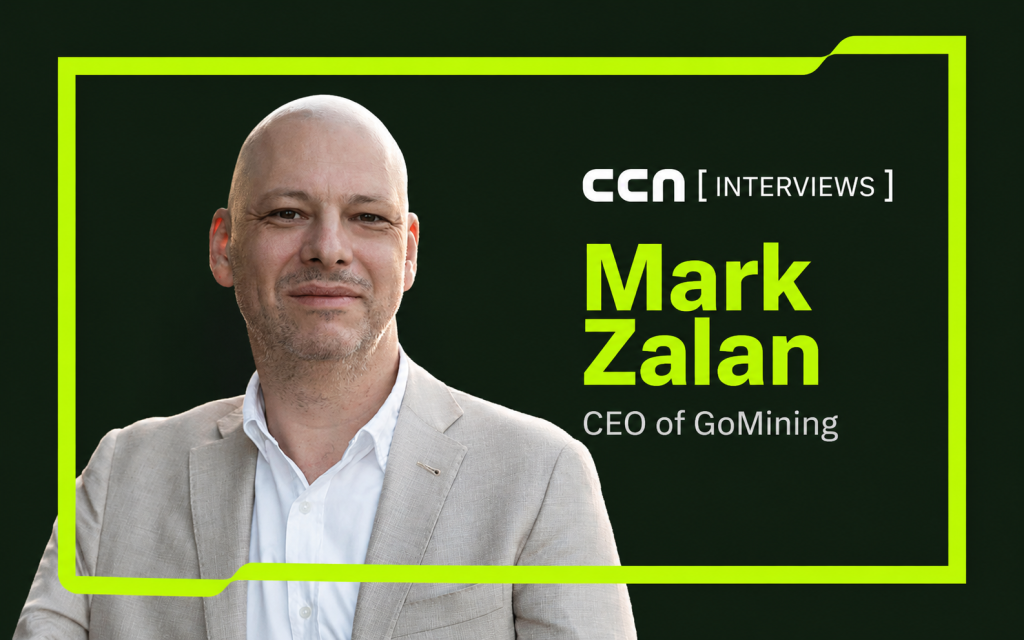
'Bitcoin’s Next Test Is Spending, Not Holding,' Says GoMining CEO Mark Zalan
Share
Key Takeaways
Bitcoin mining has become industrialized, and GoMining is trying to reopen access through tokenized hashrate.
GoBTC Pay aims to make Bitcoin usable for everyday transactions with low fees and instant settlement.
A hybrid custody model seeks to balance user sovereignty with payment reliability.
Native Bitcoin yield, according to Zalan, is best achieved through mining rather than synthetic DeFi solutions.
At Consensus 2026 in Miami, where crypto’s biggest firms gathered to pitch the next phase of digital finance, CCN’s Maxwell Moeller interviewed GoMining CEO Mark Zalan about a deceptively simple problem: Bitcoin is easy to hold, but still hard to spend.
GoMining has built its name by packaging industrial Bitcoin mining into digital mining products for everyday users. The company says it now has more than 5 million registered users and more than 15 million TH/s of mining hardware power across its ecosystem. Consensus 2026, held May 5 to May 7 at the Miami Beach Convention Center, brought together more than 20,000 attendees across crypto, finance, technology, and policy.
For Zalan, the mission goes beyond mining.
“Bitcoin was supposed to be open and available for everybody, but mining became an extremely high barrier to entry.”
From Industrial Mining to Everyday Access
Bitcoin mining once promised open participation. That promise did not last.
Zalan described how, by 2020, the economics of mining had shifted decisively. Large-scale operators with capital, infrastructure, and technical expertise dominated the sector. For everyday users, mining became impractical.
GoMining’s response was to abstract the complexity.
The company tokenized hashrate and allowed users to buy small units of mining power. Instead of building hardware setups, users can purchase digital miners that generate Bitcoin rewards tied to real infrastructure.
The model lowers the barrier to entry. Zalan said users can start with as little as $20, scale their exposure, and even transfer ownership since the miners exist as digital assets.
The broader idea is simple. If mining historically outperformed buying and holding, then access to mining should not be restricted to industrial players.
A Larger Problem Than Mining
Even as GoMining expanded its user base, Zalan said a deeper issue became obvious.
Bitcoin is widely held but rarely used. The network was designed as a peer-to-peer electronic cash system. In practice, it has become a store of value. People accumulate Bitcoin and wait.
‘Every time you want to use Bitcoin, you go through exchanges, conversions, fees, and delays. You lose value just moving your own money,’ Zalan emphasized.
The result is a system where value is stored but not circulated. That is where GoBTC Pay comes in.
Turning Bitcoin Into a Payment Rail
GoBTC Pay is GoMining’s attempt to remove that friction.
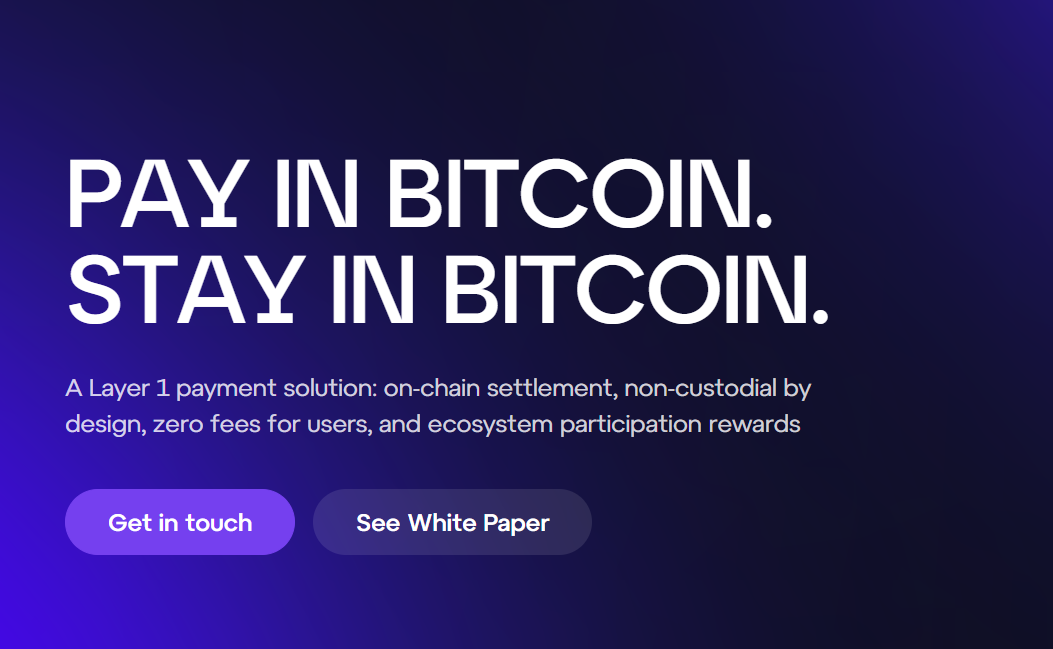
Zalan described it as an open protocol rather than a traditional product. The goal is to enable instant Bitcoin payments at the base layer, without relying on synthetic solutions or layered workarounds.
GoBTC Pay: Use BTC at a cafe, online, or between friends – the way cash should work.
The system is designed to plug into existing wallets, fintech platforms, and banking apps. Instead of building a closed ecosystem, GoMining wants others to connect to the protocol.
The economics are structured to align incentives across participants.
Merchants would pay a 0.2% fee, significantly lower than traditional card networks. Half of that fee goes to the wallet or institution that brings the user into the transaction. The other half goes to the miner that confirms the block.
‘We’re not trying to displace Visa or Mastercard. We’re trying to solve a problem that has been holding Bitcoin back, Zalan noted.
Zalan framed it as a redistribution of value within the ecosystem. Rather than intermediaries extracting multiple layers of fees, the participants who actually enable the transaction share the economics.
Rethinking Custody Without Giving It Up
One of the hardest challenges in Bitcoin payments is custody.
Full self-custody offers maximum control but makes instant payments difficult to guarantee. Full custody simplifies payments but undermines Bitcoin’s core principle of ownership.
Under normal conditions, transactions flow smoothly with GoMining’s participation. If the company becomes unavailable, a fallback mechanism allows the user to coordinate with the custodian to regain access.
Zalan described it as neither custody nor self-custody. It is a compromise designed to preserve user sovereignty while enabling reliable payments.
Regulation by Design
Global payments bring regulatory complexity.
Zalan said GoMining is not trying to manage compliance directly across jurisdictions. Instead, the protocol is designed to rely on existing financial institutions.
Wallet providers, banks, and fintech platforms already onboard users and handle identity checks. By connecting those entities to the payment protocol, GoMining avoids duplicating KYC processes.
The structure pushes regulatory responsibility to the edges of the system, where customer relationships already exist.
It also creates a new incentive layer. Institutions that connect users to the protocol receive a share of transaction fees, aligning compliance with participation.
Unlocking Bitcoin Yield
Beyond payments, GoMining is also exploring how to make Bitcoin more productive.
Bitcoin holders often face a simple reality. Their assets appreciate over time but generate no income.
Many attempts to solve this involve wrapping Bitcoin, lending it, or placing it into custodial structures. Zalan views those approaches as risky and overly complex.
GoMining’s partnership with Babylon focuses on this idea. The goal is to allow Bitcoin to be used as collateral without relinquishing custody, then channel liquidity into mining infrastructure.
That connects idle Bitcoin to an income-generating activity while keeping it within the Bitcoin ecosystem.
The store of value narrative brought users into the ecosystem. It addressed concerns about inflation, monetary policy, and long-term purchasing power.
But without usability, that narrative has limits. People eventually need to spend.
‘If you can’t spend it easily, it becomes a problem. If you can, it makes the store of value case stronger,’ Zalan reiterated.
He further noted that making Bitcoin spendable increases confidence in holding it.
What Happens If It Works
According to Zalan, Bitcoin’s evolution has repeatedly outpaced expectations, even among its earliest supporters. What he emphasizes instead is the need to remove the constraints holding it back.
Payments are one of the last major barriers.
If Bitcoin becomes easy to use in everyday transactions, its role in the global economy could expand in ways that are difficult to model today.
That shift would not replace existing systems overnight. It would introduce a parallel option that operates with fewer intermediaries and lower friction.
For GoMining, the strategy is to build infrastructure that supports that transition. The company started by opening access to mining. It is now trying to open access to spending.
Zalan sees both as part of the same mission.
Bitcoin, in his view, is not just something to hold. It is something to use.
Disclaimer:
The information provided in this article is for informational purposes only. It is not intended to be, nor should it be construed as, financial advice. We do not make any warranties regarding the completeness, reliability, or accuracy of this information. All investments involve risk, and past performance does not guarantee future results. We recommend consulting a financial advisor before making any investment decisions.
Dr. Guneet Kaur is a senior editor at CCN.com and a Science Fellow at Exponential Science. She is a fintech and blockchain expert with extensive experience in digital finance education, blockchain ecosystems, and cryptocurrency markets. She has worked with global media such as Cointelegraph, as well as education and blockchain platforms, to design and lead strategic content and learning initiatives. As an educator and assessor for top-tier executive programs, she bridges real-world fintech trends with academic insight.
Dr. Kaur is also a published researcher and peer reviewer across fintech and data science journals, including Financial Innovation Journal and International Journal of Big Data Intelligence and Applications. Her work spans data-driven analysis, Web3 innovation, and technical content development. With a strong foundation in both industry and academia, she translates complex financial technologies into practical applications, empowering learners, professionals, and institutions across the rapidly evolving digital finance landscape.
Max Moeller is a Chicago‑based writer and video editor passionate about games, tech, and crypto. Whether it’s crafting clear, insightful articles or piecing together engaging video retrospectives, he’s driven by curiosity and takes pride in keeping things human. Since 2017, Max has been published in a variety of notable crypto magazines.


 Easy
Easy