Traveling With Bitcoin? Hong Kong’s New Decryption Law Raises New Risks for Crypto Users
Share
Key Takeaways
Authorities may legally demand passwords or decryption assistance during national security investigations, and refusing to comply can be treated as a criminal offense.
The rules apply broadly to electronic equipment, which likely includes hardware wallets and other encrypted crypto storage devices.
The law applies to anyone physically in Hong Kong, including tourists, business travelers, and potentially transit passengers.
Law enforcement can seize and retain electronic devices, which could temporarily restrict access to crypto funds stored on hardware wallets.
Hong Kong has introduced sweeping new enforcement powers that could significantly impact travelers carrying Bitcoin hardware wallets, encrypted devices, or sensitive financial data. As of March 23, 2026, authorities in Hong Kong can now compel individuals to unlock devices, provide passwords, and assist with decryption under expanded rules tied to national security investigations.
For cryptocurrency holders, particularly those practicing self-custody, this development marks an important shift. Devices that once functioned as secure personal vaults may now fall within the reach of legal demands that carry criminal penalties for refusal.
BREAKING: If you travel with crypto, read this!
There are now several so called 1st world places where you can be legally forced to hand over your phone or hardware wallet and be made to unlock everything, including your wallet app.
— Unstoppable | Private Wallet (@unstoppablebyhs) March 27, 2026
The change reflects a broader global trend where governments are expanding access to encrypted data. But Hong Kong’s new rules stand out for their scope, enforcement powers, and implications for travelers.
Hong Kong’s March 2026 National Security Amendments Explained
On March 23, 2026, Hong Kong authorities gazetted amendments to the Implementation Rules for Article 43 of the National Security Law. These rules govern investigative powers available to law enforcement in cases related to national security.
The amendments significantly expand the ability of authorities to require individuals to provide access to encrypted data and electronic devices. If a person refuses to comply with such a request, that refusal can now be treated as a criminal offense.
Authorities can request assistance including:
Unlocking devices
Providing passwords or PIN codes
Supplying decryption keys
Assisting in accessing encrypted files or storage
Providing technical help to access data
Failure to comply may result in up to one year in prison and a fine of up to HK$100,000, while providing false or misleading information may lead to up to three years in prison and fines reaching HK$500,000.
This represents a notable escalation from previous enforcement practices, where refusal to unlock devices did not always constitute a standalone offense.
Why This Matters for Bitcoin Hardware Wallet Users
Bitcoin hardware wallets are designed around one core principle: only the owner controls access to funds. Devices such as hardware wallets store private keys securely and require PINs, passphrases, or multi-signature approvals to access assets.
Under Hong Kong’s new rules, this design feature could create a legal conflict.
If authorities request access to a hardware wallet, travelers may be required to:
Enter device PINs
Provide passphrases
Assist in unlocking wallet access
Help retrieve associated wallet data
Because hardware wallets function as encrypted devices, they likely fall under the law’s definition of electronic equipment, even though hardware wallets are not specifically named in the amendments.
This creates a situation where refusing to unlock a Bitcoin wallet, an action typically encouraged for security, could potentially carry legal consequences.
For individuals who rely on self-custody, the stakes can be high. A hardware wallet may represent substantial personal wealth, meaning device access requests could expose financial holdings, transaction histories, and related information.
Hong Kong Law Applies to Foreign Travelers and Visitors
One of the most important aspects of Hong Kong’s new rules is that they apply to anyone physically present in Hong Kong, regardless of nationality.
This includes:
Tourists
Business travelers
Investors
Journalists
Conference attendees
Transit passengers
Hong Kong’s National Security Law operates on a territorial basis. That means if a traveler is within Hong Kong’s jurisdiction, the law applies, even if they are visiting briefly.
Foreign nationality does not provide exemption. Travelers from the United States, United Kingdom, Europe, or elsewhere are subject to the same enforcement framework.
This has particular relevance for cryptocurrency users who frequently travel across jurisdictions while carrying hardware wallets or encrypted storage devices.
Does the Rule Apply to Airport Transit Passengers?
Hong Kong International Airport is one of the world’s busiest transit hubs, and many travelers pass through without formally entering the city. However, transit passengers remain physically within Hong Kong jurisdiction.
While there is no explicit statement confirming that all transit passengers will face device requests, legal analysts generally consider airport transit to fall within territorial authority.
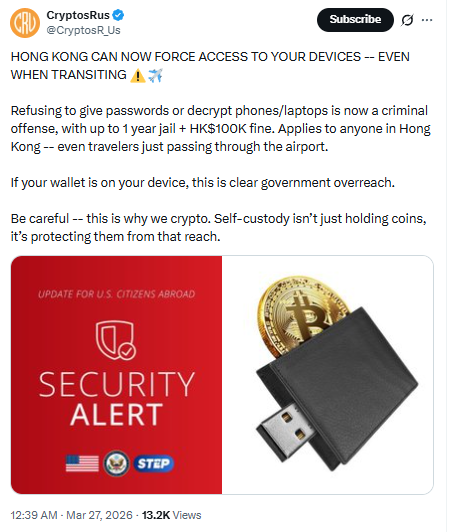
If your wallet is on your device, this is clear government overreach. | Source: @CryptosR_Us on X.
Authorities operating at the airport may still conduct questioning or device inspections in certain circumstances. This means travelers transiting through Hong Kong should not assume that remaining airside eliminates legal exposure.
For cryptocurrency holders, even brief transit through Hong Kong may now involve additional considerations.
Expanded Device Seizure Powers Under the New Rules
Alongside decryption requirements, the March 2026 amendments also expand authorities’ power to seize and retain electronic devices.
Law enforcement may now:
Remove electronic equipment for investigation
Retain devices for extended periods
Access stored or linked data
Examine encrypted storage devices
This applies broadly to electronic equipment, which may include phones, laptops, external drives, and crypto hardware wallets.
For Bitcoin users, device seizure can create practical challenges. If a hardware wallet is confiscated, users may temporarily lose access to funds. Even when backup seed phrases exist, travelers may not have immediate access to recovery options while abroad.
The expanded seizure authority therefore adds another layer of uncertainty for crypto users traveling through Hong Kong.
Growing Global Pressure on Encryption and Self-Custody
Hong Kong’s new rules reflect a wider global trend. Governments worldwide are increasingly focused on access to encrypted data, particularly in areas involving national security, financial crime, and cross-border investigations.
Cryptocurrency users are uniquely affected by these developments. Unlike traditional financial accounts, self-custodied wallets give individuals full control over assets. That control often relies on encryption and private key security.
As governments expand legal authority over encrypted devices, cryptocurrency holders may find themselves navigating new legal environments that challenge traditional self-custody practices.
Hong Kong’s March 2026 amendments illustrate how rapidly this landscape is evolving.
Why Hong Kong’s Changes Are Drawing Attention
Hong Kong has historically positioned itself as a global financial hub, with strong infrastructure and international connectivity. The city is also a major transit point for travelers moving between Asia, Europe, and North America.
Because of this, changes affecting travelers and digital assets attract international attention.
For crypto users, Hong Kong’s new rules highlight a broader shift: digital assets are no longer purely technological, they are increasingly subject to jurisdictional legal frameworks.
Traveling with Bitcoin hardware wallets now involves not just cybersecurity considerations, but also legal awareness and jurisdictional risk.
New Reality for Crypto Travel
As cryptocurrency adoption grows, more travelers carry hardware wallets, encrypted devices, and digital financial tools across borders. Hong Kong’s new rules illustrate how governments are adapting to this reality by expanding enforcement powers over digital assets and encrypted technology.
For Bitcoin users, the change underscores an emerging reality: self-custody does not exist outside legal jurisdiction. Devices designed to maximize individual control can still fall within national laws governing encryption, data access, and national security investigations.
Hong Kong’s March 2026 amendments mark another step in the evolving relationship between cryptocurrency, privacy, and state authority. For travelers carrying Bitcoin, the message is becoming clearer, crossing borders with digital wealth is no longer just a technical matter, but a legal one shaped by the jurisdictions through which they travel.
Does Hong Kong’s new rule specifically mention Bitcoin hardware wallets?
No. The legislation refers broadly to “electronic equipment” rather than naming specific devices. However, because hardware wallets are encrypted electronic devices designed to secure data, they are widely considered likely to fall within scope.
Can I refuse to unlock my device in Hong Kong?
Refusing to provide passwords or decryption assistance during a national security investigation can now be treated as a criminal offense. Penalties may include fines and possible imprisonment.
Does this apply to travelers just transiting through Hong Kong airport?
There is no explicit official clarification stating that all transit passengers are automatically subject to device requests. However, because transit passengers remain within Hong Kong jurisdiction, legal experts generally consider that the risk still exists.
Can authorities confiscate my Bitcoin hardware wallet?
Yes. The new rules expand powers allowing authorities to seize electronic devices during national security investigations. If a hardware wallet is seized, access to funds may be temporarily restricted until the device is returned or recovered using backup methods.
Disclaimer:
The information provided in this article is for informational purposes only. It is not intended to be, nor should it be construed as, financial advice. We do not make any warranties regarding the completeness, reliability, or accuracy of this information. All investments involve risk, and past performance does not guarantee future results. We recommend consulting a financial advisor before making any investment decisions.
Onkar Singh has three years of experience as a digital finance content creator. Throughout his career, he has collaborated with various DeFi projects and crypto media outlets. In his leisure time, he enjoys fitness activities at the gym and watching movies across different genres. Balancing his professional and personal interests, Onkar continues to contribute to the digital finance landscape while pursuing his hobbies.


 Easy
Easy