MiCA's Final Countdown: Who's Compliant and Who's Not?
Share
Key Takeaways
With the EU’s MiCA transitional period expiring July 1, 2026, only around 210 of the 1,200-plus VASP entities that held pre-MiCA national registrations have converted to full CASP authorization, a conversion rate of roughly 17%.
Circle’s USDC and EURC are the only top-ten stablecoins fully MiCA-compliant, while Tether’s USDT remains shut out of EU-regulated markets after refusing to pursue authorization.
Major exchanges, including Kraken, Coinbase, Bitstamp, Bitpanda, OKX, and Crypto.com, have secured licenses, but ten EU jurisdictions have yet to issue a single CASP authorization.
Three weeks – that is all the runway remaining for crypto businesses still operating in the European Union under legacy national licenses.
According to ESMA’s April 17, 2026, statement, the transitional period across the EU expires on July 1, 2026, after which any entity providing crypto-asset services without a MiCA license will be in breach of EU law and must immediately cease operations.
Europe’s MiCA regulation hits its final cutoff on July 1, 2026.
Any exchange or crypto platform serving EU clients without a full MiCA license must cease operations or face fines up to €5 million or 5% of global turnover.
For an industry that spent years lobbying for legal clarity, the deadline is arriving with a bluntness that has caught many firms off guard.
MiCA Compliance Gap: Why Over 80% of Crypto Firms Remain Unlicensed
Roughly 210 CASPs have been authorized across 23 EU member states as of May 2026. Before MiCA, over 1,200 VASP entities held national registrations across the bloc. That conversion rate of under 18% tells the most important story of MiCA’s transition period.
Industry tracker Coincub estimated 2,747 VASP registrations across Europe in 2024, with Poland alone accounting for more than 1,400.
In France, only 30% of roughly 90 unlicensed firms had applied for MiCA authorization as of January 2026. A further 40% did not intend to apply at all.
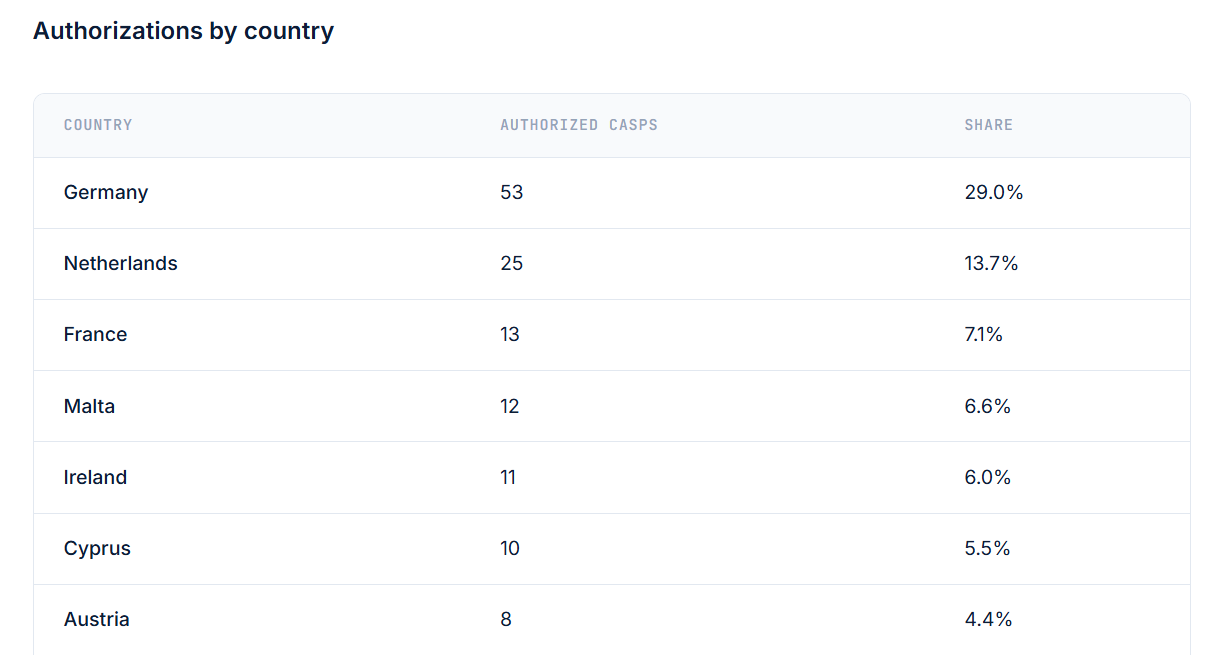
Germany dominates the register with 53 authorized entities. | Source: chainscreen.io
Estonia illustrates the scale of attrition most starkly. Its Financial Intelligence Unit reported 641 licensed VASPs in June 2021.
That number fell to 45 by October 2024 and to 40 by February 2025, as the country went from one of Europe’s largest crypto licensing hubs to a cautionary example of regulatory attrition.
MiCA-Approved Exchanges and Crypto Firms: Who Has Secured a License?
As of May 2026, public regulator registries confirm full MiCA CASP authorization for Bitvavo (AFM, Netherlands), Bitpanda (FMA, Austria), Kraken (Central Bank of Ireland and CSSF Luxembourg) and Coinbase (Central Bank of Ireland).
Crypto.com and OKX received authorizations via Malta’s MFSA, while Bitstamp was approved in Luxembourg. Revolut received its MiCA license from CySEC in Cyprus, and institutional market maker Virtu Financial Ireland received its CASP approval this week.
As of June 2026, Binance is advancing a pan-European Markets in Crypto-Assets (MiCA) license application through the Hellenic Capital Market Commission (HCMC) via its Greek subsidiary, Binary Greece. While some registries note their authorization, regulatory agencies treat the license review as active as the region approaches the July 1, 2026 deadline.
Among stablecoins, Circle’s USDC and EURC are the only top-ten stablecoins by market cap to be fully MiCA-compliant, uniquely positioned to serve the EU’s 450 million residents.
Patrick Hansen, Director of EU Strategy and Policy at Circle, tracked 39 CASP licenses and 14 stablecoin issuer approvals among the first 54 granted as of early 2026.
MiCA Non-Compliant Firms: USDT, Tether, and the Companies Still Outside the Rules
Tether’s USDT remains MiCA’s most prominent non-compliant asset. Tether did not apply for MiCA authorization, and EU-licensed venues that continue to offer non-authorized stablecoins risk losing their CASP licenses.
Coinbase began delisting USDT for EEA users in December 2024; Kraken followed in early 2025; Crypto.com delisted it alongside nine other tokens; and Binance applied geofencing across all EEA USDT pairs.
Tether CEO Paolo Ardoino has defended the stance, arguing that MiCA’s requirement to hold 60% of reserves in European banks risks triggering a simultaneous banking and stablecoin crisis.
Ten EU jurisdictions have produced zero public CASP authorization records in the ESMA register:
Croatia
Estonia
Greece
Hungary
Iceland
Italy
Norway
Poland
Portugal
Romania
Poland is the most urgent case, as it was among the most popular European jurisdictions for pre-MiCA crypto licensing, yet as of March 2026, local MiCA implementation legislation has not yet passed.
What Happens After the MiCA Deadline?
Unlicensed entities now face five options after July 1: obtain a license, stop operating, pursue an orderly wind-down, transfer clients to an authorized CASP, or merge with a license holder.
France’s AMF has warned that operating without authorization after that date will expose firms to criminal prosecution.
Separately, the European Commission has proposed centralizing CASP supervision within ESMA itself, a move Malta has publicly opposed over concerns about losing oversight of major firms licensed on its soil.
The market that emerges in late 2026 will be smaller, more concentrated, and governed by a single rulebook. Whether that is a feature or a flaw depends on who is still standing.
Disclaimer:
The information provided in this article is for informational purposes only. It is not intended to be, nor should it be construed as, financial advice. We do not make any warranties regarding the completeness, reliability, or accuracy of this information. All investments involve risk, and past performance does not guarantee future results. We recommend consulting a financial advisor before making any investment decisions.
Dr. Guneet Kaur is a senior editor at CCN.com and a Science Fellow at Exponential Science. She is a fintech and blockchain expert with extensive experience in digital finance education, blockchain ecosystems, and cryptocurrency markets. She has worked with global media such as Cointelegraph, as well as education and blockchain platforms, to design and lead strategic content and learning initiatives. As an educator and assessor for top-tier executive programs, she bridges real-world fintech trends with academic insight.
Dr. Kaur is also a published researcher and peer reviewer across fintech and data science journals, including Financial Innovation Journal and International Journal of Big Data Intelligence and Applications. Her work spans data-driven analysis, Web3 innovation, and technical content development. With a strong foundation in both industry and academia, she translates complex financial technologies into practical applications, empowering learners, professionals, and institutions across the rapidly evolving digital finance landscape.