CLARITY Act Critics Target Stablecoin Yield, but These 5 Ways to Earn Aren’t Going Away
Share
Key Takeaways
The CLARITY Act faces fresh setbacks after bipartisan talks on ethics rules and law enforcement provisions collapsed, threatening its path to a Senate floor vote.
The bill still needs at least seven Democratic votes to clear the Senate’s 60-vote threshold, with key supporters making their backing conditional on unresolved issues.
With the August recess approaching, lawmakers face mounting pressure to reach a compromise, while prediction markets and analysts increasingly view passage as uncertain.
Bipartisan negotiations over the Digital Asset Market Clarity Act fractured into two tracks last week, leaving the most consequential piece of American crypto legislation in legal limbo, with a hard deadline approaching and no agreement in sight on the provisions blocking a Senate floor vote.
A closed-door ethics meeting among Senators Kirsten Gillibrand, Ruben Gallego of Arizona, Bernie Moreno of Ohio, and Cynthia Lummis of Wyoming, joined by White House Crypto Council Executive Director Patrick Witt, collapsed on June 9 without agreement after Republicans and the White House withdrew a provision that would have authorized state attorneys general to initiate civil actions against the Justice Department over failures to enforce ethics rules tied to President Trump’s crypto business interests.
Simultaneously, the White House Crypto Council convened representatives from the National Sheriffs’ Association, the Fraternal Order of Police, and the National District Attorneys’ Association on Wednesday to address law enforcement objections to Section 604 of the CLARITY Act, the Blockchain Regulatory Certainty Act, leaving the market structure bill facing two unresolved obstacles with 31 Senate session days remaining before the August recess and a 60-vote threshold still to clear.
🚨UPDATE: White House Held EMERGENCY-STYLE 90-Min Clarity Act Talk To SAVE Senate Support 👀🇺🇸🔥
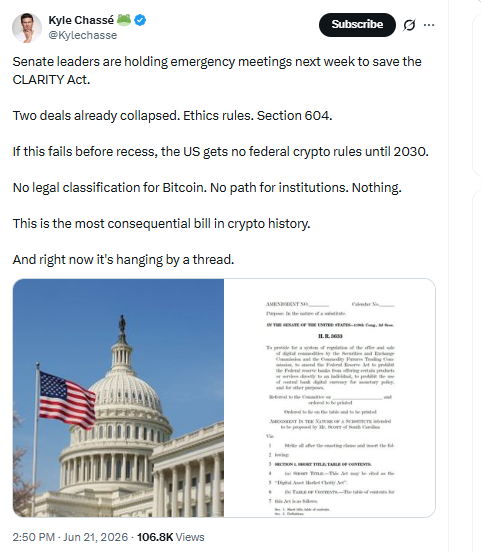
Crypto investor Kyle Chassé noted that Senate leaders are expected to hold emergency meetings next week to salvage the CLARITY Act after negotiations over ethics provisions and Section 604 broke down.
US crypto rules face an uncertain future. | Source: @Kylechasse on X.
Chassé argued that failure to advance the legislation before Congress leaves for its August recess could delay comprehensive federal crypto regulation for years, leaving unresolved questions around digital asset classification, institutional participation, and market structure.
He described the CLARITY Act as one of the most consequential pieces of crypto legislation ever considered in the US, with its prospects now hanging in the balance.
Democrats and Republicans Remain Divided on Crypto Ethics Safeguards
Republicans and Witt withdrew support for the state AG enforcement mechanism and offered a narrowed alternative limiting enforcement authority to the US Attorney General, a substitution that Democrats rejected as functionally circular, given that the Attorney General serves at the president’s pleasure. Republicans also floated impeachment as a remedy for presidential ethics violations, an offer Democrats likewise declined.
Tuesday’s session was the first closed-door ethics meeting since a bipartisan group reached a tentative framework in May following the Senate Banking Committee’s 15-9 vote to advance the bill on May 14. That tentative framework was itself the product of months of post-markup negotiations designed to resolve what the committee left deliberately unfinished.
The collapse directly reopens a fault line that was never actually closed at the committee stage. During the May 14 markup, a Van Hollen amendment barring the president, vice president, and members of Congress from issuing or promoting digital commodities failed 13-11 on party lines.
On Section 604, the National District Attorneys’ Association wrote in a letter that the provision “would severely impede the ability of law enforcement and prosecutors to investigate, trace, and prosecute criminal activity involving cryptocurrency and other digital assets.”
The National Sheriffs’ Association, National Association of Assistant US Attorneys, and other groups joined in opposing the language.
Senators Mark Warner and Catherine Cortez Masto have tied their floor support to law enforcement’s sign-off on Section 604.
Why the Crypto Bill Still Faces Major Hurdles in Congress
The Senate Banking Committee advanced the Senate version of the CLARITY Act on May 14 by a 15-9 vote, with Democrats Ruben Gallego and Angela Alsobrooks joining all Republicans on the panel. The bill was placed on the Senate Legislative Calendar as Calendar No. 423 on June 1, making it formally eligible for floor consideration. The House passed its version, H.R. 3633, on July 17, 2025, by a 294-134 margin.
The remaining procedural stack is considerable. The bill must clear a 60-vote Senate floor threshold, be reconciled with the Senate Agriculture Committee’s version, and then be merged with the House-passed text before reaching the president.
Crypto Legislation Faces a Crucial Senate Math Problem
Senators Gallego and Alsobrooks, the two Democrats whose committee votes produced the bill’s nominal bipartisan margin, stated their support was conditional and may not translate into floor votes.
Seven Democratic votes are needed to clear the 60-vote filibuster threshold, assuming all 53 Republicans vote yes.
BREAKING: The Senate is holding emergency meetings next week to save crypto regulation before time runs out.
It is an 11th-hour sprint of meetings to finalize the CLARITY Act before the Senate's window closes.
Astraea Law has projected enactment for around August 2026, while flagging reconciliation risks at each stage.
Galaxy Research has estimated passage odds at roughly 50-50 for 2026, a figure that treats the August recess deadline as the last realistic legislative gate before the calendar works against enactment.
Polymarket traders now price the bill’s 2026 passage odds near 48%, down from 74% a month ago.
Crypto Regulation Enters a Decisive Phase in Congress
The CLARITY Act establishes a regulatory framework for digital commodities, defined as digital assets that rely on blockchain technology for their value. The Commodity Futures Trading Commission generally regulates digital commodity transactions, including exchanges, brokers, and dealers.
Kristin Smith, president of the Solana Policy Institute, said many asset allocators are actively exploring digital asset exposure but are withholding capital commitments pending defined regulatory guidelines.
CLARITY ACT TALKS JUST HIT A SNAG 🚨
🇺🇸 Solana Policy Institute President Kristin Smith on Fox Business: negotiations have stalled, with sticking points around how certain assets are defined and consumer protection rules.
Brian Gardner, chief Washington policy strategist at Stifel, wrote in a note that “in order for the CLARITY Act to pass in 2026, it probably needs to get through the Senate by the end of July, preferably in June,” adding that “if the Senate fails to pass the bill before the August recess, the bill’s prospects would deteriorate materially.”
Sen. Bill Hagerty’s base-case scenario has Congress resolving outstanding provisions in the weeks following the recess and scheduling a floor vote after lawmakers return on July 13.
His remarks also invoked the GENIUS Act, the stablecoin legislation the Senate approved earlier, as evidence that regulatory clarity produces durable policy outcomes.
Whether Senate leadership schedules floor consideration before the August break or defers to the fall is now the single most consequential near-term variable.
Disclaimer:
The information provided in this article is for informational purposes only. It is not intended to be, nor should it be construed as, financial advice. We do not make any warranties regarding the completeness, reliability, or accuracy of this information. All investments involve risk, and past performance does not guarantee future results. We recommend consulting a financial advisor before making any investment decisions.
Dr. Guneet Kaur is a senior editor at CCN.com and a Science Fellow at Exponential Science. She is a fintech and blockchain expert with extensive experience in digital finance education, blockchain ecosystems, and cryptocurrency markets. She has worked with global media such as Cointelegraph, as well as education and blockchain platforms, to design and lead strategic content and learning initiatives. As an educator and assessor for top-tier executive programs, she bridges real-world fintech trends with academic insight.
Dr. Kaur is also a published researcher and peer reviewer across fintech and data science journals, including Financial Innovation Journal and International Journal of Big Data Intelligence and Applications. Her work spans data-driven analysis, Web3 innovation, and technical content development. With a strong foundation in both industry and academia, she translates complex financial technologies into practical applications, empowering learners, professionals, and institutions across the rapidly evolving digital finance landscape.