Key Takeaways
- BRICS is exploring deeper cross-border payment links among 11 economies that together account for roughly 41% of global GDP on a PPP basis.
- The bloc wants faster, cheaper payments and more local-currency settlement, potentially tackling some of the same friction XRP was designed to address.
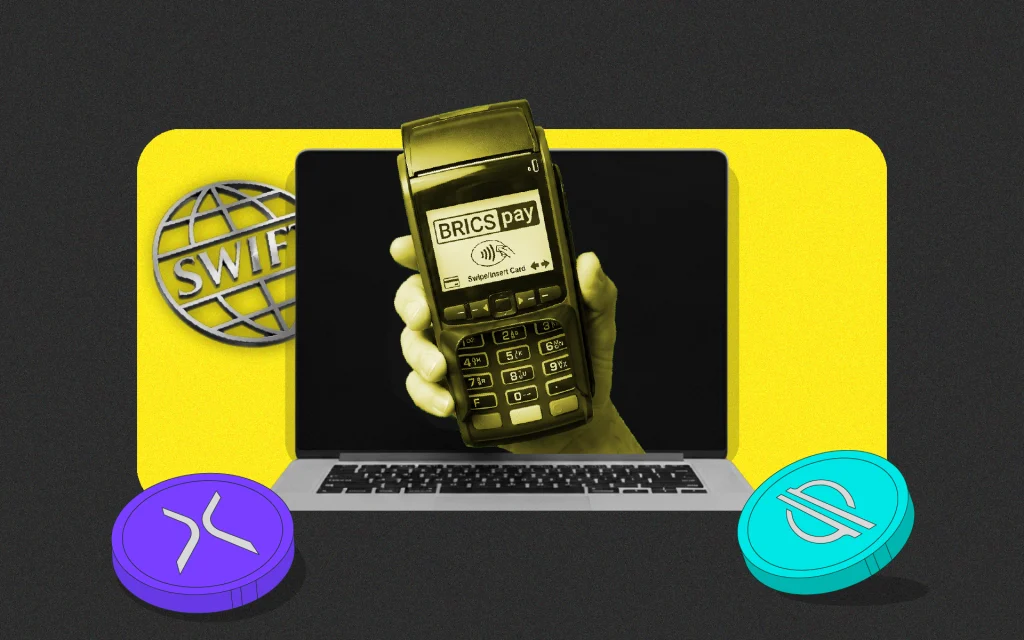
- However, BRICS leaders have not formally adopted a unified “BRICS Pay” network, and there is no indication that XRP will be part of the infrastructure.
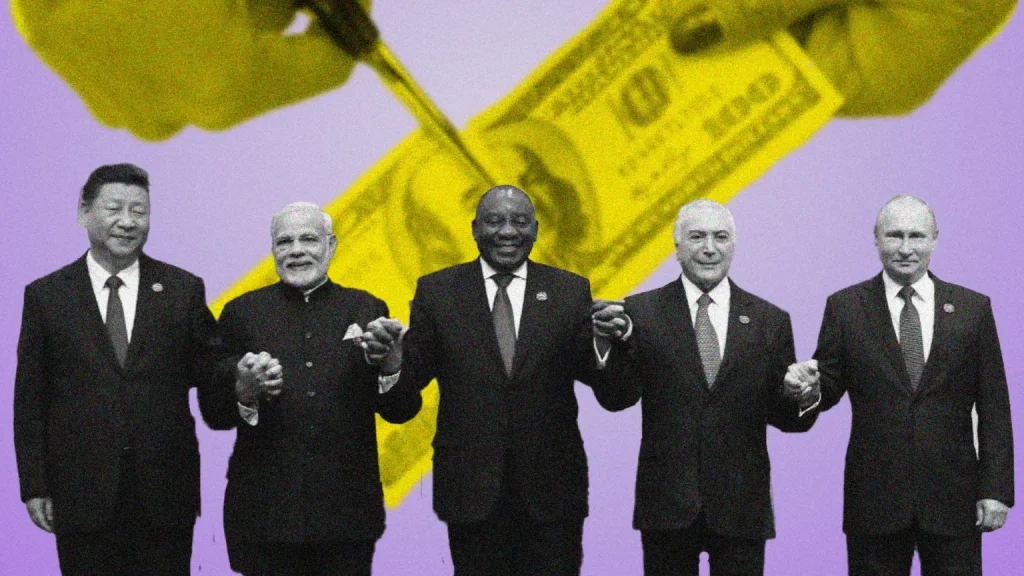
BRICS is working to connect payment systems across an economic bloc that represents roughly 41% of global GDP on a purchasing-power-parity basis, potentially creating a massive new cross-border payments network without relying on XRP.
That raises an uncomfortable question for the XRP narrative: if some of the world’s largest emerging economies can connect their own payment rails directly, how much need is there for a crypto bridge asset?
The 11-member BRICS bloc includes China, India, Brazil, Russia, Indonesia, Saudi Arabia, and the UAE, among others. Collectively, the group represents about 49.5% of the world’s population and roughly 41% of global GDP on a PPP basis in 2026, according to figures based on the IMF’s April World Economic Outlook.
Those numbers make even incremental progress on payments significant.
At the New Delhi summit on Sept. 12, BRICS leaders acknowledged work by the BRICS Payment Task Force on making payment and messaging channels more interoperable and facilitating greater settlement in members’ local currencies.
$10 Trillion Payment Base Is Already Emerging
BRICS does not need to build its payment infrastructure from scratch.
India’s UPI and Brazil’s Pix are already enormous domestic networks. Instant-payment systems across the 11 BRICS economies processed more than $10 trillion over the past 18 months, according to the Financial Times, although their use for cross-border payments remains relatively limited.
UPI alone has more than 550 million users, while Pix has more than 170 million. Both are increasingly looking beyond their domestic markets through international connections.
That scale is what makes the XRP question interesting.
XRP’s core proposition as a bridge asset is to provide liquidity between currencies and make international settlement more efficient, without requiring institutions to maintain pre-funded accounts across multiple markets.
BRICS countries are now exploring whether some of that friction can be removed by making their existing payment infrastructures communicate directly with one another.
BRICS Pay Isn’t One Giant Payment Network
The New Delhi Declaration does not announce a completed BRICS-wide payment system.
Instead, leaders said the BPTF is exploring “pragmatic solutions” for cross-border payments and studying how existing national systems could become more interoperable.
Importantly, the declaration acknowledges there is “no one-size-fits-all approach.”
Separate from the declaration, the Russian Direct Investment Fund, JSC BRICS Pay and BRICS Pay India announced an agreement on Sept. 11 to explore integrating the BRICS Pay project with Indian payment infrastructure and potentially launching pilot cross-border services.
This is important: BRICS Pay exists as an initiative, but it should not be treated as an officially adopted single payment architecture for all BRICS governments.
India has also proposed connecting central bank digital currencies across BRICS economies.
Reuters reported ahead of the summit that New Delhi’s goal was to make international transactions easier and faster rather than replace the dollar as the world’s reserve currency.
Does That Leave XRP Without a Job?
This is where XRP enters the conversation.
As mentioned above, XRP was designed to function as a bridge asset, potentially allowing two parties using different currencies to transfer value without maintaining pre-funded accounts in every destination currency.
BRICS is attacking a similar problem from another direction.
Instead of requiring a neutral cryptocurrency, countries could connect domestic payment systems, use CBDCs, or settle transactions directly in local currencies.
India’s UPI and Brazil’s Pix show how large those national rails have already become. Together, the two systems processed more than $10 trillion over the previous 18 months, according to the Financial Times.
But that does not automatically make XRP obsolete.
Connecting payment interfaces is only one part of a cross-border transaction. Countries still need mechanisms for foreign exchange, liquidity, and final settlement when trade flows between two currencies are unbalanced.
Those challenges are particularly important within BRICS because its members have different capital controls, currencies, and geopolitical priorities. Reuters reported that currency-swap arrangements would likely be necessary to address trade imbalances in a deeper BRICS payment network.
No Evidence BRICS Plans to Use XRP
For XRP holders, the clearest takeaway is also the simplest: there is currently no evidence in the New Delhi Declaration that BRICS intends to use XRP.
There is equally no announcement of a unified BRICS cryptocurrency replacing XRP, SWIFT, or the dollar.
What BRICS is building, instead, is a collection of potential connections among national payment systems, local currencies, and possibly CBDCs.
That makes the emerging competition less “BRICS Pay versus XRP” and more about which architecture can solve cross-border liquidity and settlement most efficiently.
If countries can connect their domestic rails and settle directly in national currencies at scale, the need for an independent bridge asset could diminish on those corridors.
If liquidity between those currencies remains fragmented, however, the problem XRP was designed to solve does not simply disappear.
For now, BRICS has demonstrated that it wants more payment options. It has not been demonstrated that XRP is one of them.
The information provided in this article is for informational purposes only. It is not intended to be, nor should it be construed as, financial advice. We do not make any warranties regarding the completeness, reliability, or accuracy of this information. All investments involve risk, and past performance does not guarantee future results. We recommend consulting a financial advisor before making any investment decisions.

Giuseppe Ciccomascolo began his career as an investigative journalist in Italy, where he contributed to both local and national newspapers, focusing on various financial sectors.
Upon relocating to London, he worked as an analyst for Fitch's CapitalStructure and later as a Senior Reporter for Alliance News. In 2017, Giuseppe transitioned to covering cryptocurrency-related news, producing documentaries and articles on Bitcoin and other emerging digital currencies. He also played a pivotal role in establishing the academy for a cryptocurrency exchange website. Crypto remained his primary area of interest throughout his tenure as a writer for ThirdFloor.