DePIN Could Hit $3.5 Trillion: XYO Co-Founder Markus Levin on Listings, Community, and Layer One
Share
Decentralized physical infrastructure networks (DePINs) are rapidly gaining momentum, with forecasts predicting the sector could reach $3.5 trillion by 2028.
One of the pioneers is XYO, a blockchain-powered data company founded over seven years ago that has grown into a network of over 10 million nodes.
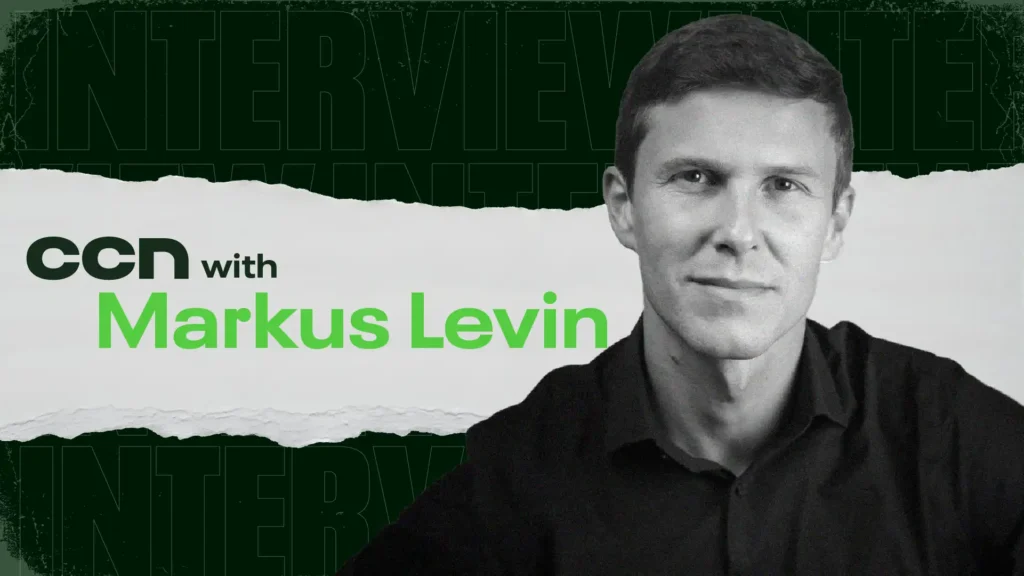
To understand how XYO is navigating exchange listings, community building, and regulation, while preparing for the launch of its own layer-1, CCN spoke with Markus Levin, co-founder of XYO. Here is the full video:
Try Our Recommended Crypto Exchanges
Sponsored
Disclosure
We sometimes use affiliate links in our content, when clicking on those we might receive a commission at no extra cost to you. By using this website you agree to our terms and conditions and privacy policy.
When asked about Kraken’s requirement of $8.8 million in verifiable revenue to qualify for listing, Levin was quick to note how dramatically the industry has shifted.
Three years ago, the market often dismissed projects that generated revenue. Having revenue even raised questions about whether a team was too centralized or too profit-driven.
As Levin put it, “in the crypto community, there are these borderless hippies. We don’t live in borders, and we don’t live in profit in a way.”
“That worked well until we had bear markets and token prices dropped and then suddenly all those projects went out of business because they didn’t have any revenue. And so today this question is often asked in listing applications—what’s your business model, how do you make revenue? If you don’t have those, then it’s unlikely that you can list on exchanges.”
He continued, “It’s a remarkable shift because nobody asked this three years ago. And I think it’s a proof of this concept called DePIN—decentralized physical infrastructure networks.”
What XYO Actually Does
When asked to explain XYO in simple terms, Levin described it as a blockchain-driven data company.
“We are one of those decentralized physical infrastructure networks, or DePINs, and we started more than seven years ago with the first one. Basically, we are a data company run on blockchain. And in a little less simple terms, we do this for location. We can prove that the location data is true and correct, so that you have certainty around location.”
He continued, explaining that XYO has grown beyond location verification to collect and validate other forms of data, including sensory and even offline data, which can then be connected to smart contracts or integrated with Web2 partners.
In practice, XYO uses a network of nodes to verify where something is in the real world and anchor that proof on-chain. This creates tamper-proof records for use cases such as supply chain tracking, delivery confirmations, and even verifying the presence of devices or people at a specific place and time.
Levin added that, unlike traditional platforms, users of XYO own the data they generate as one of its main value propositions, giving them full control.
In a world where if you don’t pay for the product, you are the product, XYO flips the model and users can choose to keep their data private or actively monetize it for rewards.
“That’s exactly right. You own your own data and that’s the beauty. You are able to monetize it or keep it private the way you want to—contrary to Google or Facebook, where you don’t own your data, you don’t know what’s happening with it, and you don’t benefit from it beyond using the product.”
The Post-ICO Era: From Community Raises to VC Dominance
Reflecting on the fundraising landscape, Levin pointed to the differences between the initial coin offering (ICO) era community funding and today’s VC-driven environment.
“I feel two ways about ICOs.”
Levin said that during the ICO era, projects were truly community-driven, with retail participants getting the same access to token sales as venture capital firms. He recalled that XYO followed this approach in 2018 and 2019, even through the bear market, raising $40 million while refusing to offer VCs preferential terms, a decision some investors disliked but that kept fundraising fair for the community.
“Today it’s a little different, unfortunately. It’s often that VCs come first and the community second in fundraising. I don’t like that,” Levin said.
He added that he expects this trend to shift back, with community participation regaining importance. In his view, future fundraising will likely feature longer lock-up periods for investors to ensure they cannot exit before the community can benefit.
Why DePIN Could Hit $3.5 Trillion by 2028
Levin is bullish on DePIN’s potential, pointing to exponential growth forecasts.
“Isn’t it an incredible number? Three and a half trillion dollars. And I think we had about a hundred billion today. That’s in two and a half years. It’s absolutely mind-boggling”, he emphasized.
And then stated, “DePIN will change the world”.
“To be part of it now is like being at the beginning of something huge. And so I encourage other people to join, not just to invest in projects, but to build projects because there’s a lot of growth to be had over the next three years.”
For Levin, transparency will separate sustainable projects from hype.
Levin noted that DePIN projects have an advantage because they can demonstrate real revenue early on. He explained that XYO became the first computer company in the U.S. to receive Securities and Exchange Commission (SEC) qualification for a Regulation A offering, which let them sell shares to non-accredited investors.
“Then we tokenized those shares and listed them as well. Now we have annual and semi-annual filings with the SEC and audited financials. You can’t be more transparent than that.”
Looking Ahead: The XYO Layer One Era
Levin closed with a look at what success means for XYO beyond listings and market cycles.
“We have something really exciting, which is our new XYO Layer One. Success for us is that DePINs and data-focused projects are working on our Layer One”, he emphasized.
“We’ve touched data for more than seven years and at first, we hoped someone else would build a blockchain optimized for it. But nobody is as good as us with data, so we decided to build it ourselves.”
Levin pointed out that over 2025 and 2026, XYO aims to release more features on XYO Layer One, expand partnerships, and put the XYO DePIN network fully on-chain.
Only time will tell whether XYO’s Layer One vision can set the standard for data-focused blockchains and drive broader adoption of DePIN projects.
Disclaimer:
The information provided in this article is for informational purposes only. It is not intended to be, nor should it be construed as, financial advice. We do not make any warranties regarding the completeness, reliability, or accuracy of this information. All investments involve risk, and past performance does not guarantee future results. We recommend consulting a financial advisor before making any investment decisions.
Dr. Lorena Nessi is an award-winning journalist and media technology expert with 15 years of experience in digital culture and communication. Based in Oxfordshire, UK, she combines academic insight with hands-on media practice.
She holds a PhD in Communication, Sociology, and Digital Cultures, and an MA in Globalization, Identity, and Technology.
Lorena has taught at Fairleigh Dickinson University, Nottingham Trent University, and the University of Oxford. She is a former producer for the BBC in London, with additional experience creating television content in Mexico and Japan.
Her research focuses on digital cultures, social media, technology, capitalism, and the societal impact of blockchain innovation.
She has written extensively on digital media and emerging technologies, with her work featured in both academic and media platforms. Her Web3 expertise explores how blockchain technologies shape culture, economics, and decentralized systems.
Outside of work, Lorena enjoys reading science fiction, playing strategic board games, traveling, and chasing adventures that get her heart racing. A perfect day ends with a relaxing spa and a good family meal.


 Easy
Easy