Decentralized exchange (DEX) aggregators have become a foundational layer in modern DeFi, quietly optimizing billions of dollars in trading volume every day. As liquidity fragments across chains, pools, and protocols, traders increasingly rely on these systems not just for convenience, but for better execution, lower costs, and protection from invisible risks like MEV (Maximal Extractable Value).
Among the leading players, 1inch, Jupiter, and CoWSwap stand out, not only because of their scale, but because they embody three very different approaches to aggregation. Understanding their differences requires looking beyond surface-level features and into how each system actually processes trades.
This comparison explores how they perform across three critical dimensions: execution quality, fees (including hidden costs), and MEV protection, while balancing narrative context with structured insights.
Shift in What “Best Execution” Means
In traditional finance, “best execution” is a regulatory standard. In DeFi, it’s a moving target. Initially, aggregators like 1inch focused on routing efficiency, splitting trades across multiple liquidity sources to minimize slippage.
But as DeFi matured, it became clear that routing alone wasn’t enough. A trade could still be perfectly routed and yet executed poorly due to front-running or sandwich attacks. This realization gave rise to a new paradigm: execution is not just about where a trade goes, but how it gets there.
Each of the three aggregators reflects a different stage in this evolution:
1inch: Advanced routing across fragmented liquidity
CoWSwap: Intent-based execution with auction-driven pricing
Execution Quality: From Smart Routing to Auction-Based Pricing
Execution quality is where the philosophical differences between these platforms become most visible.
1inch has built its reputation on its Pathfinder algorithm, which can split trades across dozens of liquidity sources in real time. By aggregating liquidity from over 200 DEXs, it reduces slippage and often delivers better pricing than any single exchange. This is particularly valuable on Ethereum, where liquidity is deep but scattered.
Jupiter, by contrast, achieves strong execution not through complexity, but through speed and system design. Operating on Solana, it benefits from sub-second block times and extremely low latency. This reduces the gap between quoted and executed prices, which is especially important for retail traders. With daily volumes reaching into the billions, Jupiter has proven that fast execution can rival complex routing, at least for smaller trades.
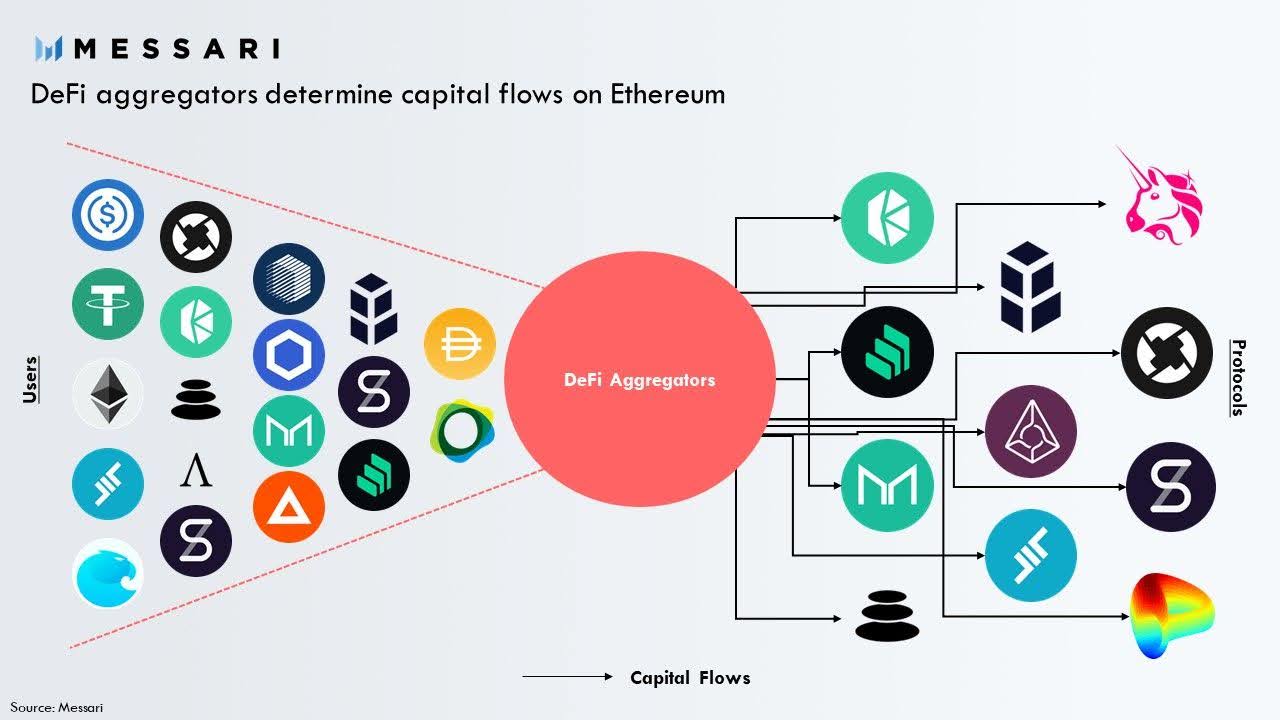
DeFi aggregators determine capital flows on Ethereum. | Credit: Messari
CoWSwap introduces a fundamentally different model. Instead of routing trades instantly, it batches them into auctions where independent solvers compete to offer the best price. This allows for:
Data from intent-based execution studies shows that auction systems like CoWSwap can outperform traditional routing, particularly for large trades (less than $100,000), where minimizing market impact becomes critical.
Jupiter delivers highly reliable execution for fast, smaller trades
CoWSwap often produces the best outcomes for large or complex orders
Fees: Understanding the Hidden Costs of “Free” Trading
At first glance, all three platforms appear inexpensive, often advertising zero or near-zero fees. But in DeFi, the true cost of a trade extends far beyond visible fees.
1inch operates primarily on Ethereum and other EVM chains, where gas fees can be significant. While it often avoids explicit swap fees, it may capture value through positive slippage, meaning users don’t always receive the full benefit of improved pricing. Still, its routing efficiency can offset costs, especially for multi-hop trades.
Jupiter has a structural advantage here. Solana’s low-cost infrastructure means transaction fees are negligible, often less than a cent. Combined with efficient routing, this makes Jupiter one of the cheapest platforms in practice, particularly for retail traders.
CoWSwap takes a different approach to cost optimization. Because trades are executed via batch auctions:
However, solvers may capture part of the surplus as profit, introducing an implicit cost. Even so, studies suggest that avoiding MEV alone can save traders 0.1%–0.5% per trade, which often outweighs these margins.
MEV has emerged as one of the most significant hidden costs in DeFi. In 2023 alone, over $1 billion was extracted through front-running, sandwich attacks, and other strategies.
This is where the three aggregators diverge most sharply.
CoWSwap is built specifically to address this issue. By executing trades through batch auctions with uniform clearing prices, it removes transactions from the public mempool entirely. This design:
Prevents sandwich attacks
Ensures fair pricing across participants
Eliminates most forms of extractable value
As a result, CoWSwap is widely considered the benchmark for MEV protection.
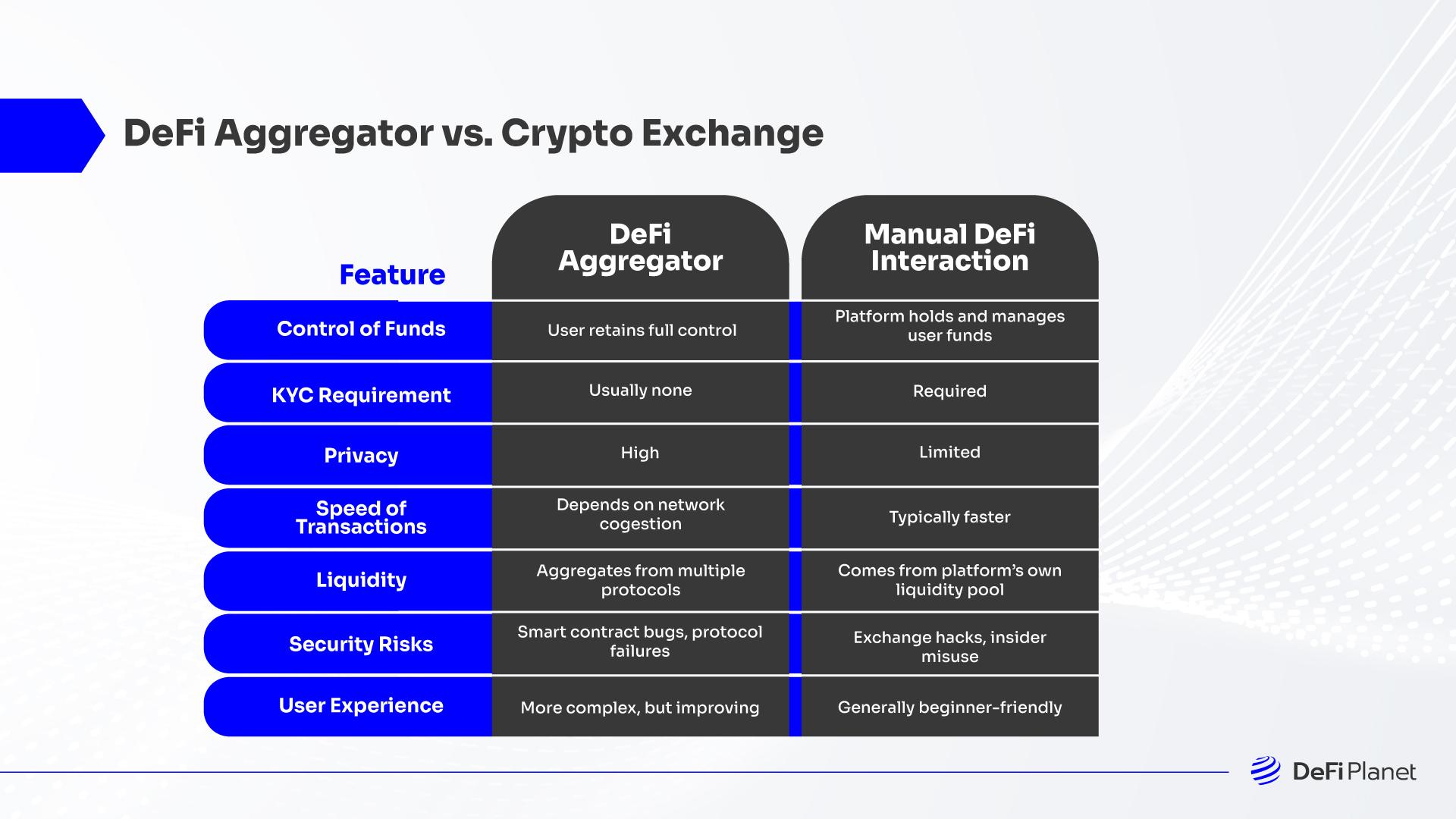
DeFi aggregators explained: how to optimize returns and cut costs. | Credit: Bitget
1inch has responded with Fusion mode, which introduces intent-based execution. Users submit trades off-chain, and resolvers compete to execute them. This reduces exposure to MEV, but:
Not all trades use Fusion
Protection depends on execution path
Jupiter operates in a different environment. Solana’s architecture reduces some MEV opportunities due to its speed and execution model, but it does not eliminate them entirely. Jupiter offers partial protection through private routing, but it lacks the structural safeguards of CoWSwap.
MEV Protection Summary:
CoWSwap: Near-complete protection via auction design
In practice, this means Jupiter is ideal for high-frequency or time-sensitive trades, while CoWSwap is better suited for users who prioritize outcome over immediacy.
Putting It All Together: Which Aggregator Is “Better”?
Rather than declaring a single winner, it’s more useful to understand where each platform excels.
What this comparison ultimately reveals is that DeFi aggregation is evolving beyond simple routing. The next generation of systems is moving toward intent-based execution, where users define outcomes rather than transaction paths.
In many ways:
1inch represents the best of traditional aggregation
Jupiter shows the power of high-performance infrastructure
The likely end state is not one of these models winning outright, but rather a convergence of all three: Multi-chain liquidity access, ultra-fast execution, and built-in MEV protection.
For now, choosing the right aggregator depends less on which is “best” overall, and more on what kind of trader you are.
What is a DEX aggregator and why should I use one?
A DEX aggregator is a platform that scans multiple decentralized exchanges to find the best possible price for a trade. Instead of manually checking different liquidity pools, aggregators automatically route your trade across venues to minimize slippage, reduce costs, and improve execution. This is especially important in DeFi, where liquidity is fragmented and prices can vary significantly across platforms.
Which platform has the lowest fees?
Jupiter generally offers the lowest fees in practice because it runs on Solana, where transaction costs are extremely low (often fractions of a cent).
What is MEV and why does it matter?
MEV (Maximal Extractable Value) refers to profits that validators or bots extract by reordering or inserting transactions in a block. Common examples include sandwich attacks, where traders receive worse prices due to manipulation.
Is Jupiter only for Solana users?
Yes, Jupiter is designed specifically for the Solana ecosystem. It aggregates liquidity across Solana-based DEXs and benefits from the network’s speed and low fees. If you trade on Ethereum or other EVM chains, Jupiter is not an option.
Disclaimer:
The information provided in this article is for informational purposes only. It is not intended to be, nor should it be construed as, financial advice. We do not make any warranties regarding the completeness, reliability, or accuracy of this information. All investments involve risk, and past performance does not guarantee future results. We recommend consulting a financial advisor before making any investment decisions.
Giuseppe Ciccomascolo began his career as an investigative journalist in Italy, where he contributed to both local and national newspapers, focusing on various financial sectors.
Upon relocating to London, he worked as an analyst for Fitch's CapitalStructure and later as a Senior Reporter for Alliance News. In 2017, Giuseppe transitioned to covering cryptocurrency-related news, producing documentaries and articles on Bitcoin and other emerging digital currencies. He also played a pivotal role in establishing the academy for a cryptocurrency exchange website. Crypto remained his primary area of interest throughout his tenure as a writer for ThirdFloor.


 Easy
Easy