Key Takeaways
- 1inch’s CLO says most policymakers do not fully grasp non-custodial systems, making effective regulation difficult.
- As a DEX aggregator routing trades across multiple protocols, 1inch relies on risk screening rather than direct control over transactions.
- Platforms like 1inch cannot freeze user funds, forcing them to focus on prevention rather than intervention.
- Unclear rules create legal uncertainty, pushing DeFi firms to overcompensate with stricter internal controls.
As decentralized finance (DeFi) continues to mature, one of the biggest challenges facing the industry is not technology, but regulation.
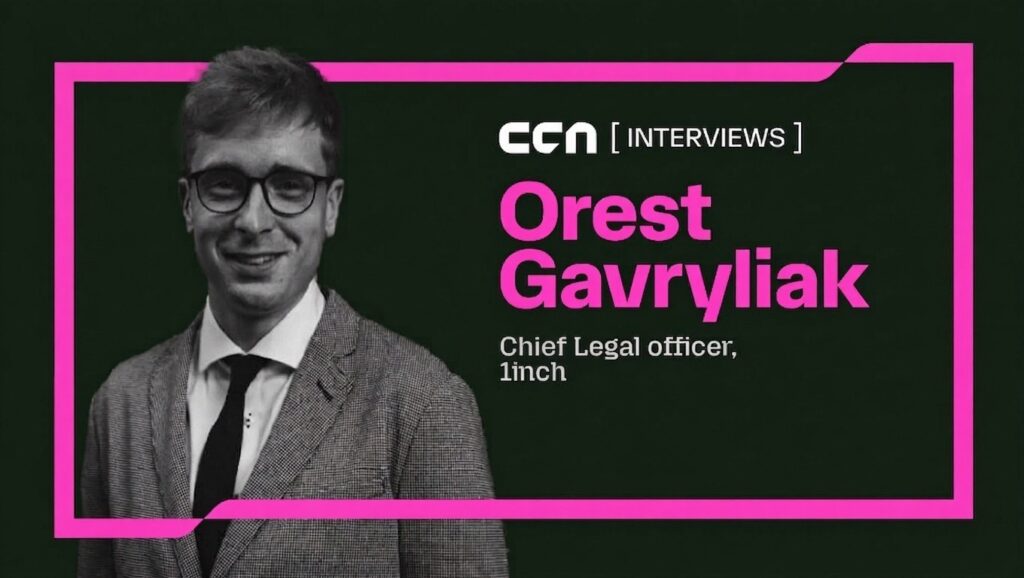
In an interview with Crypto Citizens Network (CCN)’s senior editor Dr. Guneet Kaur, Orest Gavryliak, Chief Legal Officer (CLO) at 1inch, highlighted a critical gap: regulators still struggle to understand how non-custodial systems actually work.
“Regulators do not understand what non-custodial technologies are and how to wrap them into proper laws,” Gavryliak said.
How 1inch Handles Legal Responsibility Across Multiple DeFi Liquidity Sources
1inch operates as a decentralized exchange (DEX) aggregator, routing trades across multiple liquidity sources in a single transaction. This raises a key legal question: who is responsible when something goes wrong?
According to Gavryliak, 1inch minimizes risk through pre-integration checks rather than direct control.
The platform aggregates liquidity from multiple venues but conducts risk assessments before integrating them. However, in its newer “Fusion” mode, the model shifts toward more transparency.
“In Fusion, we know exactly who the market maker is because we perform due diligence,” he explained.
By working with established players like Wintermute and GSR, 1inch aims to ensure that users interact with vetted counterparties, even in a decentralized environment.
How 1inch Balances DeFi Compliance With Permissionless Trading
Unlike centralized exchanges, 1inch does not custody user funds. Users retain full control of their assets, which limits the platform’s ability to intervene directly.
Instead, 1inch focuses on risk management at the infrastructure and interface level.
“We cannot freeze funds. It’s just the nature of DeFi,” Gavryliak said.
To address this, the platform has developed a “triple security” framework that goes beyond basic compliance checks. This includes behavioral analytics, wallet profiling, and advanced data analysis to identify suspicious activity.
“We don’t just check sanction lists. That’s only the beginning,” he added.
Why Sanctions Screening Alone Is Not Enough for Crypto Risk Management
One of the biggest misconceptions in crypto compliance, according to Gavryliak, is the belief that checking sanction lists is sufficient.
“This is the biggest misconception,” he said. “It’s just the start.”
1inch instead uses a combination of analytics, blacklists, and investigative inputs to monitor activity across its ecosystem. The company is also experimenting with “fingerprinting” technology to cluster wallets and identify patterns of behavior.
Rather than freezing assets, the goal is to isolate bad actors.
“If you have a bad profile, reputable counterparties simply won’t deal with you,” Gavryliak explained.
Why Regulatory Clarity Is Critical for DeFi Aggregators Like 1inch
Despite these efforts, legal uncertainty remains a major concern.
“We live in stress all the time because we don’t have rules,” Gavryliak said.
He emphasized that DeFi platforms want regulation, but the right kind.
Rules designed for custodial platforms like Coinbase cannot simply be applied to non-custodial protocols, he argued. Instead, regulators need to develop frameworks tailored to decentralized systems.
1inch has actively engaged with policymakers in the U.S., Europe, and the UAE to help bridge this gap.
“We want clear rules of the road. We don’t want a Wild West,” he said.
Can DeFi Meet Regulatory Requirements Without Sacrificing Decentralization?
The answer, for now, remains uncertain.
While regulators acknowledge that new frameworks are needed, they are still evaluating how to approach non-custodial systems where enforcement tools, such as freezing funds, do not exist.
Gavryliak believes the solution may lie in transparency rather than control.
By building on-chain reputation systems and sharing risk data among trusted participants, DeFi could create a self-regulating environment where bad actors are excluded organically.
How AI Trading Agents Could Transform DeFi and 1inch’s Future
Looking ahead, Gavryliak expects DeFi to evolve beyond user interfaces into AI-driven systems.
“I think in the future, trading will be done by agents,” he said.
These AI agents could execute complex strategies automatically, reducing human error and improving efficiency. However, they also introduce new risks.
To address this, 1inch is exploring verification systems where trusted AI agents are certified on-chain, potentially through NFTs that signal credibility.
“We need verification models for AI agents, just like we verify market participants,” he said.
How 1inch Is Attracting Institutional Investors to DeFi Liquidity
Institutional participation in DeFi remains limited, largely due to compliance concerns.
To address this, 1inch is developing new infrastructure, including a shared liquidity layer called “Aqua,” designed to make capital more flexible and efficient.
Rather than locking funds into a single pool, users could deploy liquidity across multiple strategies simultaneously, an approach that could appeal to institutional investors.
As DeFi grows, the tension between decentralization and regulation is becoming more pronounced.
For 1inch, the path forward lies in building systems that enhance security and transparency without compromising the core principles of decentralization.
But until regulators fully understand how these systems work, uncertainty will remain.
“Education is key,” Gavryliak said. “Without understanding, you cannot regulate properly.”
The information provided in this article is for informational purposes only. It is not intended to be, nor should it be construed as, financial advice. We do not make any warranties regarding the completeness, reliability, or accuracy of this information. All investments involve risk, and past performance does not guarantee future results. We recommend consulting a financial advisor before making any investment decisions.

Giuseppe Ciccomascolo began his career as an investigative journalist in Italy, where he contributed to both local and national newspapers, focusing on various financial sectors.
Upon relocating to London, he worked as an analyst for Fitch's CapitalStructure and later as a Senior Reporter for Alliance News. In 2017, Giuseppe transitioned to covering cryptocurrency-related news, producing documentaries and articles on Bitcoin and other emerging digital currencies. He also played a pivotal role in establishing the academy for a cryptocurrency exchange website. Crypto remained his primary area of interest throughout his tenure as a writer for ThirdFloor.

Dr. Guneet Kaur is a senior editor at CCN.com and a Science Fellow at Exponential Science. She is a fintech and blockchain expert with extensive experience in digital finance education, blockchain ecosystems, and cryptocurrency markets. She has worked with global media such as Cointelegraph, as well as education and blockchain platforms, to design and lead strategic content and learning initiatives. As an educator and assessor for top-tier executive programs, she bridges real-world fintech trends with academic insight.
Dr. Kaur is also a published researcher and peer reviewer across fintech and data science journals, including Financial Innovation Journal and International Journal of Big Data Intelligence and Applications. Her work spans data-driven analysis, Web3 innovation, and technical content development. With a strong foundation in both industry and academia, she translates complex financial technologies into practical applications, empowering learners, professionals, and institutions across the rapidly evolving digital finance landscape.


 Easy
Easy