CLARITY Act Vote Set for Sept. 15, But Prediction Markets Put 2026 Passage Odds at Just 19.5%
Share
Key Takeaways
The Senate Banking Committee is scheduled to vote on the CLARITY Act on May 14.
Major banking groups led by the American Bankers Association are intensifying lobbying efforts against stablecoin provisions.
Senator Bernie Moreno and other crypto-friendly lawmakers pushed back against the banking industry’s campaign.
A key Senate Banking Committee vote on the Digital Asset Market Clarity Act is scheduled for Thursday, May 14, bringing renewed tensions between crypto firms and banking lobby groups into public view.
The latest battle erupted over the weekend after the American Bankers Association (ABA) circulated an urgent message to bank executives warning that the bill could encourage moving funds away from conventional bank accounts.
In a further escalation on Monday, Senator Bernie Moreno, an Ohio Republican who sits on the Senate Banking Committee, fired back against the group, calling it the “banking cartel.”
Try Our Recommended Crypto Exchanges
Sponsored
Disclosure
We sometimes use affiliate links in our content, when clicking on those we might receive a commission at no extra cost to you. By using this website you agree to our terms and conditions and privacy policy.
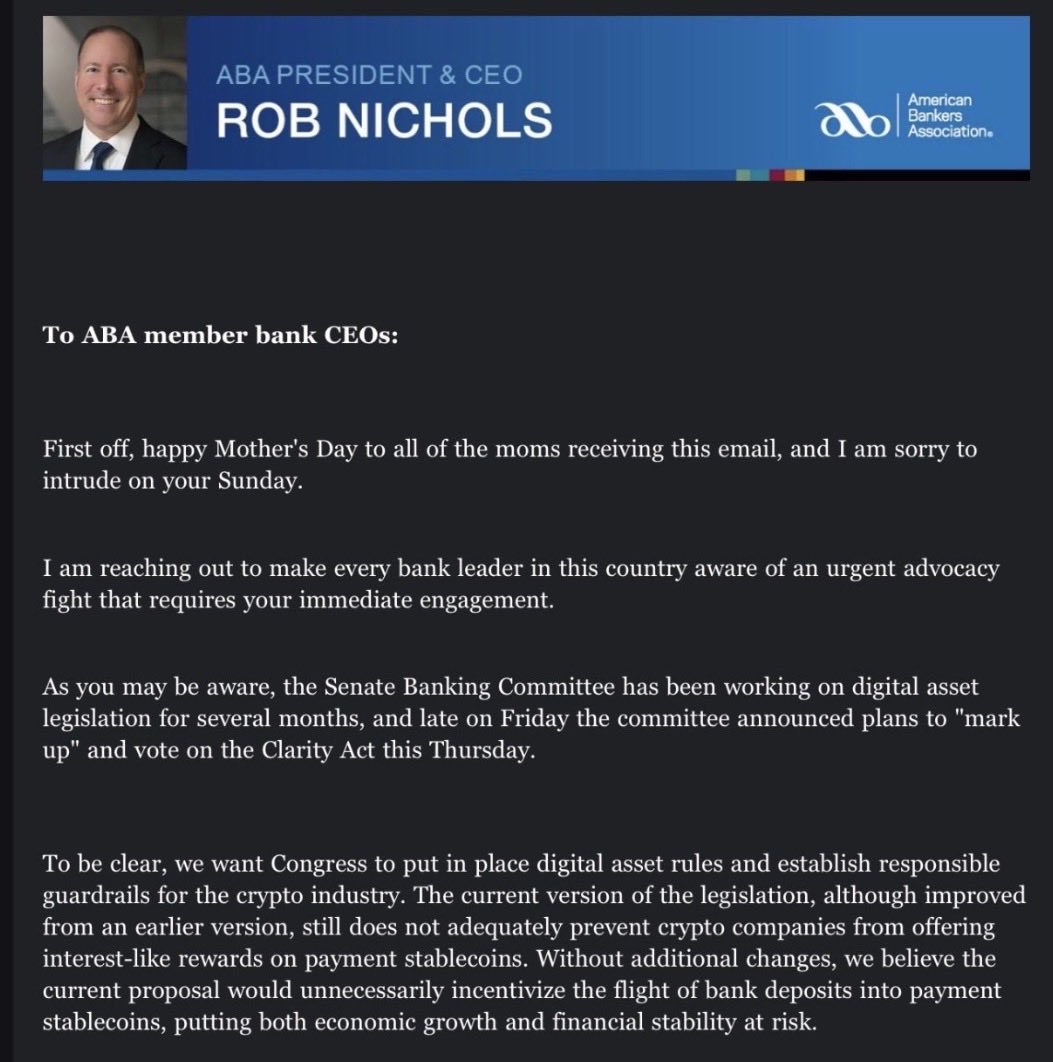
In the letter, ABA President and CEO Rob Nichols urged bank leaders to mobilize immediately ahead of the committee markup.
Nichols called the legislation an “urgent advocacy fight” requiring “immediate engagement.”
“As you may be aware, the Senate Banking Committee has been working on digital asset legislation for several months, and late on Friday the committee announced plans to ‘mark up’ and vote on the Clarity Act this Thursday,” Nichols wrote.
While the ABA said it supports “responsible guardrails” for the crypto sector, it argued the current proposal still fails to prevent crypto firms from offering interest-like incentives tied to payment stablecoins.
ABA President and CEO Rob Nichols urged bank leaders to mobilize against the CLARITY Act | Source: ABA
The group warned lawmakers that allowing such products could encourage customers to shift funds away from insured bank deposits and into stablecoins.
“… putting both economic growth and financial stability at risk,” the letter stated.
Nichols also urged banks and employees to contact senators directly before Thursday’s vote.
“We need your help to drive this message home before senators consider this legislation,” he wrote.
Banking Industry Escalates CLARITY Act Opposition
The ABA’s campaign is part of a broader lobbying effort by major banking trade associations seeking stricter restrictions on stablecoin yield.
A coalition of national banking groups previously sent lawmakers a joint letter outlining concerns over what they describe as a remaining “stablecoin loophole.”
The groups included:
American Bankers Association.
Bank Policy Institute.
Consumer Bankers Association.
Financial Services Forum.
Independent Community Bankers of America.
National Bankers Association.
Banks argue that stablecoins offering rewards or returns may directly compete with insured deposits, reducing the funding base on which banks rely for lending.
Industry opponents have reportedly expanded lobbying efforts through meetings with lawmakers and coordinated outreach ahead of the Senate Banking Committee vote.
Moreno Accuses “Banking Cartel” of Protecting Monopoly
The banking industry’s lobbying push triggered immediate backlash from crypto-friendly lawmakers, including Senator Bernie Moreno.
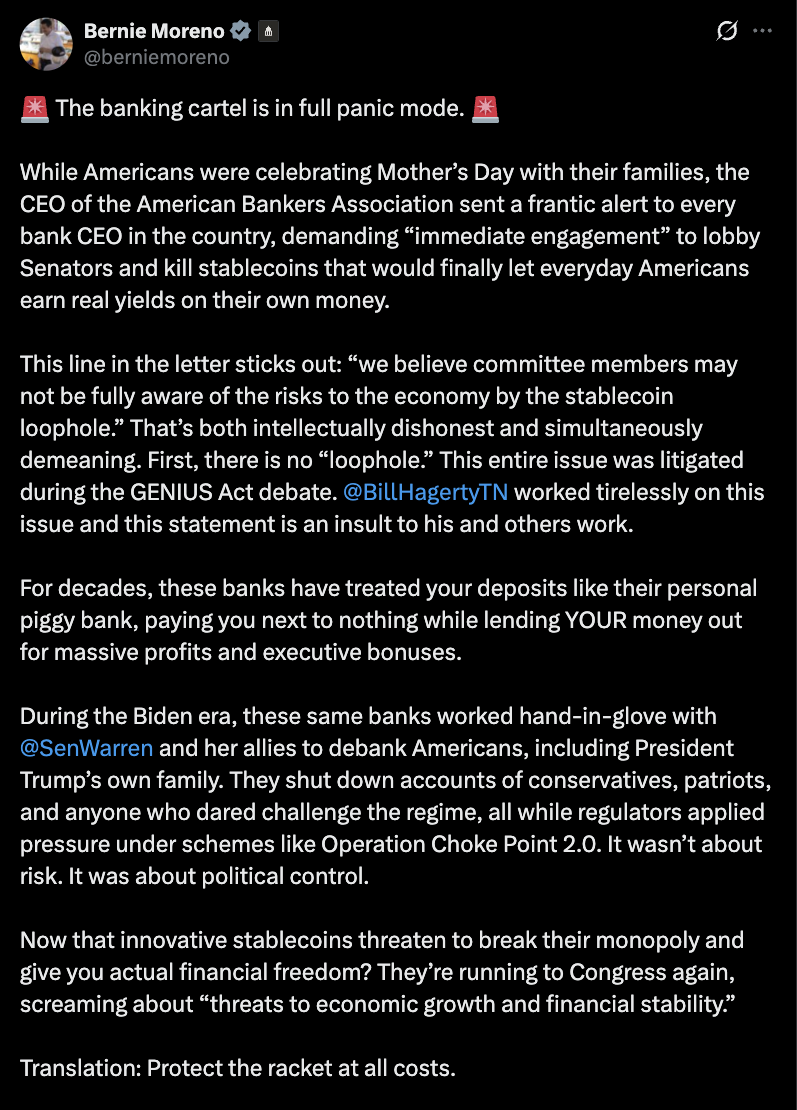
In a lengthy post on X, Moreno accused major banks of attempting to suppress competition from digital dollar products.
“The banking cartel is in full panic mode,” Moreno wrote.
He criticized the ABA’s characterization of stablecoin rewards as a “loophole,” arguing the issue had already been negotiated extensively.
“There is no ‘loophole.’ This entire issue was litigated during the GENIUS Act debate,” Moreno said.
Bernie Moreno criticized the “banking cartel” as self-serving | Source: X (@berniemoreno)
He added that Senator Bill Hagerty and other lawmakers had spent months working through the policy details.
“For decades, these banks have treated your deposits like their personal piggy bank, paying you next to nothing while lending YOUR money out for massive profits and executive bonuses,” he wrote.
The Ohio Republican accused banks of using political influence to preserve dominance over the financial system, referencing allegations of “debanking” during the Biden administration.
“Now that innovative stablecoins threaten to break their monopoly and give you actual financial freedom? They’re running to Congress again,” Moreno wrote.
“As a member of that committee, my message is clear: Hands off the people’s money. Let Americans choose real competition and better returns.”
Moreno said he would vote to advance the legislation.
Previous drafts of the legislation sparked concerns from both the banking industry and segments of the crypto sector.
Lawmakers ultimately crafted compromise language intended to prohibit stablecoins from functioning like traditional bank deposits, while still permitting certain promotional programs.
Even after those revisions, major banks have continued to press Congress for tighter restrictions.
Outside the banking sector, progressive lawmakers and labor groups have also criticized elements of the legislation.
The Congressional Progressive Caucus previously opposed earlier crypto market structure proposals due to concerns about investor protections and enforcement authority.
Meanwhile, labor organizations, including the AFL-CIO, have argued that the legislation could disproportionately benefit large crypto firms.
However, many crypto companies and fintech firms claim the bill will be a crucial step toward regulatory clarity.
Marcos Viriato, CEO and co-founder of Parfin, said the legislation could help accelerate institutional adoption of blockchain.
“The CLARITY Act marks a significant step towards regulatory certainty for digital assets in the US, and will unlock substantial opportunity for institutional markets,” Viriato told CCN.
He said that while the current debate focuses on classification and structure, a key question is being missed.
“…who is accountable when regulated assets move on-chain, and something goes wrong?”
He added that traditional financial institutions would likely remain cautious until issues surrounding control, accountability, and risk management are fully addressed.
May 14 Vote
The conflict comes ahead of the scheduled Senate Banking Committee’s first formal markup and vote on May 14.
The committee will review updated legislative text and potential amendments before voting on whether to advance the bill.
For years, the crypto sector has operated in a regulatory grey area as the Securities and Exchange Commission (SEC) and Commodity Futures Trading Commission (CFTC) debated jurisdiction over digital assets.
The SEC has historically argued that many crypto tokens qualify as securities subject to securities laws, while the CFTC has maintained that assets such as Bitcoin function more like commodities.
The legislation attempts to establish a clearer division of regulatory authority over digital assets.
Under the proposal, the CFTC would have primary authority over spot markets for digital commodities.
Meanwhile, the SEC would retain oversight of investment contract assets and securities-related activity.
Kurt Robson is a London-based reporter at CCN, specialising in the fast-moving worlds of crypto and emerging technology. He began his career covering local news in Cornwall after graduating from Falmouth University with First Class Honours in Journalism. There, he cut his teeth on everything from council meetings to missing swans.
He quickly rose through the ranks to become a frontline journalist at several of the UK’s leading national newspapers. Over the years, he has interviewed musicians and celebrities, reported from courtrooms and crime scenes, and secured multiple front-page exclusives.
Following the upheaval of the COVID-19 pandemic, Kurt shifted his focus to technology journalism—just ahead of the AI boom. With a natural curiosity and a trained eye for emerging trends, he has found a new rhythm in reporting on innovation.
At CCN, Kurt's work focuses on the cutting edge of crypto, blockchain, AI, and the evolving digital world. Drawing on his background in people-first reporting and his deep interest in disruptive tech, Kurt delivers stories that are insightful, entertaining, and human-centric.