What if a country known for its gold vaults, neutrality, and centuries-old banking tradition decided to enshrine Bitcoin, the world’s first cryptocurrency, in its national constitution?
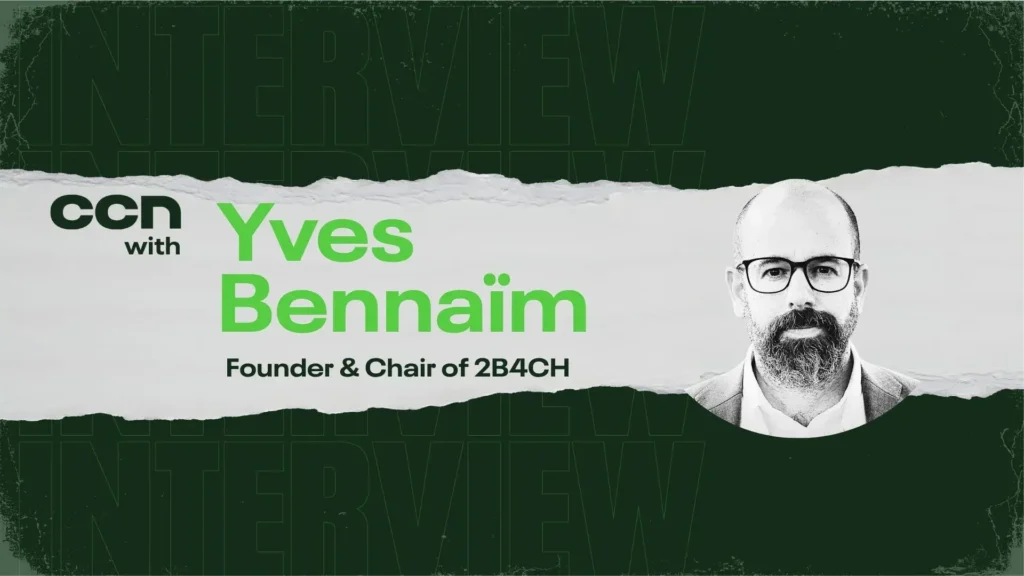
That’s the question Yves Bennaïm, founder and chair of the Swiss think tank 2B4CH, asks Switzerland to consider. His organization is leading a popular initiative that could make Bitcoin an official Swiss National Bank reserve asset, alongside gold.
It’s a radical proposal, but it’s entirely possible in Switzerland. Here, citizens can change the constitution through a direct vote. If Bennaïm’s initiative gathers 100,000 signatures, every Swiss voter will have a say in whether Bitcoin deserves a permanent place in the nation’s monetary foundation.
For Bennaïm, though, the goal isn’t simply to win. “Even if it doesn’t go into the constitution, it’s already a success,” he told CCN’s Dr. Lorena Nessi during the Plan B event in Lugano. “Because every conversation we start about how money works; that’s progress.”
2B4CH: A Swiss Think Tank on Bitcoin’s Societal and Political Impact
Bennaïm’s organization, 2B4CH, focuses on Bitcoin’s social and political dimensions, studying how the technology interacts with society, governance, and the global economy.
“2B4CH is a think tank where we study and analyze the social and political aspects of Bitcoin,” he explains. “We focus on Switzerland because this is where I am, and also because this is where I think it’s going to be the most interesting worldwide.”
That focus on Switzerland is no coincidence. The country is home to one of the world’s most advanced banking sectors, a strong culture of financial independence, and a rare form of democracy that allows citizens to shape national policy directly.
It’s also home to Crypto Valley, the region around Zug that became an early hub for blockchain companies, and the headquarters of several major crypto organizations. In many ways, Switzerland is already one of the most crypto-friendly nations, but Bennaïm wants to take it a step further.
A Constitutional Revolution: Adding Bitcoin to Switzerland’s National Reserves
The proposal at the heart of 2B4CH’s campaign would add just three words to the Swiss Constitution, but those words could make history.
Today, the Constitution states that the Swiss National Bank must hold reserves, and that it may hold some of those reserves in gold. The initiative seeks to extend that clause to include Bitcoin, placing it alongside gold as a recognized national reserve asset.
To make that happen, the group must collect 100,000 valid signatures from Swiss citizens, after which the proposal would automatically trigger a national referendum. Every eligible voter in the country would have the chance to decide whether Bitcoin belongs in Switzerland’s monetary reserves.
For Bennaïm, the goal goes far beyond winning the vote. “Even if it doesn’t go into the Constitution, it’s still a success,” he says. “Because every conversation we start about how money works, that’s already progress.”
How Switzerland’s Bitcoin Initiative Encourages Financial Literacy
Bennaïm describes the initiative not as a protest but as a learning opportunity. He believes that discussing Bitcoin in the context of national reserves helps ordinary people understand how money and central banking actually function.
“We want to create that conversation,” he explains. “It’s a way to demystify money for people and how the Swiss National Bank works.”
He notes that Switzerland’s National Bank is one of the world’s most efficient and trusted central banks. That makes it an ideal setting for a serious public debate about the future of money.
“We’re fortunate that in Switzerland, we have both a strong central bank and a system of direct democracy,” says Bennaïm. “It would be complacent not to use that privilege. We should not take it for granted.”
By tying Bitcoin to a democratic process, the campaign invites Swiss citizens to think critically about what gives money its legitimacy — is it trust in the state, scarcity, or technological design?
Why Bitcoin Fits the Swiss Ethos
Switzerland’s reputation for neutrality, stability, and fiscal conservatism has long made the Swiss franc one of the world’s most trusted currencies. In some ways, Bitcoin, decentralized, scarce, and apolitical, mirrors that same ethos.
That’s part of what makes adding Bitcoin to Switzerland’s reserves so compelling. It’s not about replacing the Swiss franc but strengthening the nation’s monetary sovereignty in a rapidly digitizing world.
Bennaïm argues that Bitcoin represents a new form of digital gold that can coexist with traditional reserves while offering greater portability and transparency. “The idea is not to change everything,” he says, “but to acknowledge that money itself is evolving.”
Including Bitcoin in the Constitution wouldn’t mean the SNB immediately buys large quantities of BTC. Instead, it would formalize Bitcoin’s status as a permissible and legitimate part of national reserves, ensuring that Switzerland remains at the forefront of financial innovation.
Bitcoin as a Bridge: Connecting Citizens, Banks, and the Future of Finance
Bennaïm is realistic about the road ahead. Gathering 100,000 signatures is no small feat, and constitutional amendments in Switzerland often take years. But to him, the process is just as valuable as the outcome.
“In ten years, or even five, the Swiss National Bank will hold Bitcoin anyway,” he says confidently. “What we’re doing now is accelerating that understanding.”
He sees the initiative as bridging the gap between citizens and institutions, between digital money and traditional banking. “When people learn about Bitcoin, they also learn how the Swiss franc works,” he says. “It’s a gateway to financial literacy.”
Even critics of the initiative acknowledge that it has sparked a rare kind of public discussion that connects technology, democracy, and national identity.
From Neutrality to Digital Sovereignty: Switzerland’s Next Frontier
Whether the proposal succeeds or not, Bennaïm’s initiative has already achieved something important: it has made Bitcoin a topic of constitutional debate in one of the world’s most financially sophisticated countries.
It reflects a uniquely Swiss approach: methodical, participatory, and open to experimentation. Just as Switzerland was early to recognize the importance of privacy and neutrality in banking, it may now help define digital sovereignty’s principles in the Bitcoin age.
“Switzerland has the tools and the culture to lead this conversation,” says Bennaïm.
“We have trust in our institutions and the freedom to challenge them constructively. That’s what makes this country special.”
A Democratic Path to Bitcoin’s Legitimacy
At its core, the movement led by 2B4CH is less about technology and more about citizenship. It’s about giving people a direct voice in how their money and nation evolve.
By proposing to inscribe Bitcoin into the Swiss Constitution, Bennaïm isn’t just advocating for a digital asset. He’s testing whether democracy can adapt to the era of decentralized finance.
And in a world where most nations still debate crypto policy behind closed doors, Switzerland’s open, participatory model may offer a blueprint for how technology and democracy can evolve together.
As Bennaïm puts it: “Even if we don’t win the vote, the process teaches us how money works; and that’s already a success.”
The information provided in this article is for informational purposes only. It is not intended to be, nor should it be construed as, financial advice. We do not make any warranties regarding the completeness, reliability, or accuracy of this information. All investments involve risk, and past performance does not guarantee future results. We recommend consulting a financial advisor before making any investment decisions.

Giuseppe Ciccomascolo began his career as an investigative journalist in Italy, where he contributed to both local and national newspapers, focusing on various financial sectors.
Upon relocating to London, he worked as an analyst for Fitch's CapitalStructure and later as a Senior Reporter for Alliance News. In 2017, Giuseppe transitioned to covering cryptocurrency-related news, producing documentaries and articles on Bitcoin and other emerging digital currencies. He also played a pivotal role in establishing the academy for a cryptocurrency exchange website. Crypto remained his primary area of interest throughout his tenure as a writer for ThirdFloor.

Dr. Lorena Nessi is an award-winning journalist and media technology expert with 15 years of experience in digital culture and communication. Based in Oxfordshire, UK, she combines academic insight with hands-on media practice.
She holds a PhD in Communication, Sociology, and Digital Cultures, and an MA in Globalization, Identity, and Technology.
Lorena has taught at Fairleigh Dickinson University, Nottingham Trent University, and the University of Oxford. She is a former producer for the BBC in London, with additional experience creating television content in Mexico and Japan.
Her research focuses on digital cultures, social media, technology, capitalism, and the societal impact of blockchain innovation.
She has written extensively on digital media and emerging technologies, with her work featured in both academic and media platforms. Her Web3 expertise explores how blockchain technologies shape culture, economics, and decentralized systems.
Outside of work, Lorena enjoys reading science fiction, playing strategic board games, traveling, and chasing adventures that get her heart racing. A perfect day ends with a relaxing spa and a good family meal.


 Easy
Easy