Debit cards have overtaken cash as the top payment method in Switzerland. | Credit: Athanasios Gioumpasis/Getty Images
Share
Key Takeaways
Debit cards have overtaken cash as Switzerland’s most common payment method.
Cryptocurrency and stablecoin ownership has increased significantly.
Despite rising ownership, digital assets remain a niche payment option.
Debit cards have officially overtaken cash as the preferred payment method in Switzerland, marking a major shift in a country known for its deep-rooted attachment to physical money.
Meanwhile, cryptocurrency ownership is on the rise, but it has yet to gain traction as a payment method.
According to a recent Swiss National Bank (SNB) survey, 35% of in-store transactions in Switzerland were settled using debit cards in 2023, while cash accounted for just 30%.
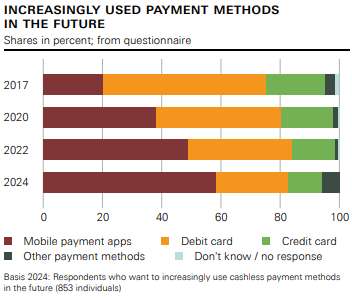
This marks a dramatic shift from 2017 when cash dominated 70% of transactions. Last year, mobile payment apps accounted for 18% of purchases, while credit cards made up 14%.
Used payment methods. | Credit: Swiss National Bank
Despite the shift, cash remains an emotional topic in Switzerland, where residents hold an average of $10,481 in physical currency—the second-highest per capita cash holdings in the world.
Yet signs of dwindling cash usage are becoming more apparent.
The SNB noted that public transport operators plan to reduce cash transactions, while mobile payment solutions like Twint have become more widely accepted than traditional bank cards.
Crypto Ownership Grows, but Adoption for Payments Lags
As Switzerland moves away from cash, cryptocurrency and stablecoin ownership is rising across all age groups, according to the SNB report.
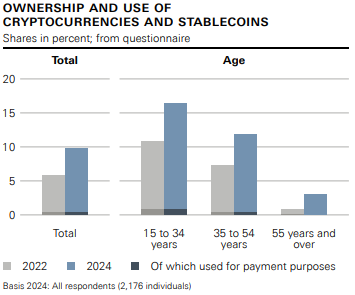
Overall, crypto ownership increased from 6% in 2022 to 10% in 2024. The 15 to 34-year-old demographic leads adoption, with ownership jumping from 10% to 17% during the same period.
Crypto holdings are rising in Switzerland. | Credit: Swiss National Bank.
However, despite growing interest, cryptocurrencies remain a niche payment option.
The report found that only a small fraction of owners use digital assets for transactions, signaling that while adoption is increasing, crypto has yet to become a mainstream alternative to traditional payment methods.
Swiss Stance on Digital Assets
Switzerland has long embraced blockchain technology, establishing itself as a global hub for digital asset innovation.
The country is home to Crypto Valley, a blockchain startup hub in Zug, known for its business-friendly policies, low taxes, and strong legal protections.
The Swiss Financial Market Supervisory Authority (FINMA) has provided clear regulatory guidelines for cryptocurrencies, balancing innovation with consumer protection.
Cryptocurrencies are treated as assets for taxation purposes and are subject to capital gains tax, but they are not recognized as legal tender.
Despite Switzerland’s openness to digital assets, the SNB remains cautious. It has warned about the risks posed by cryptocurrency volatility and its potential impact on the financial system.
For now, Switzerland’s payment landscape is evolving—but whether crypto can break into the mainstream remains an open question.
Giuseppe Ciccomascolo began his career as an investigative journalist in Italy, where he contributed to both local and national newspapers, focusing on various financial sectors.
Upon relocating to London, he worked as an analyst for Fitch's CapitalStructure and later as a Senior Reporter for Alliance News. In 2017, Giuseppe transitioned to covering cryptocurrency-related news, producing documentaries and articles on Bitcoin and other emerging digital currencies. He also played a pivotal role in establishing the academy for a cryptocurrency exchange website. Crypto remained his primary area of interest throughout his tenure as a writer for ThirdFloor.