5 Key Partners Strengthening Ripple Treasury’s Ecosystem — Including SWIFT
Share
Key Takeaways
BRICS is developing a gold-backed digital “Unit” explicitly designed for cross-border trade.
The goal is to reduce dependence on the U.S. dollar, strengthen trade sovereignty, and simplify settlements across BRICS economies.
XRP and XLM, long considered crypto alternatives to SWIFT, now face a new government-led competitor with commodity backing.
If widely adopted, the Unit may become a third global settlement rail alongside SWIFT and blockchain/stablecoin networks.
The BRICS coalition, comprising Brazil, Russia, India, China, and South Africa, has spent the last decade quietly reshaping the global economic order. Now joined by additional members such as Egypt, Ethiopia, Iran, Saudi Arabia, and the UAE (depending on the year and final membership status), the bloc has made one goal unmistakably clear: reduce reliance on the U.S. dollar in global trade.
Their latest and most ambitious step toward that objective is the proposed “gold-backed Unit”, a digital settlement medium explicitly designed for cross-border payments within BRICS and partner economies.
Although still in development, the Unit represents a significant departure from existing financial rails, including both traditional ones, such as SWIFT, and crypto-based solutions, like XRP and XLM.
If implemented successfully, the Unit could become a transformative settlement system, serving as a new alternative to traditional trade currency and fundamentally altering how value is exchanged across borders.
How Cross-Border Payments Work Today
For decades, international payments have depended heavily on SWIFT, the Society for Worldwide Interbank Financial Telecommunication.
SWIFT is not a payment system, but a messaging network that links over 11,000 financial institutions across more than 200 countries. When a bank in India sends money to a supplier in Brazil, SWIFT messages instruct intermediary banks on how to transfer the funds.
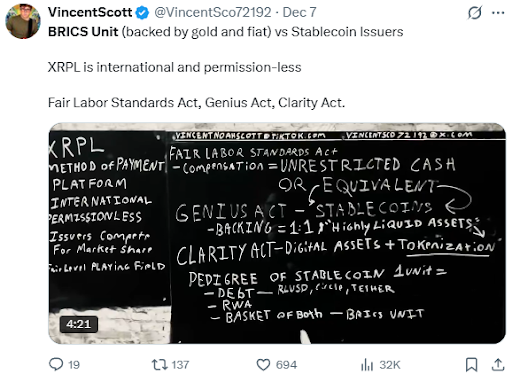
BRICS Unit vs. stablecoin issuers. | Credit: Vincent Scott X profile
But this infrastructure comes with significant limitations:
Slow settlement: Cross-border transfers often take 2-5 business days.
Multiple intermediaries: Payments may pass through 3–6 correspondent banks, each adding delays and costs.
Exposure to dollar liquidity: Many transactions require the use of the US dollar as a bridge currency.
These inefficiencies, along with the reliance on U.S. financial infrastructure, have prompted several countries and companies to seek alternatives.
Crypto Disruptors — XRP and XLM’s Role in Cross-Border Finance
Two of the earliest challengers to SWIFT came not from governments but from blockchain networks.
Ripple (XRP)
Ripple built an enterprise settlement system, RippleNet, that allows banks and fintechs to settle cross-border transfers in seconds. Its native asset, XRP, can serve as a bridge currency, allowing instant swaps between, for example, Indian rupees and Brazilian reais.
Fintechs like Tranglo and SBI Remit route payments using XRP.
Transactions that once took days now settle in 3-5 seconds, usually at a fraction of traditional fees.
Stellar (XLM)
Stellar focuses on low-cost remittances and financial inclusion, especially across emerging markets. It has powered:
MoneyGram’s on-chain remittance expansion.
Humanitarian aid disbursement programs.
Cross-border payments between African and Middle Eastern markets.
Both networks reduce settlement friction dramatically and have established themselves as private-sector alternatives to the SWIFT-correspondent banking model.
Yet their adoption still depends on financial institutions choosing them voluntarily. BRICS is proposing something different: a multilateral, government-backed settlement unit.
BRICS’ “Unit” — What It Is and How It Works
The gold-backed Unit is envisioned as a digital settlement instrument used strictly for cross-border trade, not as a domestic currency. Early descriptions suggest:
It will be backed by a basket of gold and possibly other commodities.
It will function digitally, potentially on a blockchain-like ledger.
It will not replace national currencies but facilitate trade settlement between them.
This proposal builds on earlier initiatives, including BRICS Pay, a mobile payment platform launched in 2019, which facilitates cross-border retail transactions. BRICS Pay, however, never scaled beyond limited pilots and did not become a unified settlement mechanism.
The Unit is far more ambitious and designed to replace the dollar as the settlement medium in intra-BRICS trade.
Why BRICS Is Building the ‘Unit’ — Trade and De-Dollarization
The motivations behind the Unit are both economic and political.
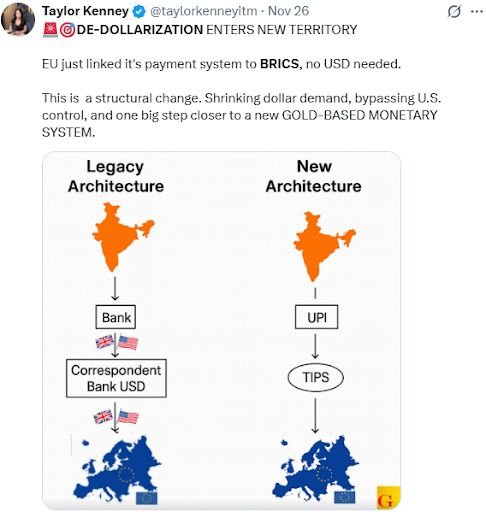
De-dollarization enters new territory. | Credit: Taylor Kennedy X profile
Trade Sovereignty
BRICS economies aim to reduce their dependence on Western-controlled banking networks and the US dollar’s liquidity. For instance:
Russia and India have explored settling oil trade in rupees or yuan.
China and Brazil already conduct part of their bilateral trade in their own currencies.
Russia, cut off from SWIFT in 2022, accelerated its search for alternative payment systems.
A unified digital settlement medium could simplify transactions across the entire bloc.
Consider the following example: a Brazilian soy exporter sells to India.
Instead of settling through USD and correspondent banks, the Indian buyer pays in the gold-backed Unit, which the Brazilian seller converts into reais via local partners.
No dollars. No SWIFT. And no intermediaries. This is the efficiency play BRICS is aiming for, and why the Unit could serve as a geopolitical statement as much as a financial tool.
How Cross-Border Payments Work With Different Systems: XRP/XLM vs. BRICS’ Unit
Let’s compare using a BRICS-only corridor example: India (Rupee) to Russia (Ruble).
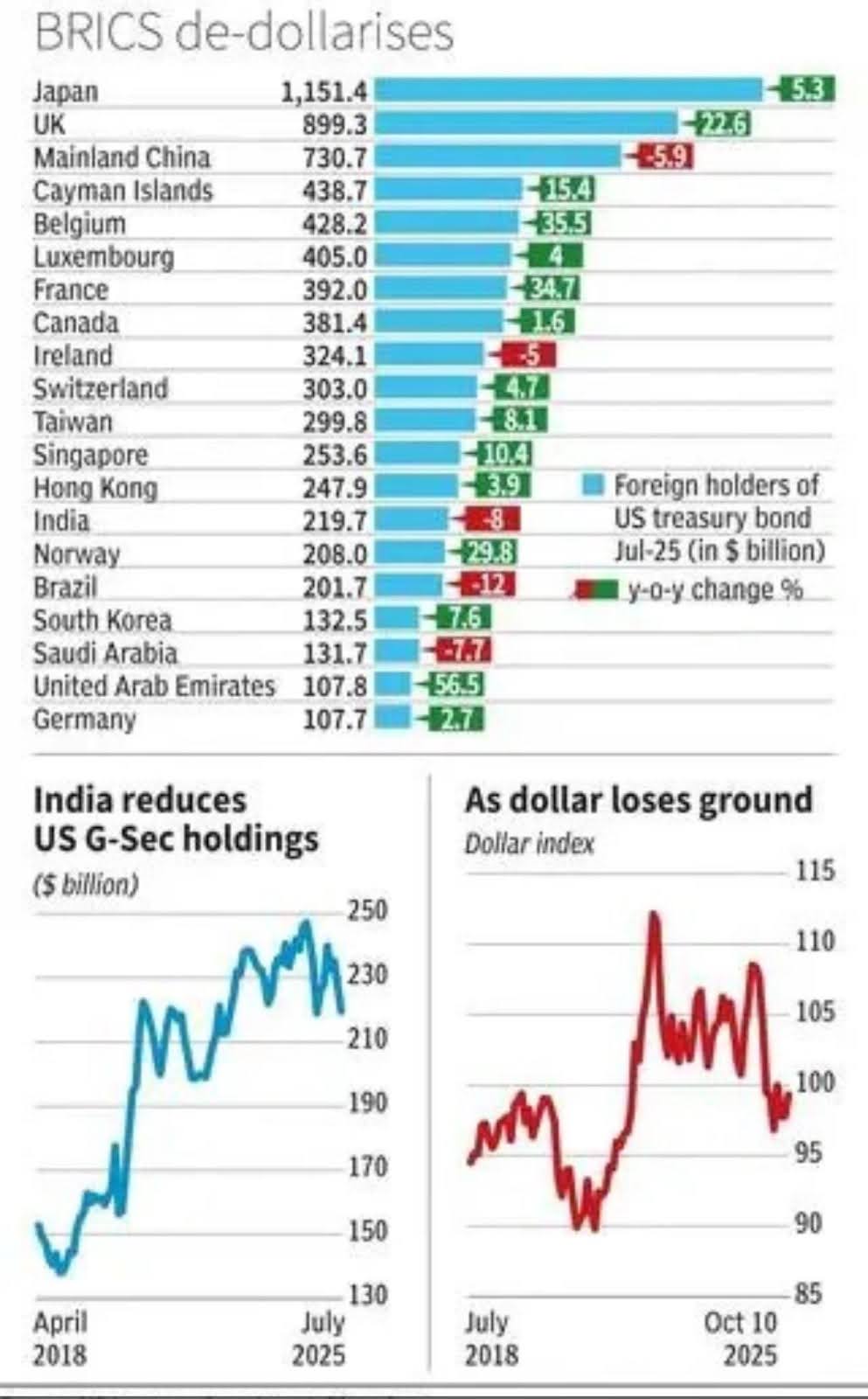
BRICS de-dollarization process. | Credit: Ritesh Jain X profile
Using XRP (RippleNet)
A fintech in India routes a payment to Russia through RippleNet’s On-Demand Liquidity (ODL) service. XRP acts as the bridge asset:
From INR to XRP in seconds.
From XRP to RUB in seconds.
The settlement takes around 5 seconds, with very low fees.
Using XLM (Stellar)
A remittance provider in India sends funds to Russia via a Stellar anchor:
Settlement is fast and inexpensive, making it ideal for consumer transfers.
Using BRICS’ Gold-Backed Unit
A Russian energy company invoices an Indian buyer in Units. India pays in Units through a government-controlled settlement platform. Russia receives Units and converts them to rubles domestically.
No bridging asset. No crypto. And no SWIFT. Settlement speed depends on the platform’s design, likely minutes, not seconds.
Features
XRP Ledger
Stellar (XLM)
BRICS Gold-Backed Unit
Settlement speed
3-5 seconds
3-5 seconds
Minutes (estimated)
Backing
None (crypto asset)
None
Gold and commodities
Governance
Private consortium
Nonprofit foundation
State-controlled
Primary users
Banks/fintechs
Remittance providers
Governments & exporters
Ideal use case
High-speed liquidity
Low-cost remittances
Commodity trade settlement
Currency bridge
XRP
XLM
Unit (gold-linked)
Dependency on USD
None
None
No dependency
How the “Unit” Could Reshape Cross-Border Trade
If BRICS successfully deploys the Unit, the global settlement environment may evolve into three main rails:
State-backed digital settlement units, such as the BRICS Unit.
Potential impacts include:
Commodity market shift: If BRICS countries begin settling oil, gas, metals, and agriculture in the Unit, global demand for dollars could decrease.
Regional copycats: ASEAN, the Gulf Cooperation Council, or even the African Union might build similar digital trade units.
Blockchain hybridization: BRICS may adopt blockchain-style ledgers for transparency. But with centralized control, unlike XRP or XLM.
Reduced western financial leverage: Countries under sanctions or political pressure may embrace non-dollar rails to maintain trade access.
This is not just a payment technology shift; it’s a geopolitical realignment.
Opportunities and Risks of BRICS Gold-Backed ‘Unit’
As BRICS pushes forward with its gold-backed “Unit,” the new system introduces both powerful advantages and complex vulnerabilities.
On the one hand, it promises greater monetary independence, faster settlements, and a more stable medium of trade. On the other hand, its centralized governance, convertibility questions, and geopolitical weight raise genuine concerns about global adoption and long-term viability.
Opportunities
Lower dependence on dollars.
Stronger trade ties within BRICS.
Stable settlement medium via gold-backing.
Faster and potentially cheaper cross-border transactions.
Alternative for sanctioned or dollar-constrained nations.
Risks
Centralized control may reduce global trust.
Liquidity challenges in the early stages.
Potential retaliation or political friction.
Convertibility concerns: How easily can a unit be converted into local currency?
Gold-backing limits supply flexibility.
Possible divide between BRICS and Western markets.
The BRICS “Unit” is a proposed digital trade settlement currency being developed by Brazil, Russia, India, China, and South Africa. It’s designed to facilitate cross-border transactions between member nations using a gold and currency-backed reserve system, reducing reliance on the U.S. dollar and Western banking infrastructure.
How does the BRICS “Unit” differ from XRP and XLM?
Unlike XRP and XLM, which are decentralized blockchain tokens used by private institutions for instant currency conversion and remittances, the BRICS Unit would be government-backed and centrally issued. It’s intended for large-scale trade and state-level settlements, not retail or public use, and would likely operate under strict policy and regulatory control.
Why is BRICS creating its own digital trade currency?
The initiative is part of a broader de-dollarization strategy among BRICS nations. By settling trade in a gold-linked Unit instead of U.S. dollars, member states aim to protect themselves from sanctions, currency volatility, and high transaction costs in Western-dominated systems. It also strengthens intra-BRICS trade by giving them a shared, asset-backed medium of exchange.
Could the BRICS Unit replace SWIFT or challenge crypto-based systems?
It’s unlikely to fully replace SWIFT or crypto networks, but it could become a third global settlement rail — alongside traditional banking and decentralized systems. If successful, it might handle a significant share of commodity and energy trade among emerging economies, signaling a shift toward regionalized, gold-backed digital finance rather than global dollar dominance.
Disclaimer:
The information provided in this article is for informational purposes only. It is not intended to be, nor should it be construed as, financial advice. We do not make any warranties regarding the completeness, reliability, or accuracy of this information. All investments involve risk, and past performance does not guarantee future results. We recommend consulting a financial advisor before making any investment decisions.
Giuseppe Ciccomascolo began his career as an investigative journalist in Italy, where he contributed to both local and national newspapers, focusing on various financial sectors.
Upon relocating to London, he worked as an analyst for Fitch's CapitalStructure and later as a Senior Reporter for Alliance News. In 2017, Giuseppe transitioned to covering cryptocurrency-related news, producing documentaries and articles on Bitcoin and other emerging digital currencies. He also played a pivotal role in establishing the academy for a cryptocurrency exchange website. Crypto remained his primary area of interest throughout his tenure as a writer for ThirdFloor.


 Easy
Easy