The BRICS Unit is a gold-anchored digital trade currency designed for cross-border settlement.
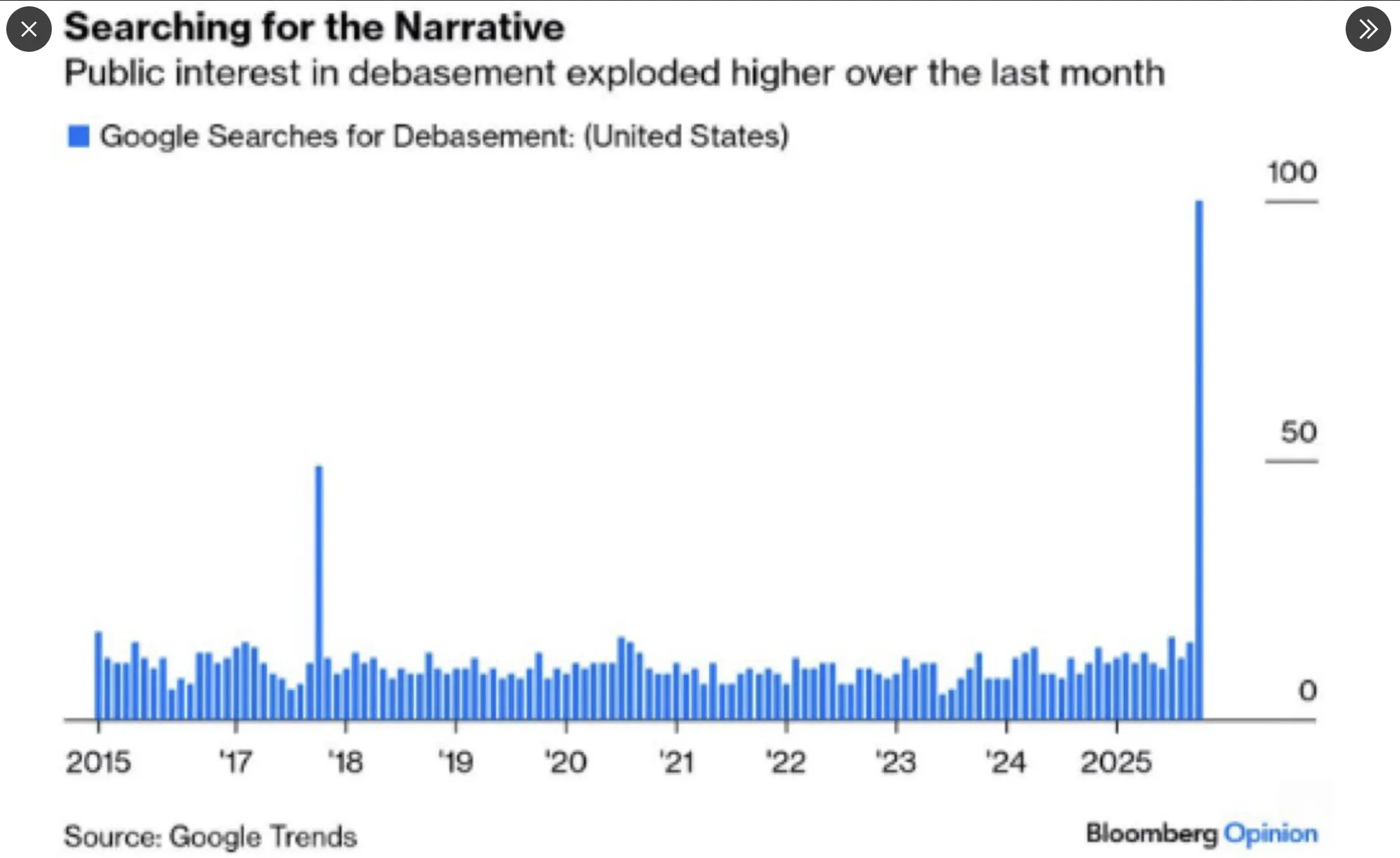
Its launch coincides with record public anxiety about dollar debasement, as shown in Google Trends data shared by Bloomberg.
The prototype uses a 40% gold and 60% BRICS-currency basket that adjusts daily.
The pilot signals a structural move toward de-dollarization and strengthens long-term global demand for gold.
The titans of global finance fight using algorithms and asset reserves instead of armies, and they just got a whole new supply of advanced battle equipment.
As of December 8, 2025, the BRICS alliance, a bloc of 10 full members including Brazil, Russia, India, China, South Africa, Egypt, Ethiopia, Indonesia, Iran, and the United Arab Emirates, has launched “The Unit” aiming to hit the heart of Western monetary hegemony. The concept centers on a gold-anchored digital instrument designed to reroute trillions in trade away from the U.S. dollar.
NEW: BRICS Group launches gold-backed UNIT payment system
40% gold and 60% BRICS currency basket, UNIT will allow 30+ countries to trade precious metals outside Western platforms
As a result, public interest in dollar debasement, or the erosion of the dollar’s purchasing power, has reached a new peak. Google Trends data shared by Bloomberg Opinion shows an unprecedented spike in searches for the term during the final quarter of 2025.
Bloomberg Opinion | Source: Google Trends
The debate surrounding the Unit’s design, purpose, and geopolitical implications has already reshaped conversations about de-dollarization, global power shifts, and the use of blockchain systems.
This article explains what the BRICS gold-backed Unit is, its structure, valuation methodology, the reasons behind BRICS members’ support for the concept, and what the emergence of such an instrument could mean for future global currency competition.
Researchers launched a pilot on October 31, 2025, to test a gold-anchored settlement “Unit” inside the bloc. The initiative came from IRIAS and formed part of a broader effort to study collateralized digital instruments for international trade.
On November 10, 2025, the International Research Institute for Advanced Systems (IRIAS) announced the initiative to build the blockchain-based settlement token on the Cardano network, positioning the project as a step toward alternative global financial architectures.
“The Unit” is a digital trade currency pilot created for settlement between BRICS economies. It holds value through a basket of local currencies and physical gold.
The initiative began as part of a search for alternative monetary structures through the IRIAS, whose original purpose was “to carry out comprehensive research and development in the field of theory and practice of organization and management of socialist social production” and is now recognized as an international body with legal personality.
The Unit does not replace national currencies. Instead, it aims to act as a neutral settlement tool that reduces reliance on the U.S. dollar in trade between BRICS economies.
The UNIT Foundation and Its AI-Driven Leadership Model
The UNIT Foundation oversees the development of the proposed BRICS settlement instrument and its governance model, and it has appointed an AI CEO to lead the project instead of a traditional executive.
The foundation argues that an AI-based leader keeps Unit free from personal bias, emotional influence, and political pressure while providing consistent memory, analytical precision, and continuity.
This approach reflects the foundation’s view that a neutral intelligence is better suited to guide a global settlement instrument than any individual leader.
How Does a BRICS Settlement Unit Connect To Concerns About Dollar Debasement?
Although the Unit does not compete with domestic currencies, it still challenges the wider dominance of the dollar.
Any system that allows major economies to settle trade without using the U.S. dollar reduces global demand for it.
Lower demand can erode the dollar’s purchasing power over time, fueling concerns about gradual debasement.
The shift is subtle, but for policymakers and analysts, a growing network of dollar alternatives signals a long-term erosion of the dollar’s role as the default medium for international trade and reserves.
How the Unit Works: The Structure Behind the BRICS Gold-Backed Currency
The Unit follows a structured model designed to balance stability, political neutrality, and tradability. Its framework combines hard assets with national currencies to create a settlement instrument that avoids dependence on a single economy.
The Unit’s mechanism works with a reserve basket, meaning a predefined mix of assets used to determine the instrument’s value. This basket anchors the Unit’s valuation and guides its daily pricing.
The basket is composed of:
40% physical gold, equal to 40 grams in the initial test and 60% BRICS currencies, split into five equal weights of 12% each:
Real (Brazil)
Yuan (China)
Rupee (India)
Ruble (Russia)
Rand (South Africa)
These currencies represent the original BRICS core with the most developed financial markets, deeper liquidity, larger economies, and more stable currency infrastructures.
BRICS Unit Issuance, Valuation Method and System Implications
The Pumpkin Batch forms the reference set for tracking how each Unit gains or loses value as the reserve basket changes.
The role of gold: Gold serves as the numeraire, stabilizing valuation during periods of currency volatility.
Blockchain calculation: All deposits and daily pricing updates run on a permissioned blockchain maintained by IRIAS.
Research-only stage: The model remains an IRIAS pilot, not yet adopted by BRICS central banks or the New Development Bank.
Policy background: The project builds on discussions from the 2024 Kazan Summit and earlier BRICS Pay experiments.
Regulatory coordination: Expansion requires harmonized rules across multiple members.
Why BRICS Created the Unit: Trade Without the Dollar
Many BRICS members face a risk of sanctions, high dollar borrowing costs, and volatility tied to U.S. monetary policy.
BREAKING:
China is officially promoting BRICS de-Dollarization, taking an initiatives like BRICS pay system to facilitate trade in local currencies.
Store value using gold instead of foreign reserves
Reduce exposure to dollar liquidity shocks
Build a cooperative monetary framework independent of Western systems
BRICS leaders have discussed such an initiative since 2022. The pilot demonstrates that the proposal is aiming to evolve into a functional model.
BRICS’ Strategic Answer to Dollar Debasement: The Gold-Backed Unit
As of December 8, 2025, gold demand remains high. Countries facing inflation, weak currencies, and rising debt move toward assets that hold real value. The Unit follows that shift, using gold to support trade between BRICS nations.
What drives this trend:
U.S. deficit spending: Heavy borrowing raises doubts about the dollar’s long-term strength
Geopolitical fragmentation: Rival blocs seek options beyond dollar-based systems
Elevated inflation: Price pressure pushes capital into more stable assets
Declining purchasing power: Many currencies lose value faster than wages or savings can keep up
Rising gold demand: Central banks continue to increase their reserves
The Unit makes gold part of daily settlement, not just storage, thereby shifting the role of metal from a passive reserve to an active trade asset.
Additionally, the design can strengthen gold’s position in global finance based on the following elements:
Gold becomes a tool for government-level transactions
BRICS members need reserves to issue more Units
Expansion means more consistent gold buying
Gold moves through trade and not only vaults
As a result, the Unit marks a shift in how value moves across borders. While still a pilot, it brings gold back into the spotlight as more than a hedge. It becomes part of the global trade system. Whether this experiment scales or not, its launch signals that the search for alternatives to the dollar is no longer theoretical. It is already underway.
Future Outlook: Could the BRICS Unit Scale Beyond a Pilot?
The next phase of the Unit depends on whether BRICS members treat it as a research exercise or a blueprint for a shared settlement system. Expansion would require coordinated reserves, unified rules, and deeper interoperability between national payment networks.
If the pilot succeeds, the Unit could form the first large-scale gold-linked settlement rail in the digital era, a development with long-term implications for global liquidity, foreign reserves, and the structure of international trade.
A scalable version of the Unit would also require political alignment across a diverse bloc whose members hold different monetary priorities. Some BRICS economies rely heavily on capital controls, others maintain managed exchange rates, and several use floating regimes that react sharply to global shocks.
For the Unit to function as a shared settlement layer, members would need to agree on how to manage volatility, contribute reserves, and respond to stress events. These structural differences form the core challenge that will determine whether the Unit becomes a functional multilateral tool or remains a controlled research prototype.
No. It is a research pilot backed by the IRIAS organization and supported by some BRICS members.
Will consumers use the Unit?
No. It is built for governments, banks, and cross-border settlements.
Can the Unit replace gold?
No. The model increases gold’s monetary role by tying every Unit to physical reserves.
Which countries are showing interest beyond BRICS?
Several African governments have signaled interest in alternative settlement systems that do not rely on the dollar.
Disclaimer:
The information provided in this article is for informational purposes only. It is not intended to be, nor should it be construed as, financial advice. We do not make any warranties regarding the completeness, reliability, or accuracy of this information. All investments involve risk, and past performance does not guarantee future results. We recommend consulting a financial advisor before making any investment decisions.
Dr. Lorena Nessi is an award-winning journalist and media technology expert with 15 years of experience in digital culture and communication. Based in Oxfordshire, UK, she combines academic insight with hands-on media practice.
She holds a PhD in Communication, Sociology, and Digital Cultures, and an MA in Globalization, Identity, and Technology.
Lorena has taught at Fairleigh Dickinson University, Nottingham Trent University, and the University of Oxford. She is a former producer for the BBC in London, with additional experience creating television content in Mexico and Japan.
Her research focuses on digital cultures, social media, technology, capitalism, and the societal impact of blockchain innovation.
She has written extensively on digital media and emerging technologies, with her work featured in both academic and media platforms. Her Web3 expertise explores how blockchain technologies shape culture, economics, and decentralized systems.
Outside of work, Lorena enjoys reading science fiction, playing strategic board games, traveling, and chasing adventures that get her heart racing. A perfect day ends with a relaxing spa and a good family meal.


 Easy
Easy