ETH’s bounce toward $2,300 looks corrective, not a bullish reversal.
Daily CMF staying negative implies capital is still flowing out on balance.
DMI (trend strength with -DI > +DI) indicates the downtrend remains dominant.
Ethereum (ETH) has rebounded toward the $2,300 level after recording one of its sharpest drawdowns of the year.
This development has offered brief relief to a market weighed down by persistent selling pressure since late January.
Across both lower- and higher-timeframe momentum indicators remains bearish.
This occurred as the trend strength and capital flow metrics show limited signs that buyers have regained control.
Consequently, expectations of a return to the psychologically important $3,000 level in February 2026 look increasingly unrealistic. Here is why.
ETH Rebound Lacks Strength
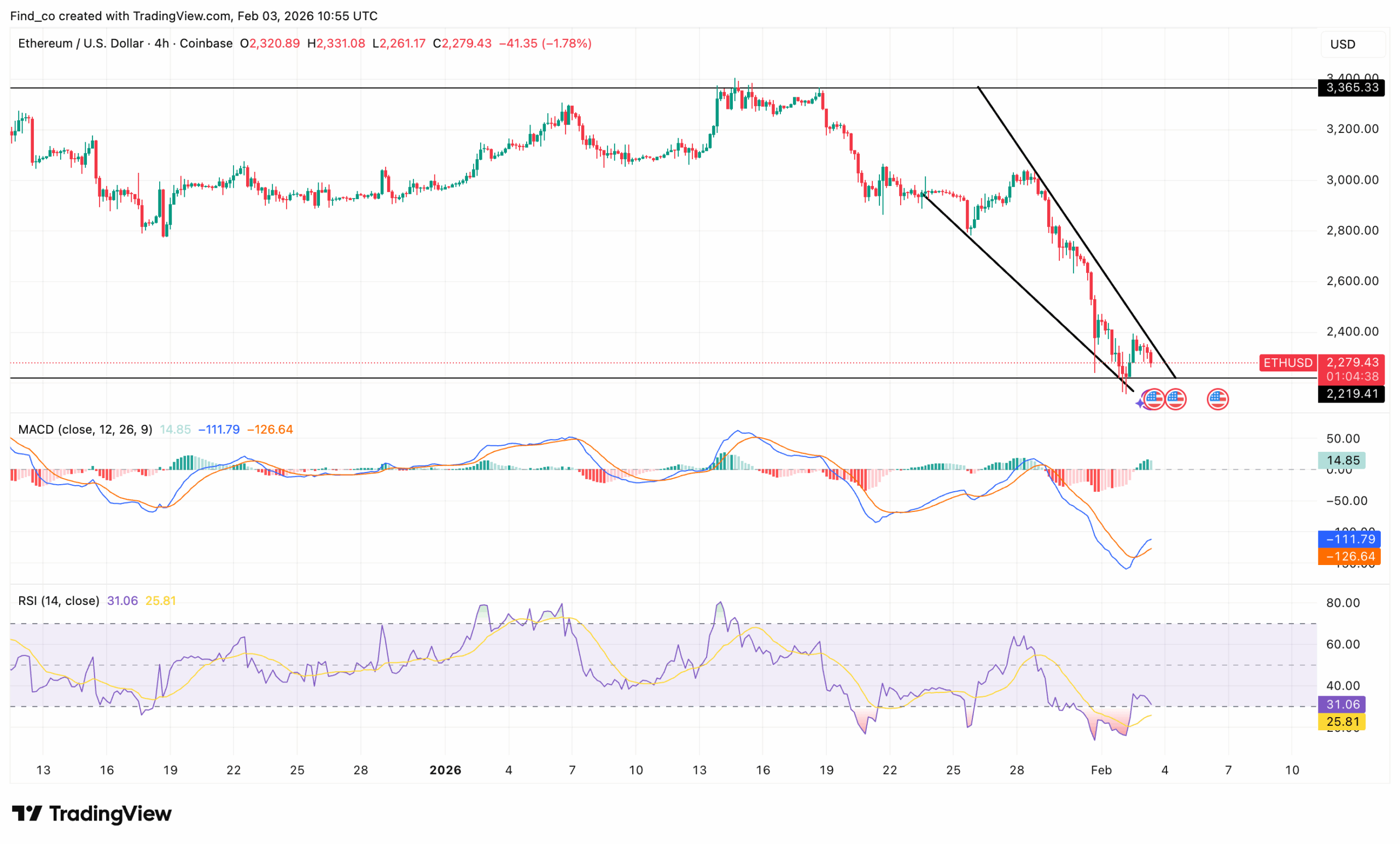
The Moving Average Convergence Divergence (MACD) is attempting a bullish turn, with histogram bars flipping green for the first time since late January.
Still, the 26-period EMA remains above the 12-period EMA, signaling that the broader bearish trend structure remains intact despite the short-term relief rally.
Historically, this setup aligns more with corrective moves than with sustainable reversals.
The Relative Strength Index (RSI) supports this cautious stance. Hovering around 34, the indicator remains well below the neutral 50 mark.
Notably, this highlights weak buying pressure and continued seller dominance.
While the RSI has rebounded from deeply oversold conditions, it has yet to print a higher high. For context, this acts as a necessary confirmation of bullish momentum.
The recent rebound aligns more closely with a dead-cat bounce, especially given the absence of strong volume inflows and bullish moving-average crossovers.
Unless ETH’s price reclaims and holds above the $2,450 level with expanding volume, any upside movement is likely to remain corrective rather than impulsive.
ETH Price Prediction: Downside Risk Remains Elevated
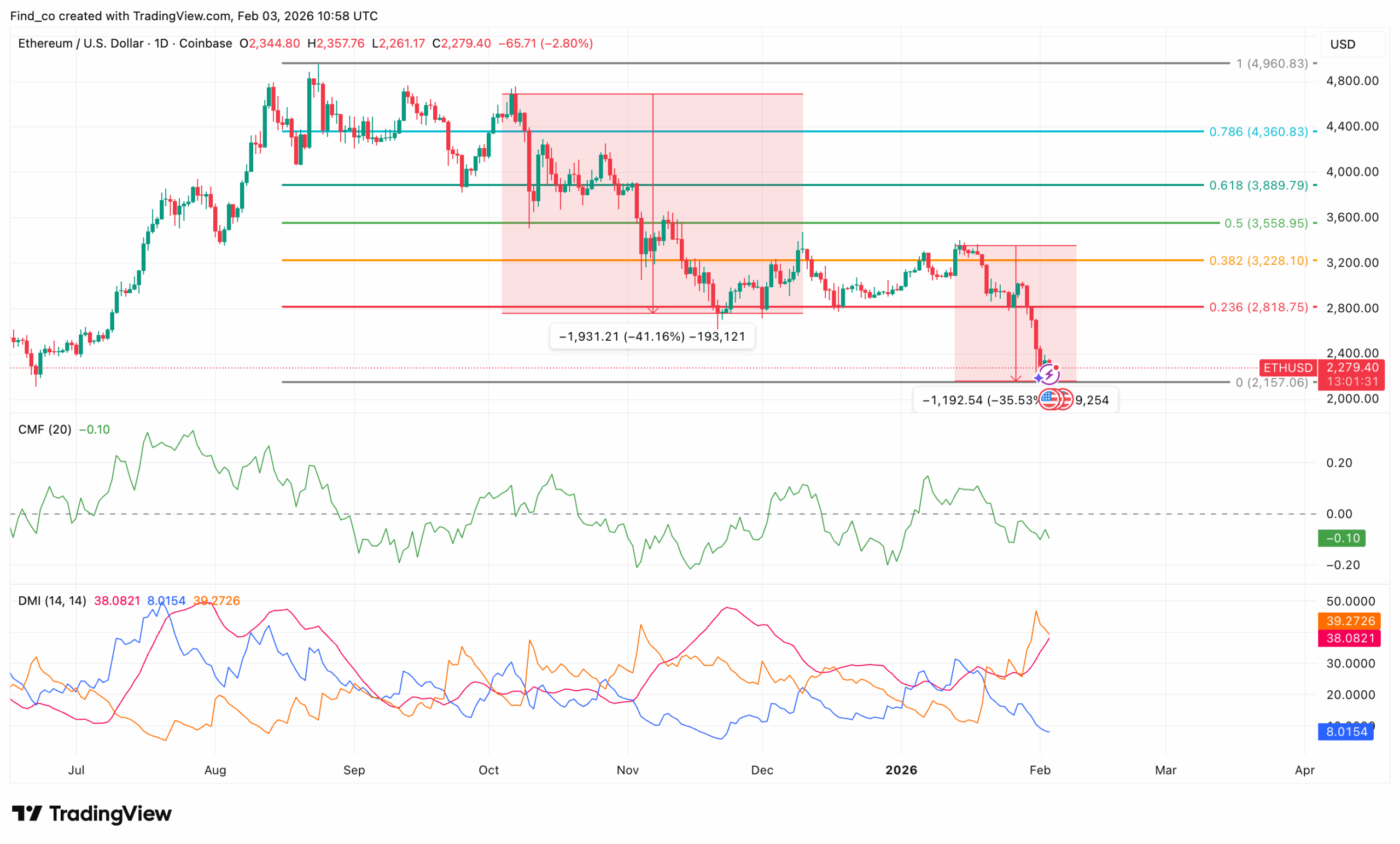
On the daily chart, Ethereum’s price has staged a modest rebound after losing key support levels. At the time of writing, the asset trades at $2,321.00.
Momentum indicators, however, continue to undermine the recovery narrative.
The Chaikin Money Flow (CMF) remains firmly in negative territory. As seen below, the CMF continues to trend lower, signaling sustained selling volume and weak buyer conviction.
Meanwhile, the Directional Movement Index (DMI) reinforces the bearish outlook.
The negative directional index is holding above the positive directional index, confirming that selling pressure still dominates the broader trend and that the recent bounce lacks structural strength.
Additionally, the Average Directional Index (ADX) stands strong at 39, confirming that the prevailing trend remains well-defined rather than corrective noise.
In this situation, bearish control remains intact, and ETH’s rebound appears more like a technical pause.
Without a realignment in momentum indicators and a return of capital inflows, ETH’s price remains exposed to downward pressure, with bulls yet to regain control of the daily structure.
The Fibonacci retracement levels place ETH’s price just above the zero Fib line, a positioning that often reflects fragility rather than strength following a breakdown.
This zone frequently serves as a final buffer for short-term relief moves. So, failure to hold could open the door to further downside.
Without a reclaim of higher Fibonacci levels, particularly the 0.236 and 0.382 regions, ETH’s price action remains vulnerable, reinforcing the broader bearish bias reflected across both momentum and trend indicators.
That said, a break above the $2,818 zone would reopen the path toward the $3,200 region.
Bullish Potential Despite Caution
Meanwhile, according to crypto analyst Leshka, ETH is likely to see a major breakout within the next six months, even as near-term price action remains muted.
Crypto analyst Leshka sees a potential major move for Ethereum over the next six months.
They noted, “ETH will 3x-4x in the next six months. I can’t believe it myself, but the pattern screams about it.”
He drew parallels to a chart structure from eight years ago, when Ethereum surged from $56 to $1,151.
While the context today is slightly different—accumulation phases are longer and institutions are stacking billions—Leshka highlighted a significant supply shortage on centralized exchanges.
Despite maintaining a generally bearish stance, they believe these factors could set the stage for a substantial upside move.
Whether that will be the case remains to be seen. However, in the meantime, Ethereum’s price will likely remain trapped below the psychological $3,000 mark.
Disclaimer:
The information provided in this article is for informational purposes only. It is not intended to be, nor should it be construed as, financial advice. We do not make any warranties regarding the completeness, reliability, or accuracy of this information. All investments involve risk, and past performance does not guarantee future results. We recommend consulting a financial advisor before making any investment decisions.
Victor Olanrewaju is a crypto analyst and reporter at CCN with deep roots in on-chain research and technical analysis. His crypto journey began in 2017, but it was the 2020 Uniswap airdrop that sparked a full-time pivot into the space.
With a foundation in copywriting, Victor honed his craft creating high-converting content for leading crypto brokers — most notably an XRP price prediction that ranked #1 on Google during the 2021 bull run.
He later joined AMBCrypto in 2022, where he combined storytelling with technical and on-chain analysis to cover key market narratives.
In 2024, he expanded his expertise at BeInCrypto, collaborating with analysts and using tools like Glassnode, Santiment, and IntoTheBlock to break down Bitcoin and altcoin trends.
At CCN, Victor covers the top cryptocurrencies, memecoins, macro shifts, blending real-time insights with deep-dive metrics.
He holds a Bachelor’s degree in Physics from the University of Ibadan, equipping him to simplify complex data for a wide audience. Follow his work or connect on LinkedIn or X.