Coinbase Launches 4.1% USDC Rewards in Canada: How It Compares to GICs and Savings Accounts.
Share
Key Takeaways
Coinbase’s 4.1% USDC rewards beat most Canadian GICs (2–3%) and savings accounts (<1%).
Unlike bank deposits insured by CDIC, USDC balances on Coinbase have no government protection.
CRA requires all crypto rewards to be reported as income, similar to interest on bank products.
USDC relies on issuer reserves and exchange stability, making it riskier than insured bank deposits.
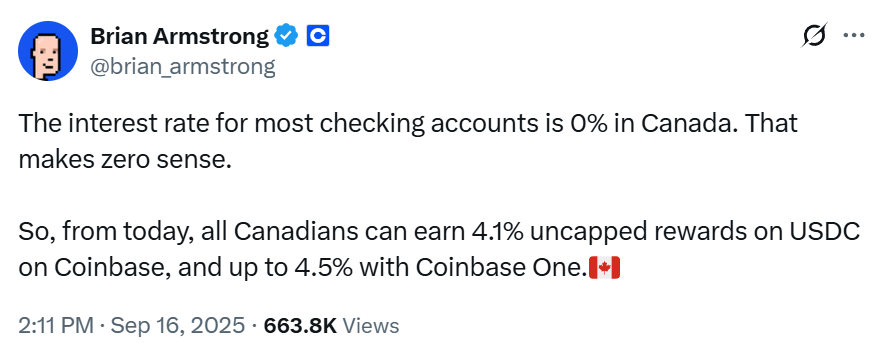
Coinbase has announced that Canadian customers can now earn 4.1% annual rewards (APY) by simply holding USDC in their Coinbase accounts.
USDC is a USD-pegged stablecoin issued by Circle. According to Coinbase’s own documentation, eligible users automatically receive “USDC Rewards,” a loyalty program funded by Coinbase, on their USDC balance. Rewards accrue daily based on the amount of USDC held and are distributed weekly into the user’s USDC balance.
For example, Coinbase notes that users earn rewards every week they hold at least $1 USDC, and the higher your balance, the more rewards you receive.
The advertised rate is 4.1% per year, which Coinbase prominently displays on its site. Coinbase also emphasizes that USDC is designed to be redeemed 1:1 for U.S. dollars and that it does not use or lend customers’ USDC without permission.
New Trending Crypto Wallet Offers
Sponsored
Disclosure
We sometimes use affiliate links in our content, when clicking on those we might receive a commission at no extra cost to you. By using this website you agree to our terms and conditions and privacy policy.
Official Coinbase documentation explains that the USDC rewards program has no minimum holding limit (beyond $1 USDC). Rewards are calculated every day on your balance.
For each day you hold USDC, the daily interest portion is accrued, and at the end of the week (typically on Friday) Coinbase distributes the weekly rewards into your account.
Canadians can earn 4.1% uncapped rewards on USDC on Coinbase. | Source: @brian_armstrong on X
You earn roughly 4.1% per year on your USDC balance under this scheme. Coinbase also notes that the actual APY may change over time or by account type. The program is described as a customer incentive, a “loyalty program funded by Coinbase” and the company explicitly states your USDC is not treated as a bank deposit, so it is not lent out without your instruction.
Traditional Bank Rates vs. 4.1% USDC Yield
To assess the appeal of 4.1% USDC rewards, it helps to compare with what banks currently offer in Canada. Traditional savings accounts and GICs at major Canadian banks generally pay much lower rates.
TD e-Premium savings account: A high-interest savings product, currently paying only 0.85% APR on balances above $10,000 (and 0% on the first $10,000).
RBC high-interest eSavings (promo): A limited-time 4.70% APR for 3 months on new deposits, then reverting to a much lower regular rate.
Scotiabank MomentumPLUS (promo): Roughly 4.90% APR for a 90-day promotional period.
BMO savings amplifier: A base rate of 0.80%, with promotional boosts up to 4.7%.
In short, aside from short-term promotions, typical savings rates hover around 1%, and GICs around 3%. By comparison, Coinbase’s 4.1% USDC reward is competitive with the highest short-term promos and outpaces most non-promotional products. It is roughly double what regular GICs pay, and far above normal savings account rates.
Canadian Regulatory Context for USDC and Crypto
Holding and earning on USDC in Canada carries different regulatory considerations than a bank deposit. Coinbase Canada operates as a Restricted Dealer under Canadian securities law, but USDC itself is not a bank deposit or account.
Stablecoins like USDC fall under evolving rules for “crypto assets.” The Canadian Securities Administrators (CSA) have issued guidance on “value-referenced crypto assets” (VRCAs) such as stablecoins. Under this framework, stablecoins can only be offered by registered trading platforms if they are pegged 1:1 to fiat currency and the issuer provides transparency.
In December 2024, Circle (USDC’s issuer) filed an official undertaking with the CSA confirming that USDC is a Value-Referenced Crypto Asset pegged one-for-one to the U.S. dollar. This filing allows registered Canadian crypto exchanges, including Coinbase Canada, to continue offering USDC.
Another key regulator is FINTRAC, Canada’s anti-money-laundering agency. FINTRAC classifies cryptocurrency exchanges and wallet services as money services businesses (MSBs). This means platforms like Coinbase must register and comply with strict AML and KYC rules.
For Canadian users, the key takeaway is that while Coinbase is regulated as a trading platform, USDC holdings are not equivalent to insured bank deposits.
Tax Treatment: Crypto Rewards vs. Bank Interest
In Canada, interest from traditional accounts (bank savings or GICs) is classified as “interest and other investment income” and is fully taxable as income in the year earned.
Crypto earnings follow a similar principle. The Canada Revenue Agency (CRA) emphasizes that all crypto transactions are taxable and must be reported on your return. The USDC rewards you receive are likely considered taxable income at the time of receipt, valued in Canadian dollars.
This means USDC rewards are treated much like bank interest: 100% is included in your taxable income at your marginal rate. While some crypto gains are taxed as capital gains, recurring reward payments are generally treated as income, not gains.
Banks provide a T5 slip to report interest income. With Coinbase, you are responsible for tracking and reporting your crypto rewards.
Risk and Deposit Insurance Comparison
The most significant difference between USDC rewards and traditional bank products lies in insurance and safety.
Bank accounts and GICs: Eligible deposits are insured by the Canada Deposit Insurance Corporation (CDIC) up to $100,000 per depositor, per institution. This guarantee ensures that if a member bank fails, your deposits are protected.
Coinbase USDC: Coinbase explicitly warns Canadian users that USDC balances are not insured by CDIC or the Canadian Investor Protection Fund (CIPF). If Coinbase or Circle (the USDC issuer) faced insolvency or reserve issues, there is no guarantee of repayment.
USDC is marketed as “reserve-backed,” with Circle holding equivalent reserves in secure accounts and government securities. However, these reserves are not covered by CDIC. Stablecoins also face unique risks, such as de-pegging if reserves become insufficient.
Finally, Coinbase itself introduces counterparty risk. While regulated, it remains a private company vulnerable to operational, technical, or regulatory issues. Banks, in contrast, are heavily regulated and supported by government-backed insurance.
Coinbase’s 4.1% USDC reward program is a notable alternative for Canadian savers seeking higher yields. It outpaces standard GICs and savings accounts and competes with even the best promotional bank offers.
But higher returns come with trade-offs:
Rewards are taxable just like bank interest.
Funds are not CDIC-insured.
Stablecoins carry unique risks compared to guaranteed bank deposits.
For beginners, the decision comes down to risk tolerance. USDC rewards can boost returns, but they are best used with caution and as part of a diversified approach, not a replacement for secure, insured savings.
Disclaimer:
The information provided in this article is for informational purposes only. It is not intended to be, nor should it be construed as, financial advice. We do not make any warranties regarding the completeness, reliability, or accuracy of this information. All investments involve risk, and past performance does not guarantee future results. We recommend consulting a financial advisor before making any investment decisions.
Onkar Singh has three years of experience as a digital finance content creator. Throughout his career, he has collaborated with various DeFi projects and crypto media outlets. In his leisure time, he enjoys fitness activities at the gym and watching movies across different genres. Balancing his professional and personal interests, Onkar continues to contribute to the digital finance landscape while pursuing his hobbies.


 Easy
Easy