Data analysis shows USOR does not track U.S. oil reserves or crude prices. Learn how it compares with regulated oil ETFs and discover major tracking failures. | Credit: CCN.com
Share
Key Takeaways
$USOR has not tie to U.S. oil reserves as there is no legal, financial, or on-chain evidence showing any connection to U.S. oil.
The project relied on a manufactured political narrative, spreading rumors of Trump involvement and “U.S. Oil Coin” legitimacy to drive viral attention.
On-chain data shows extreme supply concentration, including a bundled 25% allocation and heavy clustering among the top 100 wallets.
Tools like Bubblemaps and GMGN indicate wallet interconnections that contradict claims of decentralization or institutional backing.
In January 2026, a token called $USOR exploded across X, TikTok, and Instagram with an eye-catching claim: it was supposedly backed by U.S. oil reserves and poised for a political-style pump tied to Donald Trump.
The narrative spread fast, reached millions of impressions, and, predictably, pulled in a wave of retail traders who believed they were early to the “next big thing.”
But when you strip away the viral marketing and look at the on-chain data, the story collapses quickly.
This article breaks down what $USOR claimed, what real oil-backed or commodity-linked tokens require, and what the blockchain evidence actually shows.
How Paid Creators Pushed the US Oil Coin ($USOR) Narrative
The $USOR launch leaned heavily on manufactured legitimacy rather than verifiable facts. Hundreds of TikTok and Instagram creators, many with little or no crypto background, received small payments to push a consistent message: that a “U.S. Oil Coin” was coming, potentially aligned with Trump-era energy politics, and primed for explosive upside.
This tactic wasn’t for pro crypto users. It was designed to reach normies, people who don’t read smart contracts, don’t check token distributions, and don’t question whether a meme coin could realistically be tied to U.S. strategic oil reserves.
That framing alone should have raised red flags. The U.S. Strategic Petroleum Reserve is a federally controlled asset governed by legislation, procurement rules, and national security considerations. There is no public framework, legal or technical, for tokenizing it via an anonymous crypto wallet.
Yet the marketing worked. Retail interest surged, buy pressure increased, and the illusion of momentum took hold.
What It Would Actually Take to Create an Oil-Backed Token
To understand why $USOR’s claims don’t hold up, it’s essential to clarify what backing oil would require in practice.
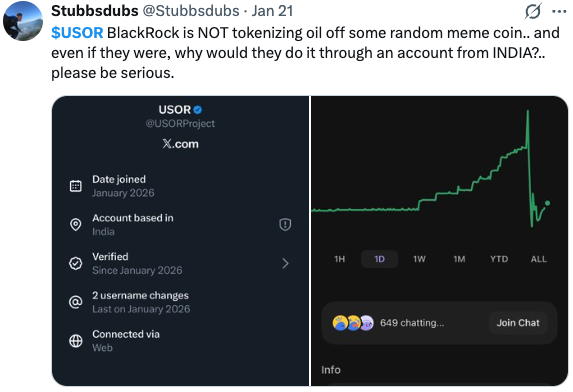
BlackRock is not tokenizing oil. | Credit: Stubbsdubs X profile
A legitimate oil-backed token would need:
A legal issuer with jurisdictional clarity.
Custodial agreements proving ownership or entitlement to oil reserves.
Audited disclosures verifying reserves, redemption rights, and liabilities.
Regulatory oversight, mainly if marketed to U.S. investors.
Even major institutions struggle with this. Commodity-linked ETFs and tokenized commodities typically rely on futures contracts, custodians, and regulated intermediaries, not vague claims and influencer hype.
There’s no documentation, audit, or legal disclosure supporting $USOR’s oil-backing claims.
Why $USOR’s On-Chain Structure Doesn’t Match Institutional Claims
When analysts examined $USOR’s blockchain data, the warning signs were immediate.
Extreme Supply Concentration
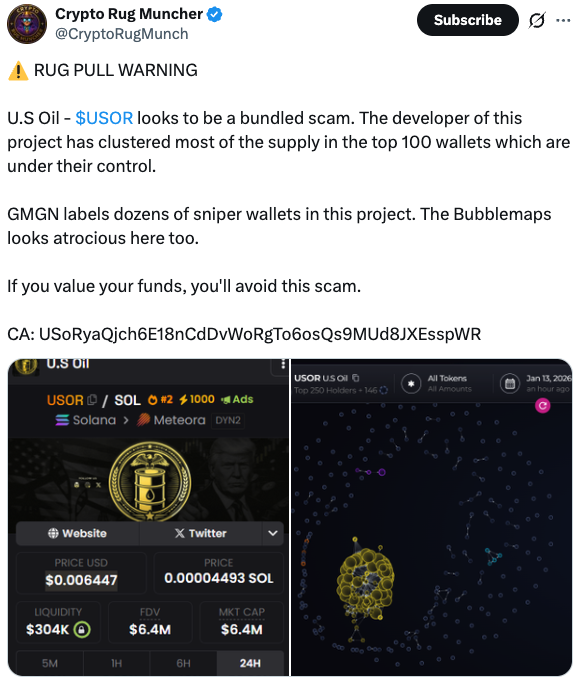
A significant portion of the token supply, roughly 25% bundled, remains under the effective control of wallets linked to the deployer. Beyond that, the top 100 wallets hold a large share of the supply, and many of them act in a coordinated manner.
This is not how legitimate projects distribute tokens. Heavy concentration gives insiders unilateral control over price action, liquidity, and exits.
Sniper Wallet Activity
On-chain tools flagged dozens of sniper wallets entering early, a common hallmark of insider-coordinated launches. These wallets often buy within seconds of deployment, ahead of retail access, and later distribute or dump into hype-driven liquidity.
Bubblemaps and Clustering
Visual analysis tools like Bubblemaps revealed dense wallet interconnections, suggesting the appearance of decentralization without actual distribution.
When wallets move together, sell together, or originate from the same funding sources, it strongly implies centralized control.
Put simply: the token’s structure contradicts every claim of institutional backing or real-world asset linkage.
What Reddit Users Are Saying About USOR
Discussion on Reddit shows a mostly skeptical and cautious tone toward USOR, with several users raising concerns about its legitimacy and long-term viability.
Some users pointed out that the project’s domain was registered very recently and questioned inconsistencies in its online presence. One commenter noted that the website appears newly created and claimed that technical details, such as site assets and branding, raise red flags about how established the project really is.
Others focused on the project’s social media and registration details, saying that while the project presents itself as U.S.-based, some accounts appear to be registered in other countries. This led to doubts about the project’s claims and overall transparency.
Several commenters described USOR as looking like a high-risk, short-term speculative play, similar to other hyped Solana meme-style tokens. While some acknowledged that such tokens can move quickly in price, they warned that it could just as easily drop fast, encouraging people to do their own research and avoid jumping in based on hype alone.
There was also criticism of claims that USOR is backed by U.S. oil reserves or connected to government or major financial institutions. Multiple users said they could not find independent proof of these claims and described the project’s messaging as vague or overly promotional.
Another common concern was price behavior and promotion tactics. One user said the chart looked unusual, with long periods of little movement followed by sudden large price jumps, and suggested that influencer marketing may be driving attention rather than organic demand.
Overall, the dominant sentiment in the thread is doubt and caution, with many users suggesting that USOR may be speculative at best and potentially misleading at worst, and advising others to be careful before investing.
No Verified Team or Developers Behind $USOR
Despite claims of large-scale backing and political relevance, the $USOR project has no publicly verified team. Official disclosures, regulatory filings, and credible media reports identify no founders, developers, corporate entities, or institutional partners.
Project materials and exchange listings refer only to an anonymous or generic “team,” without names, credentials, or jurisdictional details. There are also no published audits, legal opinions, or third-party verifications that would normally accompany any project claiming ties to real-world assets, especially government-controlled commodities.
In legitimate RWA or commodity-linked token projects, team transparency is not optional. Investors typically expect:
Named executives or developers
A registered operating entity
Clear legal jurisdiction
Public accountability in case of disputes or failures
None of these are present in $USOR’s case.
An anonymous launch does not automatically prove malicious intent, but when combined with extraordinary claims about U.S. oil reserves, institutional involvement, and political alignment, the absence of a verifiable team becomes a major credibility gap. Without identifiable operators, there is no accountable party responsible for custody, redemption, compliance, or investor protection.
In short, the project asks the public to trust a powerful national-asset narrative without providing even basic transparency about who is actually running the token, a mismatch that serious financial products cannot operate under.
Why “Buy the Dip” Messaging Benefits Insiders, Not Retail
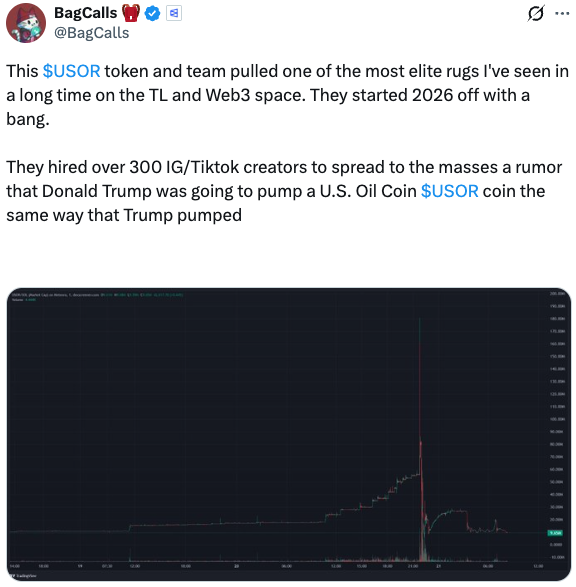
Hundreds of creators received modest flat fees to post content implying legitimacy, future pumps, or institutional involvement. Many then encouraged followers to “buy the dip” after early sell-offs, driving exit liquidity for wallets already in profit.
Users claim $USOR may be a scam. | Credit: BagCalls X profile
From a market-education perspective, this highlights a recurring problem:
Reach doesn’t mean credibility
Virality isn’t validation
Confidence doesn’t bring compliance
Creators are rarely required to verify claims, disclose risks, or understand token mechanics. When multiplied at scale, this creates a powerful misinformation engine.
No Evidence of BlackRock or US Institutional Involvement
Some $USOR content went further, hinting, or outright claiming, that entities like BlackRock or U.S. institutions were involved. There is zero evidence of this.
Avoid regulatory filings, press releases, or disclosures.
If BlackRock or any U.S. entity were tokenizing oil, it would be one of the most significant financial announcements in years (via a press release), covered by regulators, filings, and mainstream media. Not TikTok rumors.
How $USOR Matches a Typical Insider Exit Strategy
According to @CryptoRugMunch on X, the $USOR pattern fits a familiar structure of crypto rug pulls:
Narrative creation (oil, Trump, national reserves)
If the answers rely on vibes, politics, or influencer confidence rather than documents and data, walk away.
So, Is $USOR Really Backed by US Oil Reserves?
No. There is no legal, financial, or on-chain evidence supporting that claim.
The data shows that the token is heavily bundled, tightly controlled, and driven by sniper wallet activity, with marketing aimed at exploiting social media virality rather than delivering real value.
The idea that U.S. oil, or any sovereign asset, would be tokenized through an anonymous meme coin is not just unlikely; it’s structurally implausible.
Crypto doesn’t need fewer narratives; it needs more scrutiny. And $USOR is a reminder that when something sounds too politically powerful, too nationally symbolic, and too profitable to be true, the blockchain usually tells a very different story.
No. There is no evidence, legal, financial, or on-chain, that $USOR is backed by U.S. oil reserves or any government-controlled commodity. No audits, custody agreements, or regulatory filings have been produced to support those claims.
Is $USOR affiliated with the U.S. government, Donald Trump, or any federal agency?
No. There is no verified connection between $USOR and Donald Trump, the U.S. government, or any federal institution. The narrative appears to have originated from influencer content rather than official announcements or documentation.
Could the US Strategic Petroleum Reserve be tokenized?
In theory, tokenization of commodities is possible, but not in this way. The U.S. Strategic Petroleum Reserve is governed by federal law and national security policy. Any tokenization would require legislation, regulatory approval, public disclosures, and institutional infrastructure, not an anonymous meme token.
Why are people calling $USOR a rug pull or bundled scam?
On-chain data shows extreme supply concentration, with a large portion of tokens controlled by wallets linked to the deployer. Tools like Bubblemaps and GMGN also flagged coordinated wallet behavior and sniper activity, common indicators of insider-controlled liquidity and potential rug mechanics.
Disclaimer:
The information provided in this article is for informational purposes only. It is not intended to be, nor should it be construed as, financial advice. We do not make any warranties regarding the completeness, reliability, or accuracy of this information. All investments involve risk, and past performance does not guarantee future results. We recommend consulting a financial advisor before making any investment decisions.
Giuseppe Ciccomascolo began his career as an investigative journalist in Italy, where he contributed to both local and national newspapers, focusing on various financial sectors.
Upon relocating to London, he worked as an analyst for Fitch's CapitalStructure and later as a Senior Reporter for Alliance News. In 2017, Giuseppe transitioned to covering cryptocurrency-related news, producing documentaries and articles on Bitcoin and other emerging digital currencies. He also played a pivotal role in establishing the academy for a cryptocurrency exchange website. Crypto remained his primary area of interest throughout his tenure as a writer for ThirdFloor.


 Easy
Easy