Solana's WAR token reaches $0.045 as trading volume explodes past $24 million | Credit: Veronica Cestari
Share
Key Takeaways
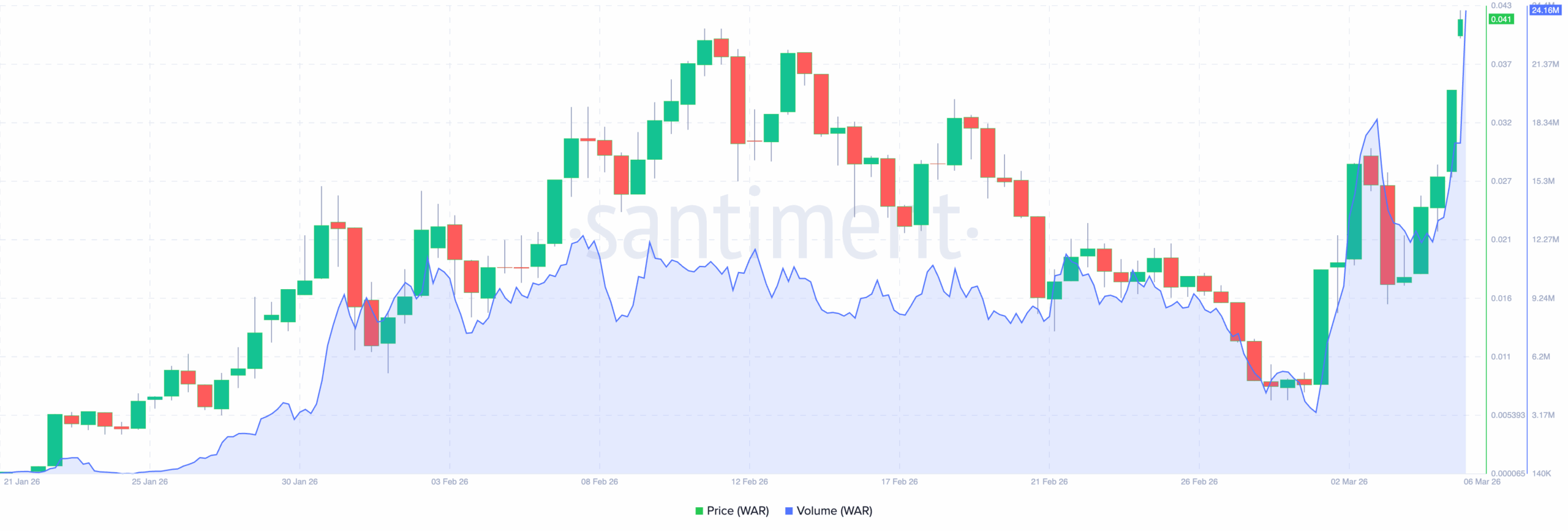
WAR reached a new all-time high of $0.045 following a 658% climb in less than three months.
Trading volume has surged past $24 million, reflecting intense retail interest in the memecoin.
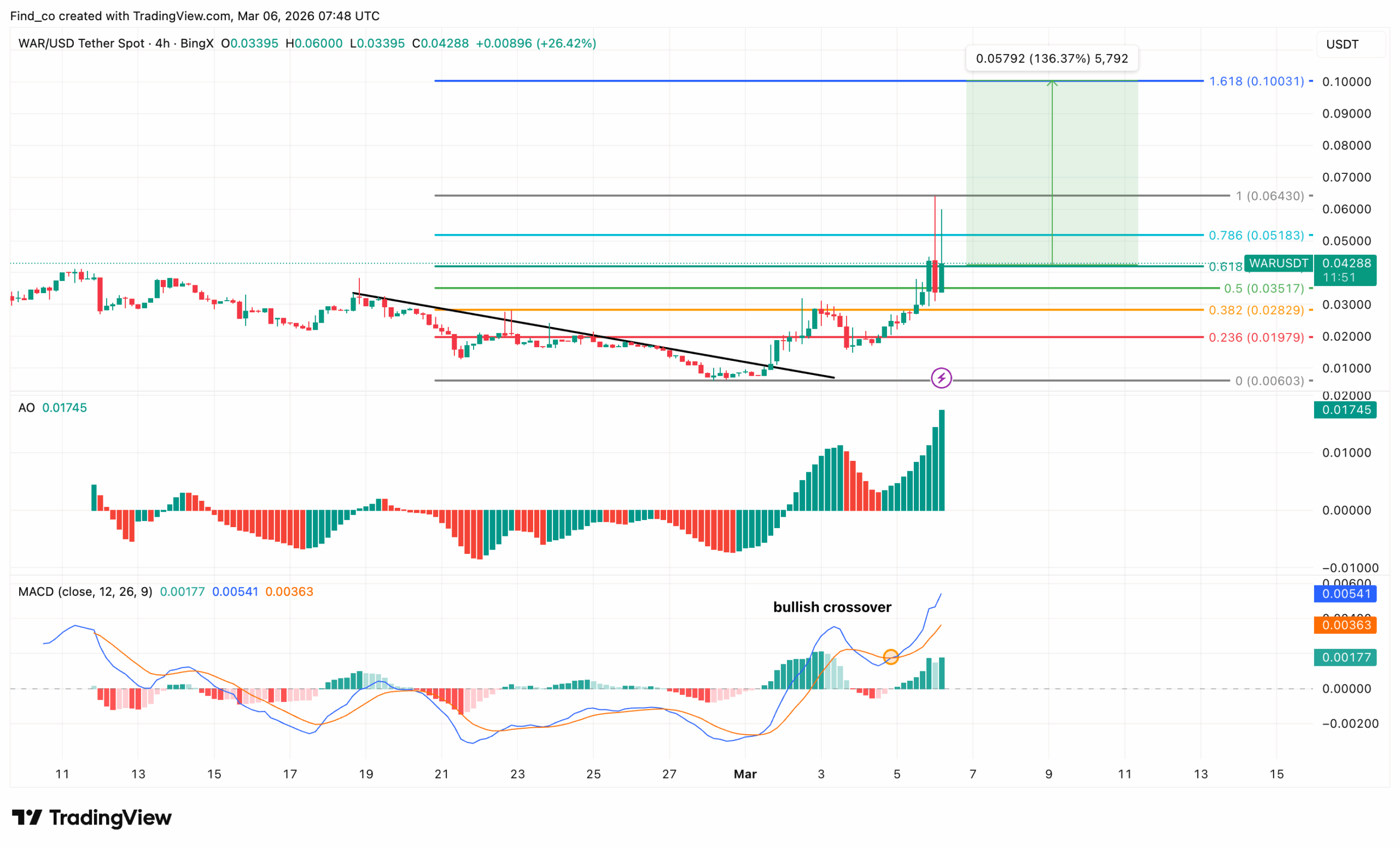
WAR has broken out of a three-week descending channel, clearing the 0.618 Fibonacci level.
WAR, which seems to be Solana’s hottest geopolitical memecoin, has reached a new all-time high.
This development followed WAR crypto’s 658% climb over the past three months.
According to CCN’s findings, three simultaneous catalysts drove the token to this level.
In this analysis, we break down every catalyst, the on-chain risks hiding in plain sight, and what could be next for WAR’s price.
What Is the WAR Token?
WAR has done something remarkable: it has built a thesis.
Not a dog or a frog, nor a celebrity name like most Solana-based memecoin.
What makes it different from thousands of other memecoins is its narrative hook: it’s branded as a “geopolitical sentiment token”—meaning its price is supposed to reflect the extent to which global tension and conflict dominate headlines.
Get These Top Crypto Casino Offers Now!
Sponsored
Disclosure
We sometimes use affiliate links in our content, when clicking on those we might receive a commission at no extra cost to you. By using this website you agree to our terms and conditions and privacy policy.
The token surged from its post-launch lows to an all-time high of $0.045 earlier today.
Since then: a Kraken exchange listing and a migration to Pump. fun, and escalating Middle East conflict have kept the narrative burning hot.
Just yesterday, the WAR crypto surged 50%, helping its market cap surpass $40 million.
New Abode, Higher Volume
However, it is important to mention that it launched on Bonk.fun (formerly LetsBonk.fun) in early 2026.
But on March 3, the team behind the project announced it was migrating to Pump.fun.
“The $WAR migration is live. Migration window is open for 7 days. After this period, a new http://Pump.fun contract will be deployed,” It revealed.
Think of it like this: when the news says “war,” the token called $WAR gets attention.
For WAR, migration into this ecosystem means gaining access to Pump. fun’s built-in discovery tools. This includes its enormous retail trader base and its liquidity routing infrastructure.
Following the development, the WAR memecoin trading volume has surged above $24 million. This increase in volume, alongside the price, indicates rising interest in the token.
Hence, if sustained, this could drive the WAR price higher, potentially leading to a new all-time high.
Another reason it could break past the new highs is if the US-Israel-Iran strikes continue in the weeks to come.
Risk or Reward?
On-chain analytics flagged by Bubblemaps research identified that the developer allegedly controls roughly 31.32% of the total WAR supply across linked wallets.
However, this might not be a major concern compared to several memecoin with staggering uneven distributions.
A closer look at the data also shows that the top 80 holders own between 0.10% to 5.73 of the supply. Going by this, it appears the WAR crypto might not be a pump-and-dump scheme.
Still, this does not imply that the WAR price might not collapse.
At the time of writing, the token trades at $0.043, having exploded from a descending channel that compressed it toward the zero Fib floor at $0.0060 over the past three weeks.
Notably, the price has cleared the 0.382 ($0.028), 0.5 ($0.035), and 0.618 ($0.043) Fibonacci levels. Amid that, a measured move of 136.37% is projected, targeting the 1.618 extension at $0.10.
Both momentum indicators confirm the move. For instance, the Awesome Oscillator (AO) at 0.01745 is its highest reading on this chart.
In addition, the Moving Average Convergence Divergence (MACD) fired a bullish crossover on March 3, two days before today’s surge, giving an early warning before the breakout.
Immediate resistance sits at $0.052 (0.786 Fib). Holding $0.043 (0.618) on any pullback keeps the bull structure intact. If the WAR crypto loses this support, then the bullish thesis could be invalidated.
Is $WAR Different From Other PolitiFi Memecoins?
WAR belongs to a growing category called PolitiFi tokens. However, the track record of this category is mixed at best and brutal at worst.
For instance, the TRUMP token exploded to a multi-billion market cap on inauguration hype before bleeding over 90%.
MELANIA reached a billion-dollar valuation in hours before collapsing by 98% amid insider-dumping allegations, wiping out retail investors who bought after the initial spike.
In addition, the LIBRA token triggered active fraud probes following a rug pull scandal.
However, WAR’s fair-launch credentials seem to distinguish it from some of the worst offenders.
But the developer wallet concentration issue could still be a problem. Also, like other memecoins, there’s no guarantee of a sustained upward pressure.
Disclaimer:
The information provided in this article is for informational purposes only. It is not intended to be, nor should it be construed as, financial advice. We do not make any warranties regarding the completeness, reliability, or accuracy of this information. All investments involve risk, and past performance does not guarantee future results. We recommend consulting a financial advisor before making any investment decisions.
Victor Olanrewaju is a crypto analyst and reporter at CCN with deep roots in on-chain research and technical analysis. His crypto journey began in 2017, but it was the 2020 Uniswap airdrop that sparked a full-time pivot into the space.
With a foundation in copywriting, Victor honed his craft creating high-converting content for leading crypto brokers — most notably an XRP price prediction that ranked #1 on Google during the 2021 bull run.
He later joined AMBCrypto in 2022, where he combined storytelling with technical and on-chain analysis to cover key market narratives.
In 2024, he expanded his expertise at BeInCrypto, collaborating with analysts and using tools like Glassnode, Santiment, and IntoTheBlock to break down Bitcoin and altcoin trends.
At CCN, Victor covers the top cryptocurrencies, memecoins, macro shifts, blending real-time insights with deep-dive metrics.
He holds a Bachelor’s degree in Physics from the University of Ibadan, equipping him to simplify complex data for a wide audience. Follow his work or connect on LinkedIn or X.